











2026 Coach House Arriva V-24 TB review: dry-bath comfort, documentation homework
Research-based 2026 Coach House Arriva V-24 TB review covering the dry-bath layout, specification conflicts, pricing limits, used listings, and exact-unit inspection checks.

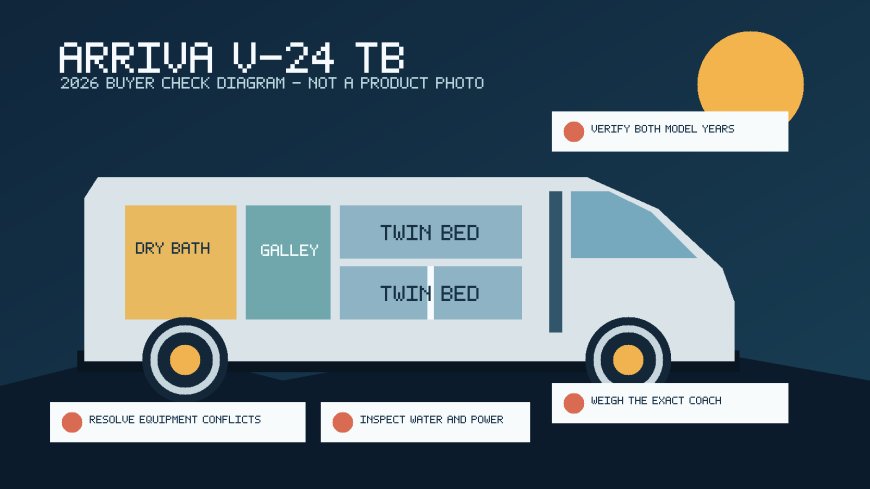

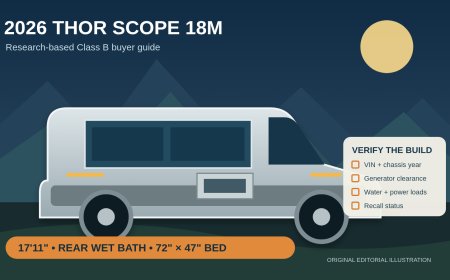
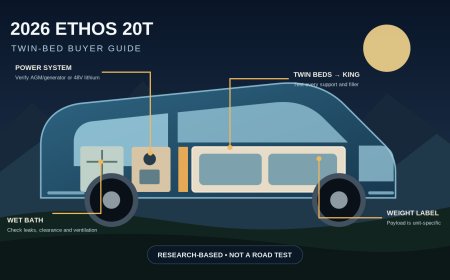
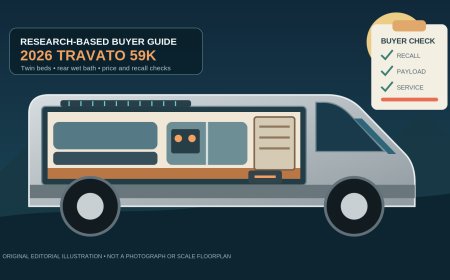
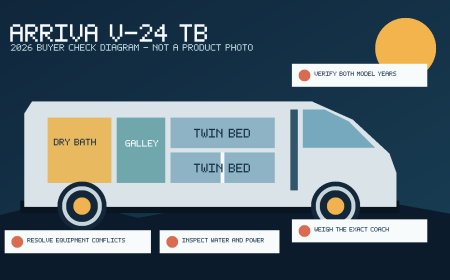
Original RVCamping.info buyer-check diagram. This is not a photograph or exact floorplan rendering of the reviewed unit.
2026 Coach House Arriva V-24 TB review: dry-bath comfort, documentation homework
Summary: The 2026 Coach House Arriva V-24 TB pairs longitudinal twin beds and a rear dry bath with a 24-foot Sprinter body. The layout solves two common Class B compromises, but a model-year labeling conflict, unpublished exact-year MSRP, tight cargo math, and a sparse owner record make build-sheet verification essential.
Research disclosure: This is a desk-researched buyer guide, not a road test. RVCamping.info did not drive, inspect, weigh, rent, sleep in, purchase, or otherwise test this motorhome.
Review identity
| Item | Reviewed vehicle |
|---|---|
| Manufacturer | Coach House, Inc. |
| Model family | Arriva |
| Coach model year | 2026, subject to the identity conflict explained below |
| Exact floorplan | V-24 TB, longitudinal twin beds converting to a king, rear dry bath |
| RV class | Class B diesel motorhome |
| Chassis | Mercedes-Benz Sprinter 3500, 170-inch wheelbase; RWD standard and AWD described as available on the rolling page |
| Review method | Current manufacturer page, factory ordering record, 2026 owner manual, third-party year-specific catalogs, owner/forum reports, federal recall query, and time-stamped listings |
| Publication/update date | October 9, 2026 UTC |
The Arriva family is absent from the parsed RVCamping.info RV-review manifest for the preceding 365 days. This package therefore does not repeat a recently reviewed model family.
Bottom line
The Arriva's strongest idea is spatial, not electronic: two people can leave narrow beds made up, walk between them, and reach a genuinely separate rear toilet and shower. Join the beds and the sleeping surface becomes king-like, but the aisle disappears and nighttime bath access becomes less convenient. Up front, swiveling cab seats form the dining and work area; the galley includes a large refrigerator, convection/microwave, sink, and pantry. Coach House's rolling model page also identifies a Sprinter 3500, 208-hp high-output diesel, nine-speed transmission, and optional all-wheel drive.[1]
That is an appealing couples' touring layout, especially for buyers who dislike wet baths. It is not the obvious answer for four-person travel, urban parallel parking, a large rear gear garage, or buyers who want a public, configuration-specific 2026 price before contacting the factory.
Best fit: one or two travelers who prioritize separate bath spaces, easy twin-bed access, diesel highway range, interior storage, and factory-direct support over minimum exterior length.
Skip it: buyers who need four berths, belted rear passenger seating, easy bath access while the king bed is assembled, deep exterior cargo storage, a short city footprint, or transparent exact-unit payload and pricing online.
Official and year-specific specifications
Coach House's current page supplies the chassis and layout facts.[1]
The factory ordering record supplies dimensions, weights, tanks, generator, and appliance figures, but its model-year label is unstable: search indexes have called the same stock record both 2026 and 2025, while the live URL now returns a not-found page.[2]
RVUSA and RV Guide separately identify a 2026 V-24 TB, but they are independent catalogs rather than manufacturer documents.[4][5]
The table keeps those evidence layers visible instead of presenting a synthetic “official 2026” sheet.
| Specification | Figure used for this review | Evidence status |
|---|---|---|
| Chassis | Mercedes-Benz Sprinter 3500, 170-in wheelbase | Current Coach House page [1] |
| Engine | 2.0L high-output turbo-diesel I4, 208 hp, 332 lb-ft | Current Coach House page [1] |
| Transmission | 9G-Tronic nine-speed automatic | Current Coach House page [1] |
| Drive | RWD; AWD described as optional | Current Coach House page [1] |
| Length | 24 ft 2 in | Factory order record and 2026 RVUSA catalog [2][4] |
| Exterior width / height | 6 ft 7 in / 9 ft 8 in | Factory order record; its year label conflicts [2] |
| Interior height | 6 ft 2 in | Factory order record; its year label conflicts [2] |
| GVWR / GCWR | 11,030 / 15,250 lb | Factory order record; exact-unit labels control [2] |
| Diesel capacity | Current page: 24.5 gal; factory record: 26.4 gal | Unresolved official-source conflict [1][2] |
| Fresh / gray / black | 31 / 20 / 13 gal | Factory order record; verify exact build [2] |
| LP | Factory record displays “55/12,” without a clear unit label | Unresolved; inspect certification plate [2] |
| Generator | 3.6-kW LPG “Micro-Quiet” | Factory order record and 2026 RVUSA catalog [2][4] |
| Refrigerator | Current page says 6-cu.-ft. three-way; 2026 RVUSA says two-way AC/LPG | Unresolved official/current-versus-catalog conflict [1][4] |
| Climate | Ducted A/C; factory record lists 15,000 BTU and 30,000-BTU furnace | Current page plus factory order record [1][2] |
| Sleeping | Two longitudinal twins converting to a king | Current Coach House page [1] |
| Coach warranty | 3 years / 36,000 miles, conversion portion only | 2026 Coach House owner manual [3] |
Conflicts to settle before deposit
The biggest conflict is identity. The same Coach House stock URL has appeared in search as “New 2026,” while the retained search capture and current title call it “New 2025.” Meanwhile, RVUSA and RV Guide publish 2026 Arriva V-24 TB entries.[2][4][5] A dealer's typed model year is not enough. Require the Coach House serial/build sheet, completed-vehicle certification label, window sticker, sales contract, and title application all to identify the same coach year and floorplan.
The fuel tank conflict is numerical: Coach House's rolling page says 24.5 gallons, while the factory ordering record says 26.4 gallons.[1][2]
The refrigerator conflict is functional: the rolling page says three-way, while RVUSA's 2026 catalog text says two-way AC/LPG.[1][4]
Photograph the installed refrigerator data plate and the Sprinter fuel specification; do not infer equipment from a stock photo or generic description.
The factory record also shows “30 btu” furnace and “15 btu” air conditioner fields. Those appear to be truncated thousands, not literal ratings, but the page is not clear.[2] Treat 30,000 and 15,000 BTU as dealer claims requiring appliance model-plate confirmation, not as settled exact-build facts.
Coach year versus chassis year
“2026 Arriva” is the completed coach model year. Mercedes-Benz may have produced the Sprinter in a different model year. Record the chassis year, coach year, VIN, Coach House serial, warranty in-service date, and emissions family separately. The chassis year controls many parts, recalls, software campaigns, and Mercedes warranty questions; the coach year controls conversion documentation.
Floorplan and daily-use analysis
Beds, bath, and nighttime movement
Longitudinal twins are the Arriva's practical advantage. Each traveler can get out without climbing across the other, and the center aisle remains open in twin mode. The forum discussion recognized that easy exit and the large rear bathroom were the floorplan's distinctive strengths.[7] Joining the beds may improve shared sleeping width, but buyers should build the king themselves and test whether a person can reach the bath without disturbing a partner.
The rear bath separates the shower from the toilet rather than turning the whole compartment into a wet room.[1] That keeps the toilet and storage drier, but it consumes valuable rear volume and means the back doors open into the bath area. A forum participant immediately identified the trade: more bathroom means less dirty-gear storage.[7] Check where two camp chairs, leveling blocks, hose, power cord, shoes, and damp outerwear can ride without blocking plumbing or an emergency exit.
Seating, dining, and travel occupancy
The front seats swivel toward a removable table, so daytime living is concentrated at the cab end. The reviewed material does not establish rear belted seats for the V-24 TB. Treat it as a two-person travel coach unless the exact completed-vehicle label and manuals say otherwise. Do not count a bed position as a legal travel seat.
The long body is manageable by motorhome standards but not “park anywhere.” At 24 feet 2 inches, it will overhang a normal curb space and can require two end-to-end parking spaces. Test the turning path, rear swing, mirror width, camera coverage, filling-station access, and campground site length with the exact drivetrain and any hitch equipment.
Kitchen and storage
Coach House describes a 6-cubic-foot refrigerator-freezer, convection/microwave, pantry, and kitchen sink.[1] That is unusually generous cold storage for a narrow van, but the large refrigerator and rear bath leave limited open counter and bulky-gear space. Lay out a realistic meal, open every door, and check whether the aisle remains passable.
The refrigerator-source conflict matters in daily use. A true three-way refrigerator and a two-way AC/LPG unit have different control logic but both require safe leveling and venting practices. Identify the model, read its manual, verify recalls, and test every approved energy source. Never operate an LP appliance in a prohibited setting such as fueling.
Water, winter use, and service access
The factory record gives 31 gallons fresh, 20 gray, and 13 black.[2] Those capacities favor short two-person stays, but gray capacity will usually constrain showers before fresh water runs out. Fill, measure, and drain every tank; generic spec sheets cannot reveal a slow drain, inaccurate monitor, inaccessible valve, or damaged heat pad.
RVUSA's 2026 catalog calls the plumbing “4 Season all-weather interior plumbing,” while the forum's launch-era feature list mentioned all-weather plumbing and optional heated holding tanks.[4][7] Those are not proof of a certified temperature range. Ask Coach House to identify which lines, valves, drains, and tanks sit inside conditioned space and what heating method protects each exposed component.
Coach House's 2026 manual divides service responsibility. Coach-built conversion defects fall under the Coach House limited warranty, Mercedes handles chassis systems, and appliance makers handle many installed components. Coach House requires preapproval for its warranty work and may ask the owner to return to Nokomis, Florida.[3] Buyers far from Florida should identify a willing local service shop before purchase.
Payload and towing
The published 11,030-pound GVWR is a ceiling, not payload.[2] No retained official source published the completed unit's unloaded weight or occupant-and-cargo allowance. Read the yellow cargo label on the exact van and weigh it with people, fuel, water, propane, bedding, food, tools, options, and travel gear aboard.
The 15,250-pound GCWR shown in the factory record does not establish usable towing capacity by itself.[2] Subtract actual loaded coach weight, then apply hitch, tongue-weight, axle, wheel, tire, and Mercedes limits. A vehicle close to GVWR can have much less tow margin than a generic sales statement implies.
What independent owners and reviewers report
Independent evidence is thin, and almost none addresses a confirmed 2026 build. That scarcity is itself a buying limitation.
- RV Insider displayed one owner review for an identified 2024 Mercedes 3500 Arriva. The owner praised the layout, separate shower, bed comfort, finish, hinges, doors, and carpet, and assigned top category ratings.[6] One highly positive self-report is useful context, not a reliability sample.
- A long-running Class B Forums thread began when the Arriva launched. Participants liked the easy-exit twins, rear dry bath, front swivel-seat workspace, refrigerator, pantry, and counter extension. They also questioned the amount of storage, king-bed bath access, side-door galley intrusion, and price.[7] Most posts predate the reviewed year by many years, so they identify ergonomic checks rather than 2026 defects.
The two sources are independent of Coach House, but they do not establish a recurring mechanical issue pattern. There is no responsible basis here to claim the 2026 is either exceptionally reliable or problematic.
NHTSA's model-level API returned zero recalls for a 2026 Coach House Arriva at 2026-10-09 00:07 UTC.[8] A zero-result model query is not VIN clearance. Recheck the 17-character VIN with NHTSA and Mercedes immediately before purchase because chassis campaigns may appear under Mercedes-Benz or Sprinter rather than the converter/model spelling.
New purchase path, MSRP, and asking-price snapshot
Coach House markets the Arriva factory-direct from Nokomis, Florida. At 2026-10-09 00:07 UTC, the factory order record was no longer live, but retained search evidence showed an order-only unit, stock CHARRIVA, with an MSRP “starting at” $225,828 and Call For Price instead of a public sale price.[2]
That $225,828 figure is not represented here as a verified 2026 MSRP. The same record is indexed as 2025 in the retained capture despite separate 2026 catalog entries. The honest 2026 MSRP finding is therefore: not publicly resolved from an unambiguous official exact-year document. The nearest manufacturer-origin reference is a $225,828 starting MSRP on the conflicted factory record.
“Starting at” also excludes the configuration work needed for a real comparison. Obtain a signed build sheet and buyer's order that separates base coach, RWD or AWD chassis, paint, cabinetry, batteries, solar, generator, freight, factory delivery, dealer or factory preparation, documentation fees, taxes, title, registration, trade assumptions, financing conditions, warranty products, and accessories. A call-for-price listing is not an asking-price discount, and an MSRP is not an out-the-door price.
Used-market snapshot
These are advertised asking prices observed at 2026-10-09 00:07 UTC. They are not completed-sale prices, appraisals, or a statistical market value. Listings can expire or change, and older Arrivas can differ in engine, electronics, appliances, batteries, generator, insulation, driver aids, and warranty.
| Marketplace / seller | Used unit | Location | Mileage | Ask at capture |
|---|---|---|---|---|
| RV Trader result set | 2018 Arriva V24 TB | Seneca, South Carolina | Not published in retained result | $95,000 [9] |
| LocalRVs | 2023 Arriva 24 TB, stock 474958 | Alexandria, Louisiana | 22,945 | $145,000 [10] |
| LocalRVs | 2023 Arriva V24-TB, stock 470977 | Mountain Home, Arkansas | 8,338 | $156,000 [11] |
| LocalRVs | 2016 Arriva 24TB, stock 491760 | Palatka, Florida | 47,297 | $79,900 [12] |
The sample spans two marketplaces and four units. Two 2023 advertisements differ by $11,000 and more than 14,000 miles, but condition, options, drivetrain, title history, seller terms, and inspection results are unknown. Do not treat that spread as depreciation guidance. Confirm the exact ad is active and the price is unconditional before traveling.
Used-unit inspection checklist
- Identity: Match the dash VIN, door label, title, registration, lender record, Mercedes documents, Coach House serial plate, and completed-vehicle certification label.
- Two model years: Record both Sprinter chassis year and Coach House model year; obtain the build sheet and both warranty in-service dates.
- Floorplan: Confirm V-24 TB on factory documents, not only on the advertisement. Verify twin cushions, king infill, rear bath, and intended occupancy.
- Recalls and campaigns: Run the VIN through NHTSA, Mercedes-Benz, and Coach House on inspection day; ask for proof of every completed remedy.[8]
- Title and history: Check title brand, lien, odometer record, ownership sequence, collision history, lemon/buyback history, and seller identity.
- Cargo capacity: Read the completed-unit cargo label, then weigh the loaded coach by axle. Compare with GVWR, each GAWR, wheel ratings, and tire ratings.
- Chassis service: Have a Sprinter-qualified technician scan every module and inspect diesel service history, emissions equipment, fluids, belts, cooling, brakes, steering, suspension, and driveline.
- Tires: Record size, load range, DOT date, pressure, cracking, repairs, uneven wear, spare arrangement, and valve-stem access.
- Road test: Drive from cold through city, highway, crosswind, rough pavement, reversing, tight turns, and braking. Listen for cabinets, plumbing, doors, and bed components moving.
- Driver aids: Verify camera, sensors, cruise, lights, wipers, navigation, keyless entry, warning lamps, and windshield condition.
- Body and roof: Inspect every roof opening, window, door, awning mount, antenna, vent, light, seam, fastener, and paint edge for seal failure or repairs.
- Water intrusion: Moisture-meter the roof perimeter, upper cabinets, windows, cab transition, bathroom, floor edges, plumbing penetrations, and rear doors. Look below after each water test.
- Fresh water: Fill the tank, sanitize-history permitting, test pump cycling, city connection, faucets, exterior shower, winterization valves, and low-point drains.
- Waste system: Fill and drain gray and black tanks; inspect monitor accuracy, toilet seal, flush fitting, venting, termination assembly, cap, and dump valves.
- Dry bath: Run shower and toilet together. Check enclosure seals, pan flex, drain speed, fan, privacy, door latches, storage, headroom, and access in both bed modes.
- Hot water and furnace: Cold-start each appliance; verify model plates, fuel source, exhaust, duct temperatures, fault codes, service records, and carbon-monoxide detector.
- Refrigerator identity: Resolve two-way versus three-way from its data plate and manual. Test every permitted mode, door seals, cooling temperatures, venting, and LP flame where applicable.[1][4]
- LP system: Have a qualified technician pressure- and leak-test tank, regulator, lines, valves, detector, quick-connect, refrigerator, furnace, cooktop, water heater, and generator supply.
- Generator: Confirm model, serial, rated output, hours, service history, fault log, cold start, transfer operation, exhaust integrity, and full-load behavior.
- Shore and 12-volt power: Test inlet, cord, breakers, GFCIs, converter, batteries, disconnects, fuses, outlets, USB ports, lights, emergency start, and charging voltage.
- Solar and upgrades: Inventory every nonfactory panel, controller, inverter, battery, charger, antenna, and wiring change; check fusing, cable support, penetrations, manuals, and warranty effect.
- Air conditioning: Run from every approved source. Measure temperature split, current draw, cycling, noise, condensate drainage, thermostat response, and duct output.
- Beds and cabinetry: Assemble twins and king repeatedly. Inspect cushion support, mattress condition, table mounts, hinges, latches, drawers, pantry travel locks, and bedding storage.
- Doors, awning, and exterior equipment: Cycle sliding, rear, bath, cabinet, and screen doors plus awning and steps on level and slightly uneven ground. Find every manual override.
- Safety equipment: Check smoke, LP, and CO detector dates; fire extinguisher gauge and recall status; emergency exits; seat belts; first-aid provisions; and propane shutoff labeling.
- Serviceability: Identify local Mercedes, Coach House, generator, refrigerator, and HVAC service options. Get written confirmation that each will work on this unit.
- Paperwork and money: Require manuals, appliance serials, option sheet, maintenance receipts, warranty documents, keys, deposit terms, fee schedule, and a signed independent-inspection contingency.
Use both an independent RV inspector and a Sprinter technician. A factory or seller orientation is not a pre-purchase inspection.
Alternatives worth comparing
- 2026 Pleasure-Way Plateau TS: another long Sprinter couples' van with a rear lounge/bed and wet bath. Compare daytime seating, fixed-sleep convenience, electrical system, and service access.
- 2026 Midwest Patriot MD4: emphasizes belted passenger seating and a rear power lounge. Compare travel capacity against the Arriva's twin beds and separate bath.
- 2026 Winnebago Travato 59K: a shorter gas ProMaster with longitudinal twins and rear wet bath. Compare purchase price, diesel versus gas service, bath separation, and payload.
- 2026 Jayco Swift 20T: another twin-bed layout on a shorter gas chassis. Compare refrigerator size, bath arrangement, warranty network, and cargo label.
- 2026 Coachmen Galleria 24FL: similar extended-Sprinter footprint with a social rear lounge. Compare permanent sleeping convenience, generator/lithium configuration, and exact-build pricing.
Compare the units by actual bed comfort, bathroom access at night, cargo-label payload, underbody clearance, local service willingness, and itemized out-the-door price—not by brochure feature count.
Methodology, limitations, and disclosures
This review used Coach House's rolling Arriva page, a conflicted factory ordering record, the 2026 Coach House owner manual, two year-specific third-party specification catalogs, two independent experience/discussion sources, a federal recall query, and four used listings across two marketplaces. Evidence was captured at the stated UTC timestamp. An exact-model Wikimedia Commons image search returned no result, and no exact real photograph with verified compatible reuse rights was found.[13]
We did not contact Coach House, Mercedes-Benz, sellers, owners, or forum posters. We did not inspect a VIN, vehicle, title, build sheet, window sticker, cargo label, appliance plate, service record, or warranty form. The factory order URL was unavailable at capture, and retained indexing disagreed on whether that stock record was 2025 or 2026. Exact 2026 MSRP was not resolved. Current-page and catalog text conflict on fuel capacity and refrigerator energy modes. Independent owner evidence is sparse. These limitations are material, not footnotes to be ignored.
No video is embedded. The current manufacturer page exposes several YouTube embeds, and an independent 2024 walkthrough was found, but no video was verified as an exact-2026 V-24 TB walkthrough with a stable, embeddable identity. Omitting it is more accurate than implying year-specific proof.
Affiliate disclosure: This article contains no affiliate links, paid placement, dealer referral tracking, RVshare tracking, or manufacturer sponsorship. Every commercial link is an ordinary evidence or purchase-path link. RVCamping.info may use approved affiliate programs elsewhere, but none influenced this review.
Sources
- Coach House Arriva V-24 TB current model page — rolling layout, chassis, drivetrain, appliance, and feature claims; retrieved October 9, 2026.
- Coach House factory Arriva V-24 TB order listing — retained indexed MSRP, dimensions, capacities, generator and stock details; live page unavailable and model-year labeling conflict disclosed.
- Coach House 2026 owner's manual — warranty scope, service process, exclusions, weight, safety, LP, water, electrical, maintenance, and VIN guidance.
- RVUSA 2026 Coach House Arriva V-24 TB specifications — year/floorplan identification and feature text; independent catalog, not substituted for exact-build labels.
- RV Guide 2026 Coach House Arriva V24 TB specifications — year/floorplan and warranty catalog entry.
- RV Insider Arriva V-24 TB owner review — one attributed 2024 owner report on layout, bath, bed and finish.
- Class B Forums Arriva V24 TB discussion — launch-era independent observations and ergonomic questions.
- NHTSA 2026 Coach House Arriva recall query — zero model-level results at capture; VIN check still required.
- RV Trader used Coach House Arriva results — 2018 Seneca asking-price snapshot.
- LocalRVs 2023 Arriva listing, Alexandria — asking price, mileage, location, stock and listing dates.
- LocalRVs 2023 Arriva listing, Mountain Home — asking price, mileage, location, stock and listing dates.
- LocalRVs 2016 Arriva listing, Palatka — asking price, mileage, location, stock and listing dates.
- Wikimedia Commons exact-model image search — returned no exact results at capture; rights-cleared-photo search evidence.
What's Your Reaction?