





Lake Mead RV Camping: Boulder Beach vs. Las Vegas Bay vs. Echo Bay
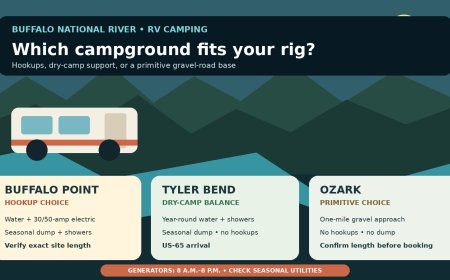
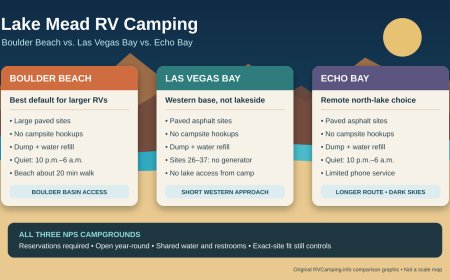
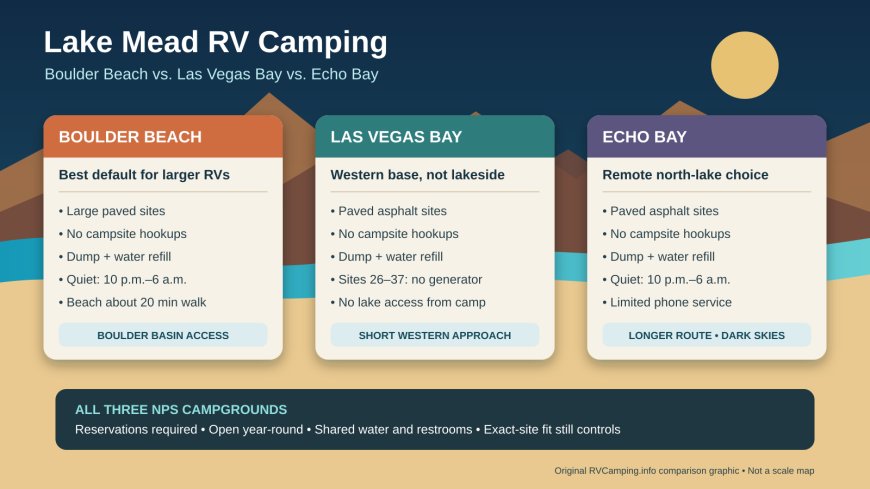
Boulder Beach is the best larger-RV default, Las Vegas Bay is the western base without lake access, and Echo Bay is the remote northern choice.

Lake Mead RV Camping: Boulder Beach vs. Las Vegas Bay vs. Echo Bay
By Romana | Updated October 11, 2026
Lake Mead’s National Park Service campgrounds can look interchangeable on a reservation screen: all three in this comparison are open year-round, use paved sites, have shared water and restrooms, and provide no campsite hookups. Their trip fit is not interchangeable. Boulder Beach is the best all-around base for larger RVs and quick access to Boulder Basin; Las Vegas Bay is the quieter western base for travelers who do not need to walk to the lake; Echo Bay trades convenience for a remote northern setting and a much longer approach.[1][3][4][5]
This comparison covers the NPS-managed campgrounds, not similarly named concession RV parks. That distinction matters: NPS says an RV may use any NPS campsite, but those sites have no hookups. Full-hookup RV parks inside the recreation area are separate concession operations with separate reservations.[2]
Quick RV comparison
| Decision factor | Boulder Beach | Las Vegas Bay | Echo Bay |
|---|---|---|---|
| Best fit | Larger-RV inventory and Boulder Basin access | Western base near Henderson/Las Vegas without lake access from camp | Remote north-lake stay and dark skies |
| Site and road surface | Large paved sites; asphalt or concrete | Paved roads and asphalt sites | Paved roads and asphalt sites |
| Hookups at NPS sites | None | None | None |
| Water and waste | Shared spigots; dump/refill near entrance | Shared spigots; dump/refill near entrance | Shared spigots; dump/refill near upper campground entrance |
| Generator planning | No unreasonable generator noise 10 p.m.–6 a.m. | Sites 26–37 are labeled “No Generator Use Area”; quiet hours 10 p.m.–6 a.m. elsewhere | No unreasonable generator noise 10 p.m.–6 a.m. |
| Lake access from camp | Walk to Boulder Beach is estimated at roughly 20 minutes; several beaches are 1–2 miles away | No lake access from the campground | Developed area has a boat launch; campground is remote |
| Access character | About 2 miles on Lakeshore Road from Boulder Beach entrance | About 2.5 miles from Lake Mead Parkway entrance, then about 1 mile on campground road | Echo Bay turnoff is 40 miles from Lake Mead Parkway entrance, then lower campground is about 5 miles from turnoff |
The official pages do not publish one reliable campground-wide maximum RV length. “Large RVs” at Boulder Beach and “RVs” at the other two are facility descriptions, not guarantees that every parking spur will fit every motorhome or truck-trailer combination.[3][4][5] Use the exact Recreation.gov site listing as the final fit check: compare the stated equipment and driveway details with the RV’s total traveling length, including tow vehicle, hitch, racks and anything carried behind the bumper.
Boulder Beach: the strongest default for a bigger rig
Recreation.gov expressly describes Boulder Beach’s sites as large, paved and able to accommodate large RVs. Roads are paved, individual sites are asphalt or concrete, and water spigots and flush-toilet restrooms are distributed through the campground. A dump station and water refill station are near the entrance. There are no showers.[3]
That combination makes Boulder Beach the least ambiguous first search for a longer motorhome or trailer. It still does not remove the site-by-site check. A long paved pad can be unusable if the reservation’s equipment limit is shorter than the complete rig or if the tow vehicle cannot remain in the designated parking area. NPS rules prohibit driving onto the dirt or across irrigation ditches to manufacture extra space.[3]
Location is the other advantage. The official estimate for walking from camp to Boulder Beach is roughly 20 minutes, while several named beach areas are one to two miles away. The campground is just inside the Boulder Beach side of the park and Hoover Dam is only minutes south by road.[3] This is the practical choice for a trip centered on Boulder Basin rather than a remote desert retreat.
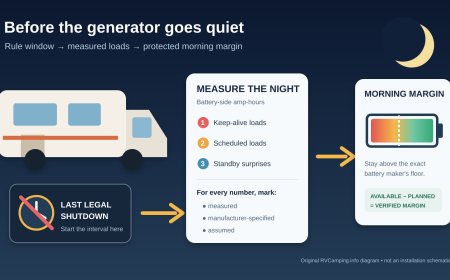
Generator use is constrained by quiet hours, not by a campground-wide daytime ban on the current listing. Recreation.gov says not to create or sustain unreasonable noise, including generator noise, from 10 p.m. to 6 a.m.[3] Because there are no electric hookups, calculate whether the house batteries can run overnight loads before arrival. A generator that must run after 10 p.m. is not a workable power plan.
One date-specific access note is now historical but worth understanding when reading cached trip advice. NPS posted that Boulder Beach loops A and B would close from May 26 through August 31, 2026, and reopen September 1.[1] For an October 11 planning package, that scheduled summer closure has passed. Still check the current NPS alerts and live reservation map before departure rather than treating a year-round label as proof that every loop is open.
Las Vegas Bay: close to the city, but not to the water
Las Vegas Bay is the choice for an easy western approach and a campground-focused stay. From the Lake Mead Parkway entrance, Recreation.gov directs travelers about 2.5 miles to Lakeshore Drive and then about one mile on Las Vegas Campground Road. The campground has paved roads, asphalt sites, shared water spigots, restrooms with sinks and toilets, and an entrance-area dump and refill station. It has no showers and no hookups.[4]
Its name creates the biggest planning trap in this comparison. The official listing says there is no access to the lake from the campground and no services within walking distance. Launch ramps, marinas, fishing piers and restaurants require a drive of about 20 minutes.[4] Choose it for a western park base, shade and the Bluffs Trail—not because “Bay” promises shoreline beside the campsite.
Las Vegas Bay also has the most important site-level generator distinction. Recreation.gov labels sites 26 through 37 as the “No Generator Use Area.”[4] Those labels are more specific than the general quiet-hours rule and should control the booking. Travelers who require daytime generator charging should exclude those sites, then still shut down during the 10 p.m.–6 a.m. quiet window. Travelers seeking less generator exposure should search those numbered sites first, without assuming they will be completely silent.
Echo Bay: the remote choice, not the overflow choice
At the park’s north end, Echo Bay sits beside the Overton Arm. Its remoteness is the feature: Recreation.gov highlights night-sky viewing, while also warning that phone service works best near the ranger station and can be limited or absent elsewhere.[5] This is a better fit for a self-contained traveler who wants distance from the Las Vegas side of the park than for someone depending on quick supply runs or reliable connectivity.
The approach deserves a fuel-and-arrival plan. From the Northshore entrance, travelers reach the Echo Bay Road turn after 10 miles heading south; from the Lake Mead Parkway entrance, they travel 40 miles north. The lower campground adds roughly five more miles after the turn.[5] Download directions before leaving service, arrive with enough fuel for the return leg, and avoid making the first drive after dark if the route is unfamiliar.
Echo Bay’s NPS sites remain dry camping despite the nearby concession presence. The campground listing identifies paved roads and asphalt sites, shared spigots, toilets and sinks, no showers, and a dump/refill station near the entrance to the upper campground. It also lists a modest picnic spot, a launch and a store in the developed area.[5] Treat the store and launch as amenities to reconfirm before building a trip around them; changing lake levels and maintenance can affect launch access, and NPS tells visitors to check current conditions.[7]
The listed generator rule matches Boulder Beach: avoid unreasonable generator noise from 10 p.m. to 6 a.m.[5] The current campground page does not label Echo Bay’s available lower sites as a no-generator loop. That is not permission to run continuously; daytime noise can still be unreasonable, and the absence of hookups makes battery budgeting part of the reservation decision.
Hookups, water and heat: what all three share
All three are NPS campgrounds without electric, water or sewer hookups at the individual site.[1][2] Water spigots and dump/refill facilities reduce the logistical burden, but they do not turn a site into a serviced RV pad. Arrive with the fresh tank at the level needed for setup, carry a hose appropriate for a shared fill point, and plan to move the RV or use a legal portable-waste workflow when the tanks need service. Do not expect a shower building at any of the three.[3][4][5]
All are listed as open year-round, but “open” does not mean mild. Official campground pages say daytime temperatures usually exceed 100°F from June through August, run around 90°F in May and September, and can fall to freezing from December through February.[3][4][5] With no electric hookup, summer air-conditioning cannot be treated as an overnight generator strategy during quiet hours. The safer planning answer is to avoid extreme heat, use a separate full-hookup concession park, or bring a power system that can support required loads without violating campground rules.
Reservations: follow the newer official pages
There is a direct conflict in NPS’s own pages. The Lake Mead reservations page, last updated May 13, 2024, says NPS campgrounds are first-come, first-served.[6] The newer Lake Mead campground page, last updated May 14, 2026, requires advance reservations for every NPS-managed site. Each current Recreation.gov listing likewise requires a reservation and allows same-day booking when space remains.[1][3][4][5]
Use the newer, campground-specific reading: reserve through Recreation.gov before occupying a site. Do not arrive expecting to claim an empty pad with cash; the listings say cash is not accepted and booking goes through Recreation.gov.[3][4][5] An entrance fee is also due in addition to the camping fee.[1]
For any of the three, save the confirmation offline and check NPS conditions on travel day. Lake levels, launch work, monsoon washouts and temporary closures can change what is reachable even when the campground itself remains bookable.[7]
Which Lake Mead campground should you reserve?
Choose Boulder Beach when the RV is on the larger side, Boulder Basin and Hoover Dam are priorities, or you want the clearest official large-RV language. It offers the best default, not a blanket fit guarantee.
Choose Las Vegas Bay for the short western approach, a shaded base and nearby city access. Skip it if walking from camp to the lake is central to the trip. Check the generator label before selecting sites 26–37.
Choose Echo Bay for a remote northern setting, dark skies and access to the Echo Bay developed area. Bring more route, fuel and connectivity margin than the other two require.
The decisive booking sequence is simple: choose the part of Lake Mead you actually want to use, reject any site whose generator rules conflict with the power plan, then verify the exact parking details against the full traveling combination. “Open year-round” and “accommodates RVs” are starting points—not substitutes for an exact-site and travel-day check.
Source credit: RVCamping.info compared current National Park Service and Recreation.gov campground, facility, rule, reservation and access records retrieved October 11, 2026. The selection framework and RV-fit analysis are original editorial work.
Sources
- Campgrounds & RV Village Parks around Lake Mead — National Park Service — Current reservation requirement, no-hookup statement, weather context and 2026 Boulder Beach loop notice. Accessed October 11, 2026.
- Camping — Lake Mead National Recreation Area — National Park Service — NPS campground services and distinction between dry NPS sites and concession full-hookup parks. Accessed October 11, 2026.
- Boulder Beach Campground — Recreation.gov — RV fit language, surfaces, facilities, access, quiet hours and reservation rules. Accessed October 11, 2026.
- Las Vegas Bay Campground — Recreation.gov — Facilities, no lake access, no-generator site labels, directions and reservation rules. Accessed October 11, 2026.
- Echo Bay Campground — Recreation.gov — Remote setting, facilities, access, connectivity, quiet hours and reservation rules. Accessed October 11, 2026.
- Reservations — Lake Mead National Recreation Area — National Park Service — Older first-come wording retained as evidence of the official-source conflict. Accessed October 11, 2026.
- Alerts & Conditions — Lake Mead National Recreation Area — National Park Service — Launch, lake-level, monsoon-road and temporary access cautions. Accessed October 11, 2026.
What's Your Reaction?