






RV awning wind safety: a decision rule for when to retract
Use a manual-first decision rule for RV awning wind safety, understand why sensor settings are not universal mph ratings, and close before the safe response window disappears.

RV awning wind safety: a decision rule for when to retract
By Romana | Tips and Trends | October 11, 2026
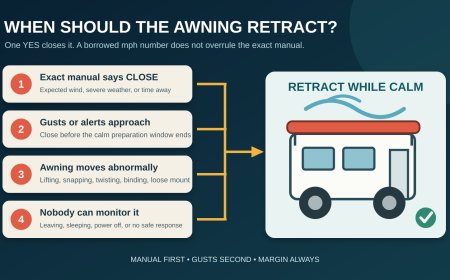
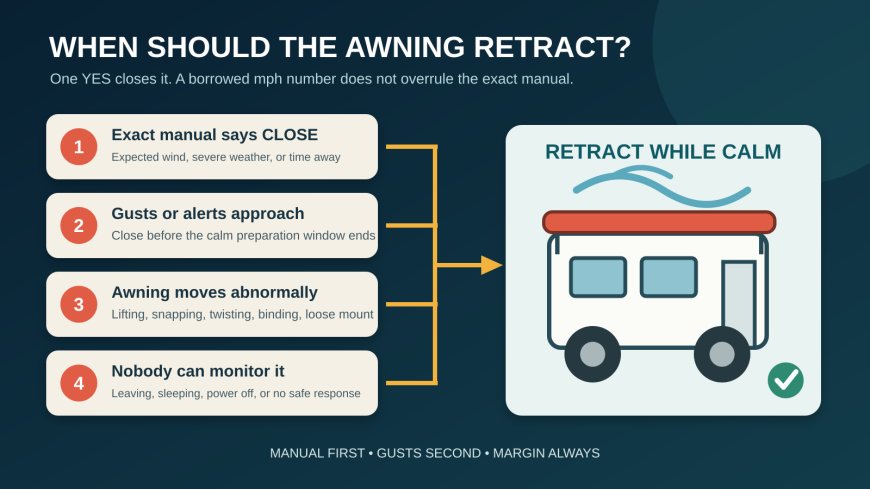
There is no responsible universal “retract at ___ mph” rule for every RV awning. The useful rule is manual first, gusts second, margin always: retract whenever the exact installed awning or RV manual calls for it; whenever forecast or observed conditions could reach that model-specific boundary before you can close safely; and whenever you will not be present, powered and ready to retract.
If you cannot identify the awning and find its documentation, treat the wind limit as unknown—not generous. Close it before wind develops.

The decision rule
Ask these questions in order:
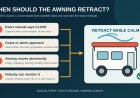
- Does the exact manual say to close for the forecast condition? If yes, retract. Dometic’s 9100 operation manual says never to leave that awning open unattended and to stow it when wind, heavy rain, snow or severe weather is expected.[1] Carefree’s Latitude manual says to roll up when wind or extended rain is expected.[2]
- Is a gust, thunderstorm, watch or advisory expected before you can clear the area and close the awning calmly? If yes, retract now. A National Weather Service High Wind Watch is a preparation signal; a Wind Advisory means strong wind is occurring and outdoor objects should be secured.[3]
- Is the awning already surging, lifting, snapping, twisting, moving unevenly or pulling at a mount? Stop using the “forecast number” as reassurance. Retract only if the normal control can close it while the area remains safe. If hardware is unstable, people are in the drop path, or severe weather is arriving, move away and shelter.
- Will everyone leave, sleep, lose sight of it, or be unable to operate it immediately? Retract. A sensor, phone app or remote does not make an open awning attended.
A single yes means close. All four answers must be no before leaving the awning extended—and the exact manual may impose additional limits.
This is intentionally a one-way rule. It tells you when to retract; it does not certify that an awning is safe to extend. Damage, loose mounts, missing fasteners, abnormal operation, pooled water or an unidentified model can all keep it closed on an otherwise calm day. Dometic directs owners not to use its cited product when adjustment or repair is necessary.[1]
Why a generic mph threshold fails
A number copied from a forum, dealer handout or different awning can sound precise while answering the wrong question.
Some systems do not measure wind speed
Carefree’s Direct Response system on the cited Latitude detects motion at the awning’s front edge. It retracts when motion exceeds a factory-set threshold.[2] That is not the same thing as a campground anemometer reporting miles per hour. The manual also says the system is inactive when awning power is off and warns that auto-retraction is not a guarantee against destructive weather.[2]
That distinction matters. A motion threshold is a response to how one installed assembly moves. It is not a published wind rating that can be transferred to another length, arm design, sensor, controller or RV. Even on the named system, the manual’s operating rule remains to roll up when wind is expected.[2]
Forecast “wind” and forecast “gust” are different fields
The NWS definition used for its digital wind-gust grid is a maximum three-second wind speed forecast within a two-minute interval at a height of 10 meters.[4] A sustained-wind value therefore does not substitute for the gust field. Nor should an hourly gust forecast be treated as a promise that every campsite and every second will remain below that number.
For an awning decision, read both sustained wind and gusts, then check thunderstorms and active alerts. Do not compare a manual’s documented limit—if it actually provides one—only with the lower sustained value. And do not reverse the logic: a forecast below a borrowed internet threshold is not manufacturer approval to stay open.
The manuals themselves use different control logic
The Dometic 9100 manual cited here gives condition-based instructions: close when wind or severe weather is expected and never leave the awning open unattended.[1] The Carefree Latitude manual also uses an expected-wind rule, while separately describing a motion-triggered auto-retract system.[2] Neither document establishes a universal mph value for all patio awnings.
Those differences are the evidence against a generic threshold. Model documentation can specify a condition, a sensor sensitivity, a motion response, a configuration-specific rating or no numeric operating limit at all. Unless the number appears in the documentation for the exact awning, controller and installation, it is not your limit.
Turn the weather forecast into a closing decision
Use the campground’s NWS point forecast and hourly view, not a city forecast from miles away. Look at the period when the awning would remain open and include the time needed to clear chairs, lights and permitted accessories.
Use this conservative sequence:
- Before extending: identify the awning, read its wind and unattended-use language, verify normal operation, and find the model-specific emergency-close procedure.
- While open: keep the normal closing path clear and monitor the forecast, alerts and actual awning behavior.
- At a High Wind Watch or Severe Thunderstorm Watch: use the preparation window to stow. NWS describes watches as “be prepared” conditions and tells people to secure outdoor items.[3]
- At a Wind Advisory: the awning should already be closed; NWS says strong wind is occurring and outdoor objects should be secured.[3]
- At a High Wind Warning or Severe Thunderstorm Warning: personal shelter takes priority. NWS directs people to seek shelter for these warning conditions.[3] Do not remain outside wrestling with fabric, tie-downs or a failed motor.
A thunderstorm watch or warning is not an awning rating. It is a decision point that eliminates any reason to keep the canopy out.
Do not outsource the decision to the sensor
Automatic retraction is a backup feature, not permission to leave. On the cited Carefree system, the protection is off when awning power is off. The company also says no auto-retract system guarantees protection from severe or destructive weather.[2]
Before relying on any sensor even as a backup, confirm all of the following from the correct manual:
- the sensor is actually installed, paired and powered;
- its batteries or power supply are healthy;
- its sensitivity setting means what you think it means;
- the travel path is clear;
- the awning closes normally and fully;
- the manufacturer’s prescribed sensor test passes.
Even a successful test does not cancel an expected-wind or unattended-use instruction. A system must detect motion, command the motor and finish closing. The safer choice is to retract before that chain is tested by weather.
What to do when the awning starts moving
If the lead rail begins bouncing, fabric snaps hard, arms flex, the roller shifts or a wall bracket moves, act before diagnosing.
- Move people, pets and loose objects away from the arm and roller paths.
- Use the normal retract control only if you can do so from a safe position and the awning is moving normally enough to close.
- Keep hands away from arm joints and never stand beneath pooled fabric or visibly distorted hardware.
- If the assembly binds, twists or partly detaches, stop cycling it. Clear the area and call campground staff or qualified service.
- If lightning, flying debris or a warning makes outdoor work unsafe, abandon the equipment and shelter.
Do not add tie-downs as a generic wind upgrade. Carefree’s Latitude manual specifically prohibits tie-down devices on that self-supporting model.[2] Another awning may have different accessory instructions, which is exactly why model identification comes first.
Build a model-specific awning card
Photograph the data label and record the manufacturer, model, serial number, controller and sensor. Then make a small card beside the switch with five answers taken from those documents:
- What weather language requires closing?
- Is any numeric limit published for this exact configuration?
- How does the sensor work, and what disables it?
- What is the normal full-close and travel-security check?
- What is the approved power-loss or manual-retraction procedure?
Do not fill a blank with somebody else’s mph number. A missing limit means you use the manual’s condition-based instruction and close early.
The memorable rule is not a speed. It is this: if the manual says close, weather may outrun your closing window, the awning behaves abnormally, or nobody can monitor it, retract while conditions are still calm.
Sources
- Dometic, 9100 Series Power Patio Awning Operation Manual (Rev. C, November 2019; unattended use, expected wind and severe-weather closure, inspection and manual-close safety).
- Carefree of Colorado, Latitude 12V Motorized Lateral Arm Awning with Direct Response Owner’s Manual (document 070005-201r9; expected-wind rule, motion-based auto-retract operation, power dependency and tie-down prohibition).
- National Weather Service, Wind Warnings, Watches and Advisories (watch, advisory and warning action language).
- National Weather Service, Implementation of Operational Wind Gust Grids (August 17, 2007; NDFD wind-gust definition and temporal context).
What's Your Reaction?