






RV toll-road planning: count the axles before the gantry
A pre-trip method for counting RV and trailer axles, matching a transponder to the complete rig, preparing for cashless tolling and checking each toll agency’s current rules.

RV toll-road planning: count the axles before the gantry
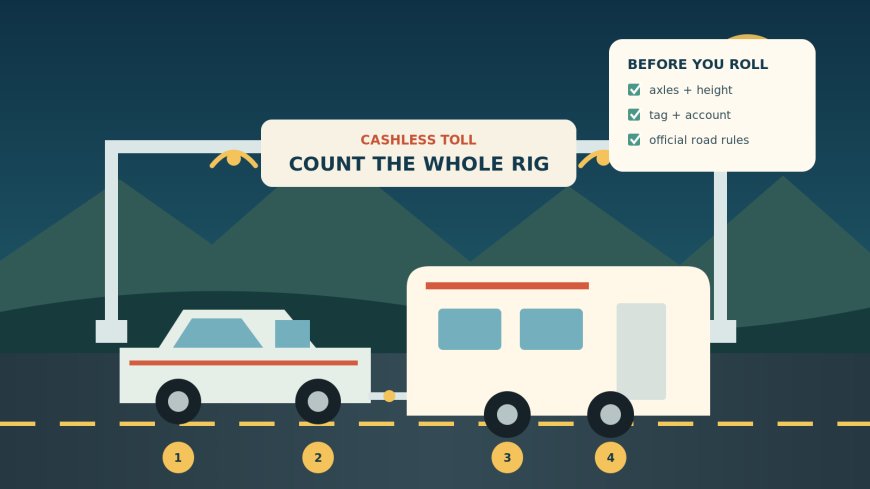
An RV toll plan starts with the exact vehicle combination that will cross each toll facility. Count the motorhome or tow vehicle's axles, add every trailer axle, note the rig's height and tire configuration, and identify every toll operator on the route. Then ask the transponder issuer and each operator whether the device is valid for that combination. Do this before departure. A transponder that works in the solo tow vehicle may need a different classification when a trailer is attached, and a road that once took cash may now bill by transponder or license plate.
There is no single national "RV toll class." New York's Thruway, for example, combines total axles with the height over the first two axles and includes towed vehicles in the axle total.[1] Pennsylvania uses axle-and-height classes on much of its system but axle-only classes at certain toll points.[2] The useful question is not simply, "What does an RV cost?" It is, "How will this agency classify this complete rig on this road, in this direction, with this payment method?"
Count the traveling combination, not the paperwork
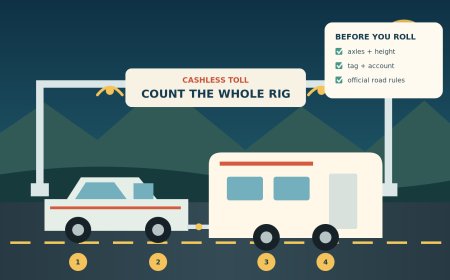
Stand where you can see the whole rig from the side. Count each axle from the front of the powered vehicle to the rear of the trailer. A two-axle pickup towing a two-axle travel trailer presents four axles to toll equipment. A two-axle motorhome towing a two-axle car also presents four. A tag axle on a motorhome changes the count even though the registration may still describe one motorhome.
Do not count tires instead of axles. Dual rear wheels are two tires on each end of one axle, not two axles. Tire configuration can still matter to an account or class definition, so record both facts rather than trying to turn one into the other. Pennsylvania tells RV customers to have weight, tires and axles ready when adding an RV to an account.[3]
Make a small rig card and keep it with the route notes:
| Item | Solo vehicle | Vehicle plus trailer or toad |
|---|---|---|
| Powered-vehicle axles | ____ | ____ |
| Trailer/toad axles | 0 | ____ |
| Total axles | ____ | ____ |
| Height | ____ | ____ |
| Dual rear wheels | yes / no | yes / no |
| Gross or registered weight requested by issuer | ____ | ____ |
| Plate(s) and issuing state/province | ____ | ____ |
| Transponder ID and class | ____ | ____ |
Height belongs on the card because an axle count alone may not settle the class. New York puts vehicles under 7 feet 6 inches in its low group and vehicles at or above that threshold in its high group.[1] Pennsylvania says height affects tolls at specified locations and uses 7 feet 6 inches as the low/high break in its axle-height system.[2] Use the operator's measuring rule. Do not assume an overall brochure height is measured at the same point the toll authority uses.
A trailer can change more than the price
The extra axles commonly move the combination into another rate tier. Illinois, for instance, places three- and four-axle vehicles, including passenger vehicles with one- or two-axle trailers, in its medium truck-and-trailer tier.[5] That is a classification example, not a nationwide conversion table.
The transponder rule can change too. Pennsylvania says a customer may use the transponder while pulling a camper or trailer on the PA Turnpike, with a higher toll applied if the combination moves into a higher class. The same manual tells travelers to contact other E-ZPass agencies for their rules.[3] Virginia takes a different approach: its E-ZPass FAQ says towing changes the vehicle type and calls for a different transponder programmed to the correct class.[6]
That contrast is the reason to check both ends of the relationship:
- Ask the transponder issuer how the account and device must be set up for the RV alone and for the RV or tow vehicle with a trailer.
- Check the toll road, bridge, tunnel or express-lane operator for vehicle eligibility, classification and payment rules.
- If the answer is unclear, contact the operator with the total axles, height, weight or tire details it requests. Save the written response or call reference in the trip folder.
Do not infer a rule from the logo on the windshield device. E-ZPass is interoperable across participating facilities, but the E-ZPass Group does not manage customer accounts or collect tolls; the issuing agencies support their own customers.[7] Compatibility answers where a device can be read. It does not erase local vehicle classes, discounts, lane restrictions or account requirements.
Cashless tolling still requires a payment plan
"Cashless" means there may be no booth where a traveler can hand over money. Florida's Turnpike describes electronic collection through a valid transponder or TOLL-BY-PLATE. Its equipment detects axle count for pricing, and a vehicle without an accepted device is photographed. The registered owner then receives an invoice that includes a $2.50 administrative charge.[4]
Plate billing can also carry a higher rate. Washington says a driver without a Good To Go! account is billed at the registration address and pays $2 more at the Pay By Mail rate.[8] Those examples should not be treated as universal fee schedules. They show why "we'll pay when we get there" is a poor plan on an all-electronic road.
Before leaving, determine which of these outcomes applies to every facility:
- the mounted transponder charges a prepaid or postpaid account;
- the plate is matched to an existing account;
- the agency mails an invoice to the registered owner;
- a time-limited visitor or plate account must be opened;
- the vehicle or combination is barred from a particular managed lane.
A plate invoice follows the registration record, not the campground itinerary. Confirm that the address is current and that someone will monitor the mail while the RV is away. Owners of a recently purchased vehicle should not assume an agency has the new record immediately. Rental and borrowed vehicles need another check: the registered owner may add service charges or process tolls under a separate agreement.
Match the device to the windshield and account
A good toll tag can fail if it is in a drawer, stuck behind metallic coating, assigned to an old plate or backed by an expired card. Follow the issuer's mounting instructions for that device and vehicle. Pennsylvania warns that incorrect mounting can prevent a read and lead to added charges; its manual also says the plate must already be on the account for a plate match to post as a video toll.[3]
Some heated, infrared-blocking or technology-equipped windshields contain metal that can interfere with a pass. Washington directs drivers to check the owner's manual or dealer for a designated mounting area and, if none exists, use the agency's license-plate pass.[8] An RV windshield may also lack the familiar passenger-car rearview-mirror location. Ask the issuer about an exterior tag or approved alternate position rather than improvising.
Use one active device where the issuer directs. Multiple compatible tags in the same vehicle can create duplicate or misdirected reads. If you carry devices for different regions, ask each issuer how to store the unused one so it cannot be read.
Run this account check several days before departure:
- correct RV, tow vehicle, trailer and toad plates are listed where required;
- the transponder is active and assigned to the right vehicle class;
- the account has enough funds or a working replenishment method;
- the email, phone, mailing address and payment card are current;
- the tag is mounted in its approved location;
- the device's coverage includes each planned facility, not merely the state;
- any trailer-specific tag or class change is ready before the trailer is connected.
Do not wait until the night before if the issuer must mail a different tag or update a vehicle class.
Build a toll sheet for the actual route
A navigation app may label a road as tolled without naming every operator or explaining how a four-axle high-profile RV combination will be charged. Break the route into facilities and use each operator's current calculator or rate table.
| Route segment | Operator | Rig configuration | Class | Payment method | Estimated toll | Rule checked |
|---|---|---|---|---|---|---|
| ______ | ______ | RV only / towing | ______ | ______ | $____ | date: ____ |
| ______ | ______ | RV only / towing | ______ | ______ | $____ | date: ____ |
| ______ | ______ | RV only / towing | ______ | ______ | $____ | date: ____ |
Record direction, entry and exit where the calculator asks for them. A border crossing or long turnpike trip can pass through more than one classification system. Pennsylvania specifically notes trips that encounter axle-only pricing at a border toll point and axle-height pricing farther along the route.[2]
Check managed and express lanes separately from the main road. A transponder may pay on both while vehicle weight, axle count, trailer status or occupancy makes the RV ineligible for a discount or for the lane itself. The roadside sign and current official lane rule control, not an old forum post.
The estimate needs a margin. A detour, missed exit or changed campground can add toll points. The point of the sheet is not to predict the bill to the cent; it is to reveal which agencies, classes and payment rules need attention while there is still time to fix the setup.
At the gantry and after the trip
Keep moving as signs direct. Do not stop, reverse or change lanes abruptly because a tag did not beep or a display was unclear. Toll systems do not all provide an immediate confirmation. Note the facility and approximate time when safely parked.
Review transactions during the trip and again after the expected posting window. Compare the charged class with the combination that actually traveled. Save campground dates, fuel receipts or a photo of the connected rig if a class dispute would be hard to explain later. Use the agency's official dispute channel and deadline.
Treat unexpected toll texts and emails as possible scams. Go to the authority's website through a saved bookmark or typed address instead of using the message link. The E-ZPass Group warns that it does not hold accounts or collect tolls and directs customers to their member agencies.[7]
The ten-minute departure review
Before the first toll road, answer these questions on one page:
- How many axles will the complete combination have today?
- Does height, weight or tire configuration affect the class?
- Is the trailer or toad plate listed where required?
- Is this transponder approved and correctly classed for towing?
- Is the tag mounted in the specified place for this windshield?
- Is the account active, funded and tied to current contact information?
- Does each facility accept this exact device?
- Are cashless, plate-billing and invoice-fee rules understood?
- Are the planned lanes open to this RV combination?
- Has each answer been checked on an official agency page recently?
The last check matters most. Toll networks share technology, but they do not share one RV rulebook. Count the rig that will cross the gantry, verify the device with its issuer, verify the road with its operator, and keep enough information to audit the charge afterward.
Sources
What's Your Reaction?