








Who Takes Out the Trash? A Waste Plan for RV-and-Cabin Groups
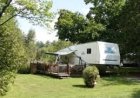
A booking-confirmation and cleanup plan for groups splitting a campground stay between RV sites and cabins or yurts.

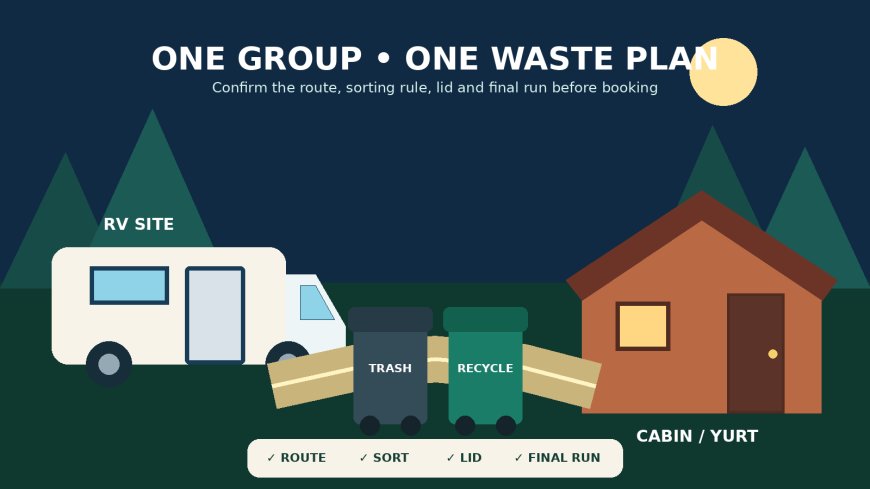
Who takes out the trash? A waste plan for RV-and-cabin groups
By Romana | October 8, 2026 | Glamping
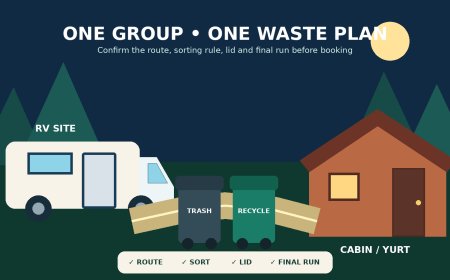
A mixed group can book an RV site and a cabin or yurt at the same campground, then discover that “trash service” means three different things: a small can beside the rental, a shared dumpster across the loop, or no collection at all. Recycling may be loose, sorted or unavailable. In wildlife country, waiting until checkout to move a leaking bag can break the property’s storage rules.
This is a replacement topic. The requested laundry-and-shower comparison substantially overlaps RVCamping.info’s September 11 shared-bathhouse guide and October 4 linens-and-cleaning-fees guide. The narrower problem here is assigning waste from two reservations to a confirmed disposal route that every guest can use.
Start with two reservations, not one garbage pile
Do not assume the RV site and roofed rental share the same service just because they share an entrance. Record the rule for each accommodation and then record the common disposal point, if there is one.
Washington State Parks illustrates the range hidden inside a statewide policy. Its camping page covers RVs and roofed structures such as yurts, directs visitors to use cans and dumpsters, encourages recycling, and also says that visitors at parks operating pack-it-in/pack-it-out programs must carry everything away.[3] The practical question is therefore not “Does the agency handle trash?” It is “What applies to our exact park, units and dates?”
Use separate columns:
| Question | RV site | Cabin or yurt | Shared facility |
|---|---|---|---|
| Where may waste wait during the stay? | ___ | ___ | n/a |
| Who supplies bags? | ___ | ___ | n/a |
| Where does tied garbage go? | ___ | ___ | ___ |
| What recycling is accepted, and how? | ___ | ___ | ___ |
| Is the route usable after dark? | ___ | ___ | ___ |
| What must leave with the group? | ___ | ___ | ___ |
The split matters at Lost Lake Cabins in Wisconsin. The federal booking page says the campground across the lake gives friends and family an RV-camping option about a quarter-mile walk from the cabins. It also tells cabin guests and campers to bring trash bags, carry all trash to the dumpster, and put loose recycling in the dumpster on the left.[2] That is a workable shared system only if the group knows the route, understands “loose,” and does not leave one lodging party to clean up after the other.
Name every waste stream before packing
One bag marked “trash” is not enough for a group meal, pets and two sleeping locations. Put likely waste into five buckets before assigning containers:
- ordinary dry garbage: wrappers, nonrecyclable packaging and broken disposable items;
- food and scented waste: scraps, grease, used food packaging, pet-food residue and coffee grounds;
- recycling: only materials accepted by the property, prepared exactly as it requires;
- special waste: batteries, propane cylinders, chemicals, medical sharps or other items the campground may not accept; and
- RV-system waste: black water, gray water and sanitation gear, which never belong in ordinary garbage unless a rule specifically identifies an allowed item.
Do not “wish-cycle” a greasy container because a recycling symbol is printed on it. Ask which materials the campground accepts, whether items must be clean and dry, whether lids stay on, and whether bags are prohibited. Lost Lake’s instruction to use loose recycling is property-specific evidence that the container method can matter.[2]
Keep special waste out of a shared bin until the operator gives an approved route. A campground dumpster is not permission to discard a propane cylinder, lithium battery, chemical, ash or medical sharp. Bring a rigid, labeled transport container when someone’s normal care generates sharps, and arrange the lawful destination before departure rather than asking a host to improvise.
Treat food waste as scented storage
Trash does not stop being wildlife attractant while it waits for the evening dumpster run. National Park Service bear guidance includes trash, toiletries, fuel, coolers and food-preparation items among scented items; it tells campers to secure food, garbage and other scented items immediately and warns that partially burned food, tea bags and coffee grounds still attract wildlife.[5]
That changes the group workflow:
- Tie off food waste promptly instead of leaving an open bag at either picnic table.
- Use the exact locker, hard-sided vehicle, approved building space or wildlife-resistant container named by the property.
- Do not move cabin garbage to the RV exterior compartment unless both the RV owner and campground approve that storage method.
- Never burn scraps or packaging to reduce bag volume.
- Close and latch wildlife-resistant receptacles after every deposit; do not balance a bag beside a full dumpster.
At Wallowa Lake State Park, Oregon’s official page places dumpsters and recycling bins at a compactor station by the far end of D loop, limits those dumpsters to garbage generated in the park, and tells campers not to burn or leave garbage in fire pits. The same park offers 121 full-hookup sites, 88 tent sites and two yurts.[4] The useful lesson is not that every park works like Wallowa. It is that a mixed-property listing should be translated into one exact disposal location and one exact handling rule.
Verify the route, lid and opening—not just the symbol
An accessibility icon on a campsite or yurt does not prove that every guest can carry a bag to the disposal point. Ask about the entire trip: door to path, path to receptacle, the space at the opening, the lid or latch, and the return route.
The U.S. Access Board’s federal outdoor-developed-area guide treats trash and recycling receptacles as outdoor constructed features. Its technical discussion describes clear ground space of 36 by 48 inches for a forward approach or 30 by 60 inches for a parallel approach. It also notes that animal-resistant hinged lids may meet operability requirements only to the extent practicable, while dumpster-type receptacles are exempt from certain reach-range and operability provisions.[1] Those federal criteria are not a promise that a particular state, local or private campground follows that chapter. They are useful prompts for asking about the actual facility.
For a guest who uses a wheelchair, walker or limited grip, request:
- the surface, grade, cross-slope, width and curb or step details from each lodging door to the receptacle;
- the clear space in front of the opening and whether another bin blocks it;
- opening height and whether use requires reaching over a wall;
- lid weight, spring tension, latch type and whether two hands are needed;
- whether a dumpster has a lower side opening;
- nighttime lighting and any vehicle crossings;
- whether staff offers an approved alternative when the standard container cannot be operated; and
- a current photo or short video, including the approach.
Do not solve an inaccessible lid by leaving a bag on the ground. Ask for the property’s procedure before booking. If staff pickup is offered, record the collection point, permitted hours, bag requirements and whom to call when the pickup does not occur.
Set a disposal rhythm instead of a checkout scramble
Choose two times: a routine waste run and a final sweep. The routine run should happen often enough that food residue never sits outside an approved container overnight. The final sweep should finish before the earliest checkout time attached to either reservation.
Assign roles rather than accommodations. One person gathers sealed garbage from the RV site; another checks the rental, porch and fire ring; a third handles accepted recycling. The person with the largest vehicle should not automatically inherit every bag. A travel trailer may remain at camp while its tow vehicle leaves, and the cabin party may be driving the only car permitted near the disposal station.
Keep bags small enough for the named person to lift and for the receptacle opening. Double-bag only when the property permits plastic bags and a leak or odor requires it. Carry a washable tote or cart for the route, but confirm that it fits the path and can be cleaned without using a drinking-water spigot or bathhouse sink.
The group also needs a full-container answer. Ask whether guests should use another station, call the host, store sealed waste in a named wildlife-safe location or pack it out. Never place waste on top of or beside a receptacle, and never force a lid open with a stick or rock.
Build a departure handoff
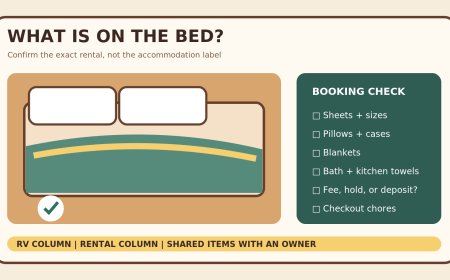
A rental checkout list may require sweeping and removing trash, while the RV party is busy retracting slides and disconnecting utilities. Put the waste deadline on both plans.
Use this order:
- Stop generating a full kitchen bag before the final meal; switch to a small departure bag.
- Empty the rental’s approved interior bins and check under beds, porch furniture and the picnic table.
- Check the RV living area, outdoor kitchen, storage bays and pet area.
- Separate accepted recycling without leaving rejected material at the station.
- Move garbage and recycling to the confirmed destination.
- Inspect both sites for micro-trash, ties, foil, bottle caps and food fragments.
- Photograph the clean rental and campsite only for the group’s private checkout record.
- Pack out anything the property does not accept.
The reservation holder for each unit should sign off on that unit. One shared cleanup lead can coordinate, but responsibility should not become ambiguous if a fee or rule dispute follows.
Booking confirmation worksheet
Send this before the cancellation deadline and ask staff to tie the answer to both reservation numbers.
We are booking RV site ___ and cabin/yurt ___ for dates ___. Please confirm the garbage and recycling rules for each unit. Where is the disposal point serving each accommodation, and may both parties use the same facility? Is service available on our dates, or is either unit pack-in/pack-out? Which materials are accepted for recycling, and must they be loose, bagged, clean, flattened or sorted? Who supplies bags? How should food waste and other scented items be stored between disposal runs? Please describe the walking/rolling route, lighting, surface, grade, steps or curbs, receptacle opening height and lid/latch. If a guest cannot operate the receptacle, what approved alternative is available? What items are prohibited, what happens when a container is full, and what must be completed before each checkout time?
Attach a one-page answer card to both confirmations:
- RV site and rental unit numbers;
- garbage destination and map point;
- recycling list and preparation rule;
- pack-out items and off-site destination;
- food-waste storage location;
- accessible route and approved assistance method;
- routine disposal time and final-run deadline;
- garbage lead, recycling lead and final-sweep lead; and
- staff confirmation name, date and phone number.
The plan is complete when every bag has an owner, every waste type has a destination and every guest has a usable route. “Dumpster available” is only the start of that answer.
Sources
- Chapter 10: Outdoor Developed Areas — U.S. Access Board; federal outdoor accessibility guidance for receptacle clear space and operability; accessed October 8, 2026.
- Lost Lake Cabins — Recreation.gov / U.S. Forest Service; mixed cabin-and-RV location, guest-supplied bags, shared dumpster and loose-recycling rule; accessed October 8, 2026.
- Camping — Washington State Parks; RV and roofed camping context, dumpster use, recycling and pack-it-in/pack-it-out variation; accessed October 8, 2026.
- Wallowa Lake State Park — Oregon State Parks; RV sites, yurts, compactor location, recycling and wildlife-related garbage rules; accessed October 8, 2026.
- Storing Food — National Park Service; scented-item scope, immediate storage and prohibition on burning food waste; accessed October 8, 2026.
What's Your Reaction?