






Two RVs, two sites: how to book neighbors without trusting the numbers
Book two RV sites as a verified pair: check the map and walking route, fit each rig, separate reservation control, and plan arrivals and cancellations.

*By Romana*
*Category: RV Camping*
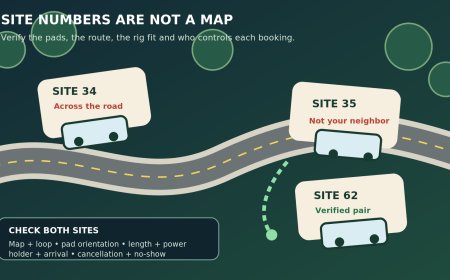
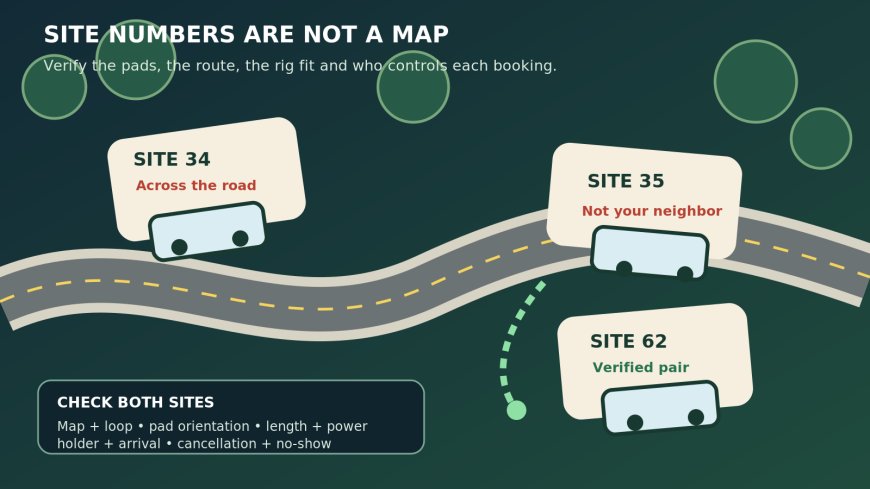
Site 34 and Site 35 look like a pair. They may not be. One could sit across a one-way road, behind a restroom, or on the far side of a bend. The numbers tell you how the campground catalogs its sites; they do not prove that two RV doors, picnic tables, or utility sides will face each other.
The safe booking method is to treat "together" as a set of facts you verify: physical position, walking route, loop, site fit, electrical service, reservation control, and arrival plan. Book only after both rigs pass their own site checks.
Start with the map, then verify the view from each pad
Open the official campground map before choosing either site. Find the loop name, road direction, bathhouse, host site, dumpsters, water points, trail crossings, and any internal road between the two pads. A loop map can also reveal that consecutive numbers sit on opposite sides of the road or at different elevations.
Platte River Campground is a useful example of why the loop matters. Its official map places electric sites in Loops 1 through 3 and non-electric sites in Loop 4; the map also shows separate site-number ranges within those areas.[4] Two available sites at the same campground can therefore produce very different power and walking arrangements.
Do not stop at the map icon. Open each site's detail page and photos. Check which way an RV enters, where its curb or patio side lands, and whether the living areas face each other. A pair separated by 40 feet of vegetation may feel private; a pair 40 feet apart across an active road does not function the same way.
Use satellite imagery only as a secondary clue. Trees move, sites get rebuilt, and imagery can predate a campground renovation. The campground's current map and site records should carry more weight. If the pair still looks ambiguous, call the campground and ask staff to describe the route from one pad to the other.
"Same loop" is a useful fallback, not a synonym for next door
When no true side-by-side pair is open, the same loop often beats two numerically close sites in different sections. It can keep both rigs under the same gate routine, generator rules, bathroom cluster, road approach, and utility pattern. It may also make evening walks easier than crossing a main campground road.
Still, ask what same-loop actually means on the ground. A large loop can have several branches. One-way roads may force a long drive between pads that are close on foot. A steep shortcut, stairs, or an unlit path may be a bad connection for children, a mobility-limited traveler, or anyone walking after dark.
Rank pairs in this order:
- verified neighboring pads with a safe walking connection;
- pads facing or backing toward one another without a busy road between them;
- same branch or small sub-loop;
- same large loop near the same bathroom or landmark; and
- different loops only if each site is otherwise a much better fit.
This ranking is a planning tool, not a promise from a reservation system.
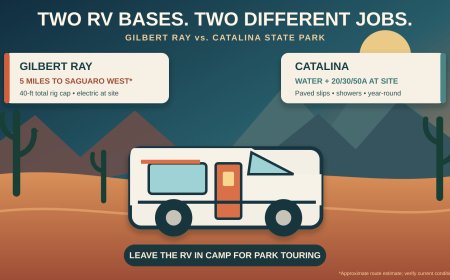
Fit each RV to its own site
Do two separate fit checks. "Both are RV sites" is not enough.
For each rig, record:
- RV type and measured travel length;
- total combination length if the listing uses that measurement;
- back-in, pull-through, parallel, or other access type;
- room needed for slides, awning, steps, rear deck, and tow vehicle;
- required electrical service: none, 20, 30, or 50 amp;
- whether water and sewer are at the pad, shared elsewhere, or unavailable;
- surface, grade, overhead clearance, and known obstructions; and
- extra-vehicle and overflow-parking rules.
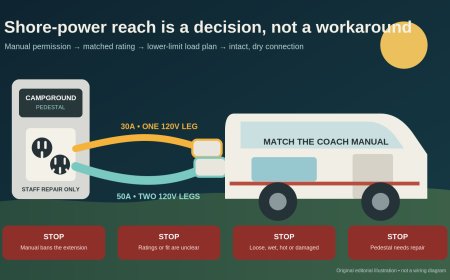
Do not average the requirements. A 24-foot motorhome and a 38-foot fifth-wheel do not become two 31-foot rigs. Put the larger or harder-to-maneuver RV on the pad with the better approach and verified dimensions. Give the 50-amp rig a 50-amp site if that service is required; do not plan on drawing 50-amp capacity through an adapter from a 30-amp pedestal.
Campground-wide summaries can hide site-level differences. California State Parks directs campers to review the specific park and campground information, while Recreation.gov warns that location-specific rules can supersede its standard policies.[1][2] Save the detail page for each exact site, not just the campground overview.
Put each reservation under the person who will use it
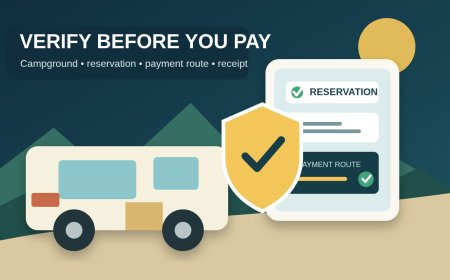
The cleanest setup is one reservation holder per occupied site. Each traveler books, pays for, checks into, and controls changes to the site their RV will use. Share both confirmation numbers and add the other traveler as an authorized contact or designee only when the campground permits it.
That arrangement matters when arrival times split or one RV cancels. Oregon State Parks says the original holder remains responsible when a designee is added, and the original holder can still cancel the reservation; a third-party buyer has no control over that booking.[3] Other systems use different terms, but the practical question is the same: who can change, cancel, or check in for each site?
Before paying, confirm:
- whether one account may hold two campsites for the same dates;
- whether the named holder must occupy the site;
- whether the second driver can be added before arrival;
- what identification, vehicle plate, pass, or discount proof is required;
- whether a discount applies only to the holder's occupied site; and
- whether a reservation can be transferred or only cancelled and rebooked.
Do not assume that forwarding a confirmation email transfers control.
Book the pair with a controlled handoff
Popular sites can disappear while two people talk. Use a short, explicit booking handoff:
- Agree on a first-choice pair and two backup pairs before the reservation window opens.
- Label each site with its assigned rig and holder.
- Put both bookings in the carts at the same time if the system allows a temporary hold.
- One person says "ready" only after checking dates, loop, site number, equipment fit, and hookups.
- Both submit, then immediately exchange confirmation numbers and screenshots.
- Reopen the official map and confirm that the purchased site numbers are the intended pair.
If only one booking succeeds, pause. Do not grab a random second site solely because its number is close. Compare it against the backup ranking and both fit sheets.
California's policy shows why it is important to know whether a park is site-specific. At non-site-specific parks, staff assign campsites on arrival and will only try to place a two-site party together, subject to availability.[2] In that situation, "two reservations" is not the same product as "two guaranteed neighboring pads." Ask what staff can note and when assignments are made.
Coordinate arrival without tying the reservations together
Choose one arrival leader, but keep each holder responsible for their own reservation. The leader carries the campground phone number, both confirmation numbers, both plate numbers, and the late-arrival procedure.
Send a one-page arrival note to both drivers:
- exact campground entrance, not just the park address;
- gate hours and check-in location;
- whether the access road is one-way;
- site and loop for each RV;
- after-hours packet, gate code, or self-check-in steps;
- which RV enters first if backing paths could conflict; and
- the point where the group stops and calls rather than improvises.
Avoid staging two large rigs at a narrow office or loop entrance. If the second RV is late, the first driver should occupy only their own assigned site. Do not park gear or a tow vehicle on the other pad to "save" it unless staff explicitly authorize that.
Late arrival can put the second booking at risk. Recreation.gov defines a no-show by whether the customer arrives or cancels by the applicable deadline, while also warning that individual facilities can have different procedures.[1] Platte River Campground, for example, requires a call when the camper expects to miss check-in by 24 hours; without that notice, the booking can be cancelled and fees charged.[4] Record the exact rule for your campground and call before the office closes.
Treat cancellation as two separate failures
Two sites booked together usually remain two reservation contracts. If one household cancels, the other reservation may stay valid, but the social plan changes. If one person booked both and cannot travel, the second household may discover that it cannot take over either booking.
Before the refund deadline, decide:
- whether either RV would still make the trip alone;
- whether the remaining party can legally keep its own site;
- whether the vacant site must be cancelled rather than informally handed off;
- who pays any cancellation or change fee; and
- whether the group will accept a replacement site that is farther away.
Cancellation clocks vary. Recreation.gov lists standard change, cancellation, and no-show rules but says the specific facility's terms control when they differ.[1] California State Parks uses timing bands that can progress from a fee to loss of the first night's site fee and, close to arrival or for a no-show, loss of all fees paid.[2] Save the policy shown at checkout for both reservations. A screenshot with the date is more useful than somebody's memory a month later.
What to ask the campground
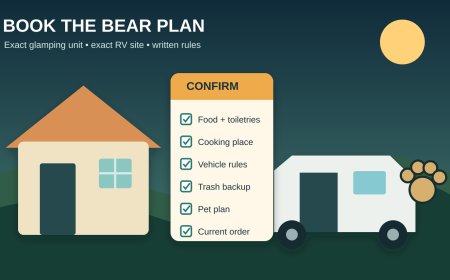
A two-minute call can settle what the map cannot. Give staff both site numbers, both rig types, and the dates, then ask:
- Are these pads physically beside each other, across a road, back-to-back, or separated by another site or facility?
- Do their usable outdoor areas face each other?
- Is there a safe, reasonably level walking route between them after dark?
- Are both in the same loop, gate area, and rule zone?
- Is either listing non-site-specific or subject to reassignment?
- Will each measured RV fit its assigned pad with slides, awning, steps, hitch, and tow vehicle?
- What electrical receptacles and amperage are installed at each exact site, and are water or sewer hookups individual or shared?
- Must each reservation have a different holder, and must that holder be present at check-in or overnight?
- Can another named adult check in, change, or cancel the reservation?
- What happens if one RV arrives late, and when is that site released as a no-show?
- If one reservation is cancelled, is the other affected in any way?
- Can staff place a note that the two parties are traveling together, and does that note carry any guarantee?
Write down the employee's answer, call date, and any instruction to call again closer to arrival. A note is useful context. Unless the campground says otherwise in writing, it is not a guaranteed site move or adjacency promise.
The booking record to keep
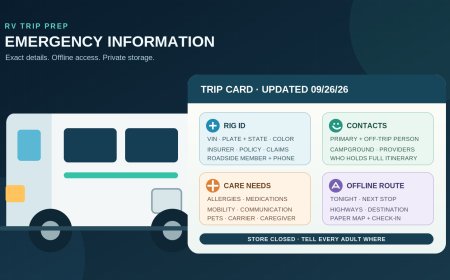
Store one shared page with the map screenshot, both site-detail screenshots, both confirmation numbers, holder names, cancellation deadlines, late-arrival numbers, rig measurements, hookup requirements, and the campground's answers. Mark uncertain items as uncertain instead of filling the gap with an assumption.
The pair is ready when each RV fits independently and the relationship between the pads has been verified. Neighboring numbers are only a lead.
Editorial note: Reservation systems and campground rules change. This guide uses official policies retrieved September 27, 2026, but the terms displayed for the exact campground, site, dates, and reservation control. No firsthand stay or site inspection is claimed.
Sources
What's Your Reaction?