










A 1,500-watt heater can use most of an RV outlet circuit
Use a portable electric heater in an RV only after checking its nameplate, shore-power budget, branch circuit, receptacle heat, clearance, and shutoff routine.

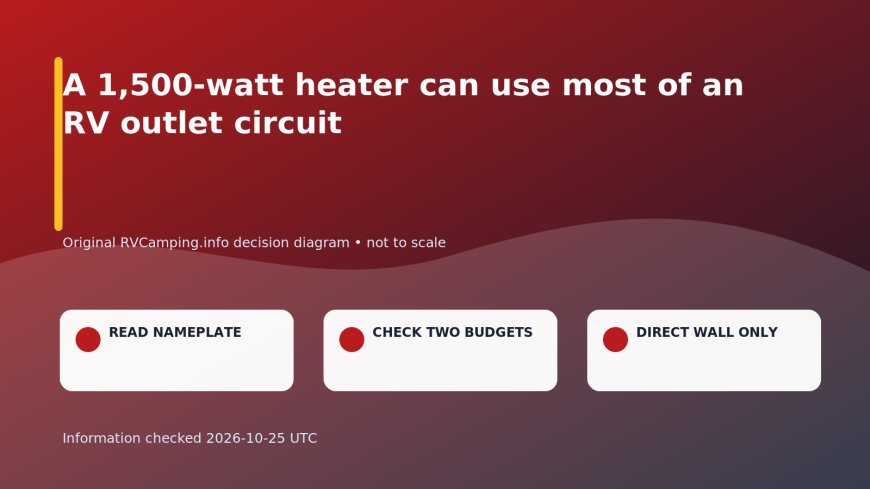
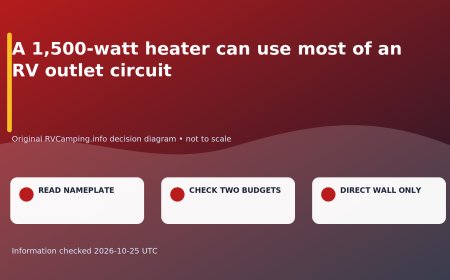
A 1,500-watt heater can use most of an RV outlet circuit
The campsite pedestal may have capacity while the heater’s outlet circuit does not; both budgets and the fire-safety setup have to pass.
Start with the heater’s own label
One Lasko model lists 900- and 1,500-watt settings at 120 volts, equal to 7.5 and 12.5 amps.[5] That is a worked example, not a universal heater specification. Read the exact appliance label and manual before doing any load math.
A 1,500-watt heater would consume about 42 percent of a nominal 30-amp, 120-volt RV service. That does not mean 17.5 amps are freely available. The converter, water-heater element and other loads can cycle, while the receptacle sits on its own branch circuit.[4][5]
The RV has two electrical budgets
A Winnebago manual labels its connection as 110/125-volt, 30-amp service and warns not to exceed the circuit rating.[4] The coach’s main service is one limit; the labeled breaker serving the chosen receptacle is another. A 30-amp pedestal does not give one outlet 30 amps.
Use the panel labels and coach manual to identify the branch. Reduce concurrent loads before the heater runs. If a breaker trips repeatedly without an obvious overload, the cited manual calls for the electrical system or appliance to be checked, not for a larger breaker.[4]
The plug and outlet are part of the inspection
CPSC and NFPA say to connect the heater to the wall receptacle itself rather than through an extension lead or power strip.[1][2] CPSC also says to disconnect the heater if its plug or cord becomes hot and to have a hot outlet checked by a certified electrician.[3]
Keep the cord out from under rugs and away from water.[3] A warm cabin does not excuse a hot plug, loose receptacle or scorched faceplate. Stop rather than moving the same high load to another unknown outlet.
Clearance and attention still decide the night
NFPA and CPSC call for at least three feet of clearance from anything that can burn, a stable level surface and placement outside foot traffic and exits.[1][3] Tip-over and overheat protection are useful selection features, but they do not authorize unattended use.
Before sleeping or stepping away from the room, switch the heater off and pull its plug.[1][3] A passed load calculation addresses current. It does not replace clearance, an intact receptacle or an awake person who can respond when something changes.
Source credit: RVCamping.info reviewed the linked primary and supporting materials on 2026-10-25. The decision sequence and recommendations are original editorial analysis.
Sources
- NFPA portable space heater safety — Accessed 2026-10-25.
- CPSC space-heater warning — Accessed 2026-10-25.
- CPSC portable electric heater safety habits — Accessed 2026-10-25.
- Winnebago View/Navion operator manual — Accessed 2026-10-25.
- Lasko 754200 specifications — Accessed 2026-10-25.
What's Your Reaction?