




Pictured Rocks RV Campgrounds: Twelvemile Beach, Hurricane River or Little Beaver Lake?
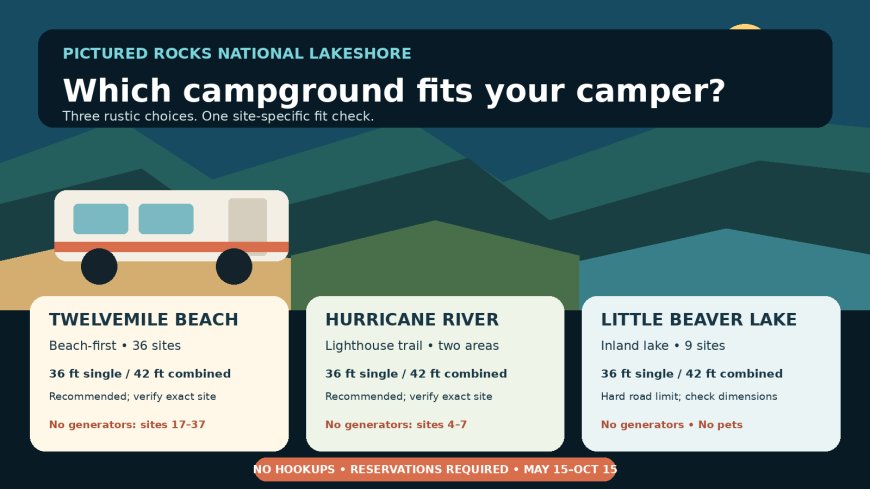
Twelvemile Beach suits beach-first trips, Hurricane River starts the lighthouse walk, and Little Beaver Lake is the strict small-rig, no-generator choice.

Pictured Rocks RV Campgrounds: Twelvemile Beach, Hurricane River or Little Beaver Lake?
By Romana | Updated October 10, 2026
Pictured Rocks National Lakeshore has three drive-in campgrounds, and none works like a conventional RV park. There are no electric, water, or sewer hookups, no showers, no dump station, and usually no cell signal. All three require reservations. The useful choice is about road geometry and what you want outside the door: Twelvemile Beach for the broadest inventory and direct beach access, Hurricane River for the Au Sable Light Station walk, or Little Beaver Lake for a tiny inland-lake camp that excludes pets and generators.[1][3][7]
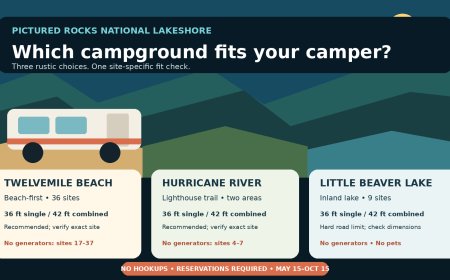
Quick comparison for RV and camper trips
| Decision factor | Twelvemile Beach | Hurricane River | Little Beaver Lake |
|---|---|---|---|
| Setting | Sandy plateau above Lake Superior | Upper woods or lower Lake Superior side | Small inland-lake campground |
| Published inventory | 36 sites | NPS lists 21; Recreation.gov describes 22 | 9 sites |
| Rig guidance | NPS recommends a single vehicle no longer than 36 ft; vehicle/trailer combination no longer than 42 ft | Same 36-ft single / 42-ft combination recommendation | More than 36 ft single or 42 ft combined is prohibited |
| Generator rule | No generators at any time in west loop, sites 17–37 | No generators at sites 4–7 | No generators anywhere |
| Pets | Allowed on a leash no longer than 6 ft | Allowed on a leash no longer than 6 ft | Not allowed |
| Standout access | Three stairways to beach; White Birch Trail | Lower loop starts the 3-mile round-trip lighthouse walk | Narrow, twisting, hilly 3-mile access road; boat ramp |
The 36/42 numbers need careful reading. At Twelvemile Beach and Hurricane River they are NPS recommendations tied to limited turning radius, not promises that every site fits a 42-foot combination. Little Beaver is different: a single unit over 36 feet or a vehicle-and-trailer combination over 42 feet is prohibited on its road and at the campground.[1][2]
Twelvemile Beach: the best default for most smaller RVs
Twelvemile Beach has 36 sites on a high sandy plateau, two accessible sites, three stairways to Lake Superior, and immediate access to both the White Birch Trail and North Country Trail. It is the easiest first choice when the trip is built around the beach and you want more inventory than the other two campgrounds provide.[1]
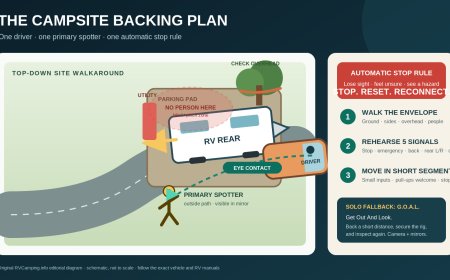
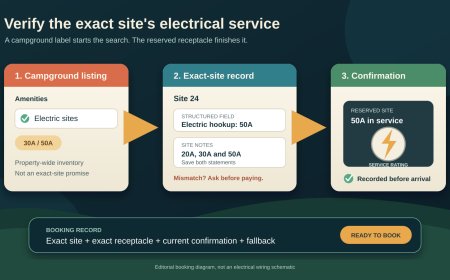
Its name can make the arrival sound simple. It is not a big-rig beach park. NPS says the campground turning radius is limited and recommends single vehicles at 36 feet or less and combined vehicle/trailer length at 42 feet or less. Recreation.gov also warns that parking at some sites is limited and tells campers to keep a camper or vehicle-trailer combination at 42 feet or less.[1][4] Open the individual site listing before paying, then compare its stated parking dimensions and photo with the complete traveling combination. A 24-foot trailer behind a 20-foot truck is a 44-foot arrival problem even if the trailer alone fits the pad.
Power strategy can eliminate half the campground. Generator use is prohibited all day in the west-end loop, numbered 17 through 37. The east loop is not generator-free, but quiet hours still restrict noise. The current NPS camping page lists quiet hours as 8 p.m. to 8 a.m.; Recreation.gov still says 10 p.m. to 6 a.m.[1][4] Follow the stricter NPS window and recheck the confirmation before running a generator. If the batteries cannot carry an overnight furnace cycle, lights, pump, and device charging, either reserve an east-loop site and plan charging outside quiet hours or arrive with enough battery and solar capacity for the stay. Do not book the west loop because it has the prettier available site and assume a brief generator run will be overlooked.
Hurricane River: choose the loop as carefully as the campground
Hurricane River is split by H-58 into upper and lower sections. The upper area is wooded; the lower area is on the Lake Superior side and serves as the trailhead for the roughly three-mile round-trip walk to Au Sable Light Station. That makes Hurricane the practical pick for campers who would rather begin a lighthouse walk from camp than drive to another trailhead.[1][5]
The same turning warning applies here. NPS recommends no more than 36 feet for a single vehicle and no more than 42 feet for a vehicle-trailer combination because the turning radius is limited. The campground access road is also on the park's list of places not well suited to large vehicles.[1][2] A site-specific parking length remains the controlling booking detail.
Generator restrictions are narrower than at Twelvemile but easy to miss: Recreation.gov identifies sites 4 through 7 as generator-free. Other Hurricane sites still fall under campground quiet hours; use the current NPS 8 p.m.–8 a.m. window rather than the older 10 p.m.–6 a.m. wording shown on Recreation.gov.[1][5] Filter by the power plan first, then decide between upper woods and the lower lake-and-lighthouse location.
There is an inventory discrepancy worth knowing before using a third-party campsite map. The NPS camping page says 11 lower sites plus 10 upper sites, for 21 total. Recreation.gov describes 10 upper and 12 lower sites.[1][5] The live Recreation.gov booking grid should decide what can actually be reserved; the difference does not change the road or generator limits.
Little Beaver Lake: the smallest and strictest RV choice
Little Beaver Lake is not a quieter substitute for a campground that sold out. It is a specific fit. Nine sites sit on or near the inland lake, and the approach leaves H-58 for a narrow, unpaved, twisting and hilly road of about three miles. NPS prohibits single units over 36 feet and vehicle-trailer combinations over 42 feet on Little Beaver Lake Road. Recreation.gov tells travelers to inspect each site's length, width, and height before booking.[1][2][6]
Those are outer limits, not a recommendation to take the maximum. The combination still has to negotiate the road and fit the selected parking space. Count the tow vehicle, tongue and rear carriers. A short trailer pulled by a long pickup can exceed the combined cap. Tall campers should also use the official site photos and current listing to judge tree clearance rather than relying on length alone.
Little Beaver bans generators throughout the campground, and pets are not permitted in the campground or on trails leading from it because of the adjacent Beaver Basin Wilderness.[1][6] Those two rules make the decision quick for many RV travelers. It is a good match for a compact camper with a quiet battery plan, no pet, and an interest in paddling or fishing. Only electric motors are allowed on Little Beaver and Beaver lakes.[1]
Services are equally rustic at all three
No campground wins on utilities. NPS lists vault toilets and well water, but no hookups. Its permit page explicitly says the rustic sites have no electrical hookups, hot water or showers; the FAQ adds that there are no sewer hookups or dump stations.[1][3][7] Fill and dump before entering the park, then carry enough fresh-water capacity for the stay. Well water at camp is a shared source, not a campsite connection.
Keep gray water and sewage contained in the RV. NPS directs campers to dispose of dish or waste water in a toilet and confirms there is no dump station in the park.[1] A portable tank does not solve the problem unless you have already identified a legal dump location outside the lakeshore and can transport it safely.
Food planning matters, too. Pictured Rocks is bear country. When these items are not actively being used, put food, drinks, cookware, storage containers and pet food inside a rigid-sided vehicle and close it securely; garbage belongs in bear-resistant cans.[1] This is more restrictive than simply closing an RV screen door over an outdoor kitchen.
Reservations, season and arrival caveats
All drive-in sites require reservations through Recreation.gov; there is no walk-up or drop-in camping. Reservations open up to six months in advance, and same-day reservations are accepted when inventory remains. The normal drive-in season runs May 15 through October 15. After October 15, the water systems and toilets shut down; the park's year-round camping language applies to reserved backcountry camping, not an RV staying in a closed drive-in loop.[1][4]
Some sites are deliberately released later. At Twelvemile, sites 4, 26 and 35 open two weeks before arrival, while sites 8, 15 and 33 open four days before arrival. Hurricane holds upper site 1 and lower site 11 until two weeks out, then upper site 2 and lower site 1 until four days out. Little Beaver sites 4 and 5 open two weeks before arrival.[4][5][6] A full six-month calendar is therefore not always the final answer, but those late releases are still reservations, not first-come sites.
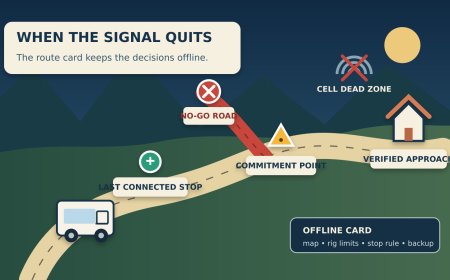
Snow closes many park roads in winter, and NPS warns drivers to stay on H-58 and signed official roads rather than follow mapping apps onto narrow dirt roads or dead ends.[2] Even during the operating season, weather, road work and temporary alerts can change access. Download the reservation, park map and route before leaving reliable service.
Which Pictured Rocks campground should you reserve?
Choose Twelvemile Beach for the largest selection and the most direct beach-centered stay. Pick the east loop if generator charging is part of the plan; pick the west loop only if the rig can operate without one.
Choose Hurricane River for the Au Sable Light Station walk or a choice between a wooded upper area and lake-side lower area. Avoid sites 4–7 if you need a generator, and verify the exact site dimensions.
Choose Little Beaver Lake only when the complete rig is comfortably inside the hard road limits, the trip is pet-free, and the electrical plan needs no generator. Its small scale and inland-lake access are the reward; the approach and restrictions are the price.
For all three, a 42-foot figure is not a campground-wide site guarantee. Measure the traveling combination, inspect the chosen site's official parking data and photo, and reserve the campground whose power rules and access road fit the actual rig.
Source credit: RVCamping.info compared current National Park Service and Recreation.gov campground, road, facility and reservation records retrieved October 10, 2026. The selection framework and RV-fit analysis are original editorial work.
Sources
- Camping at Pictured Rocks — National Park Service — Drive-in seasons, reservations, campground descriptions, road/rig guidance, services, pets, food storage and wastewater rules. Accessed October 10, 2026.
- Directions and Transportation — National Park Service — Little Beaver Lake Road's legal length limits, large-vehicle cautions and winter/GPS routing warnings. Accessed October 10, 2026.
- Frequently Asked Questions — National Park Service — Confirmation that drive-in campgrounds lack hookups, hot water, showers and dump stations. Accessed October 10, 2026.
- Twelvemile Beach Campground — Recreation.gov — Facility details, exact generator-free loop, reservation rules and held-back sites. Accessed October 10, 2026.
- Hurricane River Campground — Recreation.gov — Upper/lower descriptions, sites 4–7 generator ban and held-back reservation inventory. Accessed October 10, 2026.
- Little Beaver Campground — Recreation.gov — Hard rig limits, road and site cautions, campground-wide generator ban, pet rule and held-back sites. Accessed October 10, 2026.
- Permits and Reservations — National Park Service — Explicit confirmation that the rustic drive-in sites lack electrical hookups, hot water and showers. Accessed October 10, 2026.
What's Your Reaction?