














Weigh your loaded RV before the route gets expensive
A three-ticket public-scale method for checking loaded RV axle weights, trailer weight, hitch load and the limits an axle ticket cannot show.

Weigh your loaded RV before the route gets expensive
By Romana
A brochure weight is a starting point. The number that matters on departure day is the weight of the rig with the people, water, fuel, propane, food, tools, bikes, hitch hardware and everything else that will actually travel. A certified public scale can turn that load into an axle-by-axle ticket before a long grade, crosswind or emergency stop exposes a bad assumption.
The job takes more than comparing the ticket's bottom line with one advertised tow rating. Weigh the combination in its travel configuration, identify what each scale platform measured, and compare every useful result with the ratings on the exact tow vehicle, RV, hitch and tires.
Build a ratings sheet from your own rig
Gather the labels and manuals before visiting the scale. Photograph them so the numbers are readable at the weigh station:
- the tow vehicle or motorhome certification label, including GVWR and front and rear GAWR;
- the tire-and-loading placard and the size and load range molded into the installed tires;
- the trailer certification label, including trailer GVWR, GAWR and specified tire information;
- the receiver, ball mount, coupler, weight-distribution hitch or fifth-wheel hitch labels;
- the exact owner's manual and towing guide for the vehicle's model year, engine, drivetrain, axle ratio, wheelbase and installed towing package; and
- the motorhome or trailer occupant-and-cargo label when fitted.
NHTSA's towing guide separates GVWR, GCWR, GAWR, maximum loaded trailer weight and tongue weight, and tells owners to consult the vehicle manual and manufacturer towing information. It also says the trailer's real loaded weight, rather than a dry estimate, is what the setup must handle.[1] A scale ticket supplies measurements. It does not replace any of those ratings, and it does not increase the rating of the weakest component.
Do not copy limits from a forum post or a generic online chart. Two trucks that look alike can have different axle, payload and combined ratings. Use the labels and documents tied to the exact vehicles. If a required figure is missing or two official figures conflict, stop and ask the vehicle or RV manufacturer to identify the controlling value for the VIN and installed equipment.
Load for the trip, not for a flattering ticket
The scale visit should represent the heaviest ordinary travel condition you expect. Put the usual passengers in their normal seats. Load food, clothing, tools, chairs, bicycles, mobility equipment and pets. Fill fuel to the planned departure level. Carry the amount of fresh water, waste water and propane that the route calls for. Include dealer-installed accessories, batteries, solar equipment, generators and the hitch itself.
Michelin's RV tire guide calls for weighing with passengers, cargo, fuel, water, propane, supplies, rear-mounted gear and any towed vehicle included.[4] If the first campground has no water, weighing with empty fresh and waste tanks tells you very little about that first day's load.
Record tank levels and unusual cargo next to the ticket. A ticket without its loading state is hard to reuse. If a motorcycle comes off the rear carrier or a large toolbox moves from the trailer nose to the truck bed, the old axle distribution no longer describes the rig.
Call the scale before you arrive
Ask four questions:
- Is the scale currently certified for public weighing in this jurisdiction?
- Can the platforms fit the full combination without an axle sitting across a joint?
- Where may you safely unhitch if you want a truck-only weight?
- How will the operator charge and identify second or third weighs?
CAT Scale says all of its scales are certified in the state where they operate.[3] Other public scales may use different tickets, layouts and certification programs, so ask the operator and look for the current inspection seal. CAT also says its discounted reweigh requires the same tractor and trailer, the original ticket, the same scale and a return within 24 hours.[3] A truck-only pass after dropping the trailer may not meet that wording. Confirm the price and procedure rather than assuming every follow-up is a discounted reweigh.
Plan the maneuver before entering a busy truck stop. If the intercom is high, have the phone app ready or bring a passenger who can help. Never unhitch on the platform or in an active traffic lane. Follow the attendant's directions.
First weigh: measure the rig exactly as it travels
For a pickup and travel trailer, connect the weight-distribution system at the normal setting. For a fifth wheel, use the normal hitch position. Keep passengers seated and cargo, tank levels and accessories unchanged.
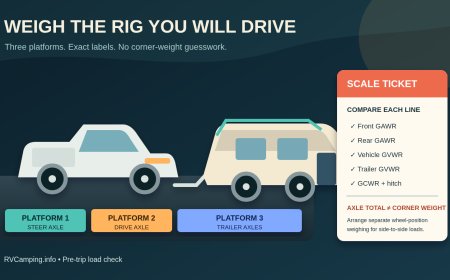
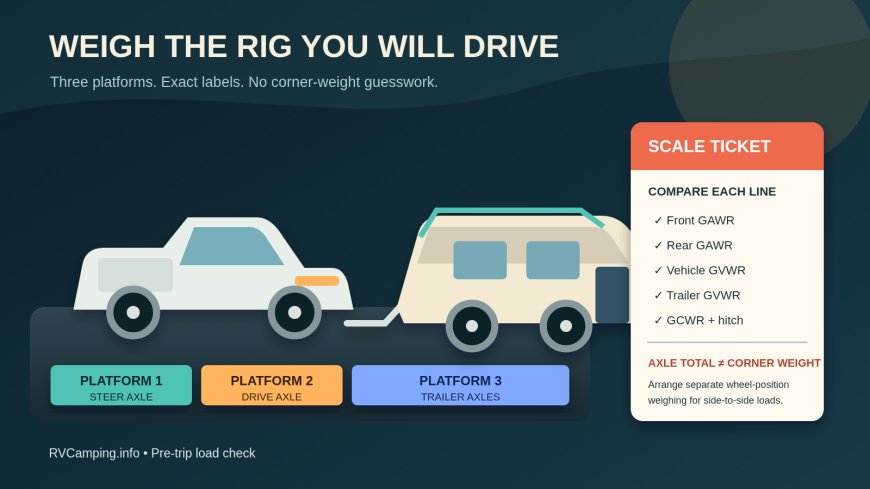
A three-platform scale normally reads the groups this way:
- Platform 1: tow vehicle steer axle;
- Platform 2: tow vehicle rear or drive axle; and
- Platform 3: trailer axle group.
CAT's current procedure uses that placement for a truck and trailer or fifth wheel. For a motorhome, the steer axle goes on platform 1 and the drive or rear axle on platform 2. A tow car normally occupies platform 3.[2] Stop with each axle group fully on its intended pad. If an axle straddles a seam, move as the operator directs and repeat the reading.
The printed lines are axle-group scale weights, not ratings. On a tandem-axle travel trailer with both trailer axles on platform 3, the trailer line is the combined load carried by those axles. It does not tell you how much each trailer axle carries. CAT has a separate movement procedure for spread axles and asks owners of tag-axle motorhomes or unusual multi-axle rigs to call for positioning help.[2]
Add platform 1 and platform 2 to get the loaded tow-vehicle weight while hitched. Add all platform readings to check the combined measured weight. Compare:
- steer reading with front GAWR;
- drive reading with rear GAWR;
- the two tow-vehicle axle readings together with tow-vehicle GVWR;
- trailer axle-group reading with the applicable trailer axle ratings, while remembering that part of trailer weight rests on the hitch;
- all platform readings together with the exact GCWR; and
- measured loads with hitch, wheel and tire limits that apply to the configuration.
Passing the combined limit does not excuse an overloaded rear axle. Passing both axle ratings does not automatically prove the tow vehicle is below GVWR. Run every comparison independently.
Second weigh: find the loaded trailer's total weight
The most useful second pass is the loaded tow vehicle by itself. Park the trailer only in the location approved by the scale operator. Keep the same passengers and truck cargo aboard, then weigh the truck's front and rear axles.
Use the two gross measurements:
loaded trailer weight = combined weight from first ticket - truck-only gross weight
That result includes the trailer's axle load and the portion carried through the hitch. Compare it with trailer GVWR and the tow vehicle's maximum loaded trailer limit for the exact configuration.
There is an important trap here. Subtracting truck-only gross from the tow vehicle's hitched weight with the spring bars tensioned gives the net load left on the truck after the weight-distribution hitch has moved some load toward the tow vehicle's front axle and back toward the trailer axles. That difference is useful, but it is not a clean measurement of uncoupled tongue weight.
For a fifth wheel, there are no spring bars making that particular transfer. The increase in loaded truck weight between the truck-only and hitched readings is the measured pin load, provided passengers, cargo and fluids did not change.
Optional third weigh: isolate tongue load and check hitch adjustment
Owners of a bumper-pull trailer can make a third pass with the trailer coupled but the weight-distribution spring bars released, if the hitch manufacturer permits that procedure and the scale operator provides a safe place to change the setup. Keep the ball coupled, do not change cargo, and follow the hitch manual for handling bar tension.
tongue load = truck gross while coupled with no spring-bar tension - truck-only gross
Then compare that tongue load with the limits in the exact tow vehicle, receiver, ball mount, hitch and trailer instructions. Use the manufacturer's required tongue-load range for this trailer and hitch type rather than borrowing a percentage intended for a different design.
The three tickets also show what the weight-distribution hitch changed. Compare the steer, drive and trailer readings with the bars tensioned against the coupled readings with the bars relaxed. Use the tow vehicle and hitch manufacturer's setup method to judge front-axle restoration. The scale numbers should verify the specified adjustment; they should not be used to invent a new target.
A worked ticket, with the arithmetic shown
These figures are fictional and illustrate the method only:
| Pass | Steer | Drive | Trailer axles | Gross |
|---|---|---|---|---|
| Travel setup, bars tensioned | 3,400 lb | 4,100 lb | 6,600 lb | 14,100 lb |
| Truck only | 3,520 lb | 3,080 lb | — | 6,600 lb |
| Coupled, bars relaxed | 3,200 lb | 4,500 lb | 6,400 lb | 14,100 lb |
The loaded trailer weighs 14,100 - 6,600 = 7,500 lb. The relaxed-bar truck weighs 3,200 + 4,500 = 7,700 lb, so the tongue load is 7,700 - 6,600 = 1,100 lb. That is 14.7 percent of this illustrative trailer's loaded weight. Whether it is acceptable depends on this trailer's and tow vehicle's exact documents.
With the bars tensioned, the truck carries 3,400 + 4,100 = 7,500 lb, only 900 lb more than truck-only gross. The missing 200 lb did not disappear; the weight-distribution system shifted load to other axles, including the trailer group. This is why a two-ticket shortcut can understate tongue load.
What a platform ticket cannot tell you
A standard segmented public scale gives axle-group weights and gross weight. It does not measure the left and right wheel positions separately. CAT states this directly for motorhomes and says it does not permit corner weighing because of possible scale or vehicle damage.[2]
That blind spot matters. An axle can be below GAWR while one side is heavily loaded. A slideout, residential refrigerator, battery bank or storage bay can create a side-to-side difference that the axle total hides. Dividing an axle ticket by two assumes balance; it does not measure it.
Michelin recommends individual wheel-position weighing for RVs and explains that an acceptable axle total can still conceal an overloaded side. Its guidance uses the heavier axle-end load to select support from the correct tire manufacturer's load-and-inflation table, while keeping equal cold inflation pressure across an axle.[4] Arrange that work with an RV weighing service or a facility that is designed and willing to obtain wheel-position weights. Do not put half an RV off a CAT platform; CAT expressly prohibits that method.[2]
For a tandem trailer, wheel-position service should also clarify whether it measures each axle end or only each side of the tandem group. The ordinary three-pad ticket cannot diagnose unequal load between the trailer's forward and rear axles.
Turn the ticket into a route decision
Make a worksheet with four columns: measured item, measured weight, exact rating and remaining margin. Use pounds or kilograms consistently. A positive gross margin cannot offset a negative axle, hitch, wheel or tire margin.
If any measured value exceeds its controlling rating, do not start the trip. Reduce or relocate cargo, change tank levels only if the route makes that practical, and reweigh in the new travel configuration. Moving weight rearward merely to rescue the truck's rear axle can reduce hitch load or overload a trailer axle. Make one documented change at a time and let the next ticket show where the load went.
After the load passes every rating, use the installed tire maker's current table and the vehicle and tire guidance to set cold inflation. The Michelin guide ties inflation to the loaded weight and warns against operating an overloaded or underinflated tire.[4] Do not bleed pressure from a hot tire after driving to the scale, and do not exceed the pressure or load limits of the tire, wheel or vehicle placard.
Keep the final tickets, label photos and worksheet together. Reweigh after adding a major accessory, changing tow vehicles or hitches, carrying substantially different tank levels, or rearranging heavy cargo. The useful number is not the one that made the sales brochure look light. It is the measured load the rig will put on each axle when you pull onto the route.
Sources
- NHTSA: Towing a Trailer—Being Equipped for Safety (National Highway Traffic Safety Administration, accessed 2026-09-15)
- CAT Scale: How to Weigh (CAT Scale Company, accessed 2026-09-15)
- CAT Scale: Frequently Asked Questions (CAT Scale Company, accessed 2026-09-15)
- Michelin RV Tires: Guide for Proper Use and Maintenance (Michelin North America, accessed 2026-09-15)
What's Your Reaction?