





A campground reservation is not a timed-entry reservation: the RV trip checklist
Keep campground bookings, timed-entry access and entrance passes in separate rows, then verify any park-specific camping exception before driving an RV to the gate.

A campground reservation is not a timed-entry reservation: the RV trip checklist
By Romana | September 25, 2026
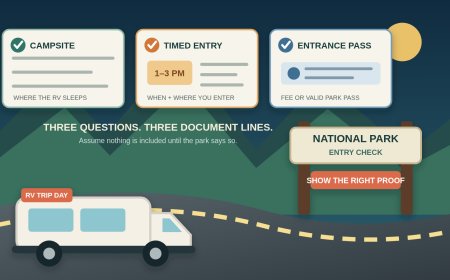
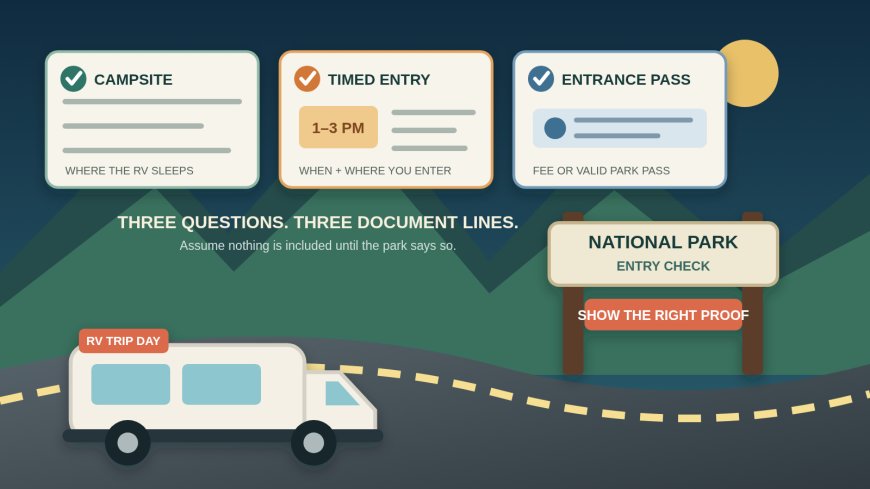
A campsite confirmation answers one question: where you may park the RV overnight. It does not, by itself, prove that your vehicle may enter every park road at any hour. Treat campground reservations, timed-entry reservations and entrance passes as three separate documents until the park's current page explicitly connects them.
Rocky Mountain National Park shows why that wording matters. In 2026, reservations at four named in-park campgrounds include timed-entry access, but the first-day start time and the area covered depend on the campground. A camping fee still does not replace the entrance pass.[2] That is an exception to verify, not a shortcut to assume at every park.
Build a three-document row for every park day
Start a trip sheet before you pay for a campsite. Give each day one row with these fields:
| Field | What to record |
|---|---|
| Sleep | Campground name, site number, arrival and checkout dates |
| Gate | Exact entrance, planned arrival time and vehicle entering |
| Timed access | Product name, controlled hours, entry window and covered area |
| Entrance | Pass type or fee still required |
| Included access | Exact park sentence saying a camping booking substitutes for timed entry, if any |
| Proof | Confirmation number, reservation holder, photo ID and offline file |
| Backup | Legal arrival time or destination that does not need the scarce reservation |
Do not write "Recreation.gov booked" across the row. The same account can hold different products, and a campsite receipt is not interchangeable with a timed-entry confirmation merely because both came from Recreation.gov.
The National Park Service uses park-specific systems, and the list can change by season. Its 2026 announcement says Rocky Mountain retained timed entry, while Arches and Yosemite did not use advance entry reservations and Glacier did not use a park-wide vehicle reservation.[1] Copying last year's checklist, or another park's rule, is therefore a poor control.
Run the campground-inclusion test
Open the official park page, not only the campground listing. Search for the exact campground name next to phrases such as "timed entry," "vehicle reservation," "included," "service reservation" and "entrance pass." Then answer five questions.
- Is this campground inside the controlled area?
- Does the park name this campground as an accepted substitute for timed entry?
- On arrival day, when does that substitute become valid?
- Which roads or corridors does it cover?
- Does the substitute remain valid after checkout or for re-entry?
A vague statement that "campers may enter" is not enough for an RV schedule. Record the start time, end time and geography. If the page does not answer one of them, call the park before building a nonrefundable route around the assumption.
The Rocky Mountain 2026 example
Rocky Mountain's current page names four campgrounds whose overnight bookings include timed entry: Aspenglen and Glacier Basin, plus Moraine Park and Timber Creek. It does not say every kind of camping does. On arrival day, the inclusion activates only once 1 p.m. arrives, which is also campground check-in time. A camper who wants to enter earlier must arrive outside the controlled hours or obtain a separate timed-entry reservation.[2]
Coverage also differs. Aspenglen, Glacier Basin and Moraine Park confirmations include Bear Lake Road access. Timber Creek gives access to the west side and other park areas but excludes the Bear Lake Road Corridor.[2] Longs Peak Campground is a sharp counterexample: its camping fee does not include timed entry.[2]
The dates and clocks matter too. Standard Timed Entry, which excludes Bear Lake Road, is required from 9 a.m. to 2 p.m. through October 12, 2026. Timed Entry + Bear Lake Road applies to that corridor from 5 a.m. to 6 p.m. through October 18. Both use two-hour entry windows.[2][3]
That produces practical results a campsite-only itinerary can miss:
- A Moraine Park reservation does not support an 11 a.m. arrival on the first camping day. Its included access starts at 1 p.m.
- A Timber Creek reservation does not authorize a mid-stay Bear Lake Road outing during controlled hours.
- A Longs Peak camping payment is not proof of timed entry.
- None of those camping documents replaces the entrance fee or valid park pass.[2]
Audit the vehicle, not just the reservation holder
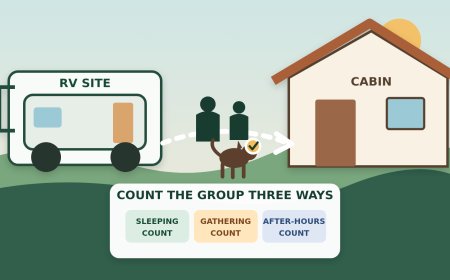
RV groups often split after setup. The motorhome may stay on the pad while a towed car goes sightseeing, or a pickup may leave the trailer at camp. Write down which vehicle will reach the gate.
At Rocky Mountain, each vehicle entering during controlled hours needs the appropriate access basis. The park explicitly counts RVs among vehicles and says the timed-entry reservation holder must travel in the vehicle.[2] For a group using two vehicles, do not assume one campsite confirmation covers both. Ask the park how the camping confirmation applies, and obtain separate timed entry when the official answer requires it.
Keep the account name aligned with the traveler who will be present. Recreation.gov states that a timed-entry confirmation is non-transferable; the named holder must be in the vehicle and may be asked for photo ID.[3] Changing drivers is easy. Changing the required reservation holder at the gate is not.
Make a first-day and checkout-day plan
Arrival day is where RV logistics collide with an access clock. Put these times on one line:
- campground check-in;
- earliest included park entry;
- reserved timed-entry window, if you bought one;
- the campground's late-arrival rule; and
- sunset and a realistic setup duration.
If the campground's included access begins after your planned park arrival, choose deliberately: reserve timed entry, enter before controlled hours when the park permits it, wait outside the park in a legal RV-sized location, or move sightseeing to another day. Do not use an entrance-station shoulder as a holding area.
Rocky Mountain says a qualifying campground confirmation remains valid for re-entry all day on checkout day, after the noon campsite checkout, but campers still need the entrance pass.[2] That is useful for a final outing. Record it as a dated rule for that park, not as a nationwide checkout benefit.
Save a gate packet that works without signal
The park and Recreation.gov both warn travelers to have the full confirmation ready. Rocky Mountain says to download the campground confirmation before arrival because cell service at entrance stations is unreliable; a partial screenshot may not be accepted.[2] Recreation.gov says the timed-entry screenshot should include the date and QR code.[3]
Create one offline folder per park and place these files inside:
- full campground confirmation, not just the booking email subject line;
- full timed-entry confirmation with date, window and QR code;
- entrance-pass record or a note that it will be bought at the gate;
- photo ID name check for the reservation holder;
- screenshot or PDF of the park's campground-inclusion language;
- route to the correct entrance and campground; and
- the written backup plan.
Use filenames that can be read at a glance, such as 2026-09-28-rmnp-moraine-campground.pdf and 2026-09-28-rmnp-bear-lake-entry.pdf. Print the essential confirmations when practical. A phone with a dead battery is not an offline plan.
Keep the products separate in the budget
Use three budget lines: campsite, timed access and entrance. A zero-dollar line still belongs in the sheet if a pass or campground confirmation supplies the requirement. This prevents the common mistake of treating one paid transaction as proof that every gate requirement has been covered.
For Rocky Mountain, Recreation.gov says a timed-entry reservation guarantees vehicle access during its assigned two-hour window, not parking at a particular trailhead.[3] Add parking and shuttle planning as a fourth operational line. Permission to pass the gate is not a campsite, a trailhead space or a promise that an RV will fit at the destination.
The night-before RV checklist
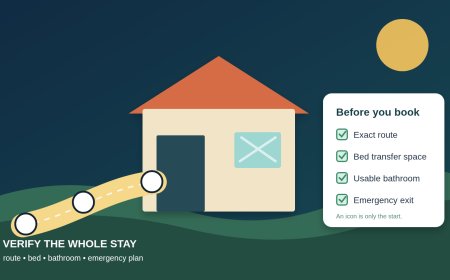
Before disconnecting utilities or hitching up, verify each item against the current official park page:
- [ ] The campground confirmation matches the correct park, campground, dates and reservation holder.
- [ ] The planned gate time is covered by a timed-entry reservation, a named campground inclusion or an outside-control-hours plan.
- [ ] The included access, if any, covers the exact corridor or road on today's route.
- [ ] Every vehicle entering has the proof the park requires.
- [ ] The entrance pass or fee is handled separately.
- [ ] Confirmations and QR codes open with the phone in airplane mode.
- [ ] The route reaches the correct entrance without an RV restriction.
- [ ] The group has a legal wait, alternate destination or later entry plan if access or parking fails.
The useful sentence at the bottom of the sheet is specific: "On this date, this vehicle may enter through this gate at this time using this document, and we still need this entrance pass." If you cannot finish that sentence, the campsite may be booked, but the park day is not ready.
Editorial note: Park access systems, controlled hours and campground exceptions can change. Recheck the official park and Recreation.gov pages for the travel date. Sources were reviewed September 25, 2026. This article does not claim firsthand gate or campground experience.
Sources
- [1] National Park Service: Summer 2026 access plans at high-visitation parks (February 18, 2026; accessed September 25, 2026).
- [2] Rocky Mountain National Park: 2026 Timed Entry Permit System (accessed September 25, 2026).
- [3] Recreation.gov: Rocky Mountain National Park Timed Entry (accessed September 25, 2026).
What's Your Reaction?