













RV toll-road planning: choose a transponder route by route
A route-by-route method for matching RV toll tags to U.S. systems, classifying trailers and toads, handling rentals and finding coverage gaps.

RV toll-road planning: choose a transponder route by route
Planning note (September 15, 2026): Toll compatibility, rates and vehicle classes change. Treat the examples below as a method, not a permanent national coverage map. Check every toll operator on your exact route shortly before travel.
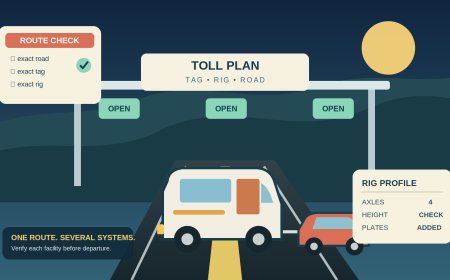
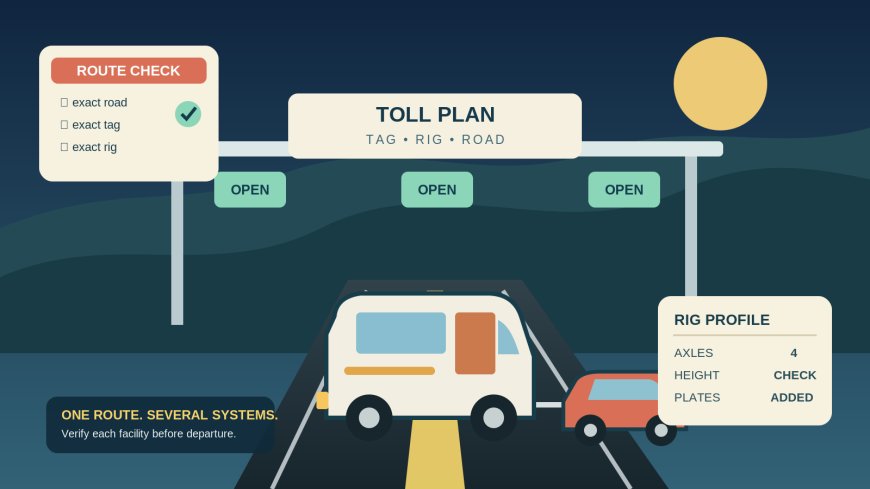
The safest way to plan tolls for a multi-state RV trip is to work by road segment, not by logo. List each toll road, bridge, tunnel and managed lane; identify its operator; confirm that operator accepts your exact transponder product; then price the connected RV configuration that will cross it. A tag that covers most of a trip can still miss one road, and a tag read successfully can still be billed at a higher class once a trailer or towed car adds axles.
Do this before choosing between a tolled route and a free alternate. The result is a short toll plan with no mystery charges hiding behind the phrase “my pass works there.”
A transponder brand is not a national guarantee
Three things often get blurred together:
- the account issuer, such as SunPass, an E-ZPass member agency or North Texas Tollway Authority;
- the transponder product attached to that account;
- the network or individual facilities where that product is accepted.
Those are not interchangeable. Florida says its portable SunPass PRO works in Florida and 23 other states, including E-ZPass locations, but its own coverage list still names exceptions such as Colorado’s Northwest Parkway. The same page says an existing non-PRO SunPass continues to work in Florida, Georgia and North Carolina.[1] Buying “a SunPass” therefore does not answer where it works; the product name matters.
A regional tag can also have uneven edges. NTTA says TollTag works throughout Texas, Oklahoma and Kansas, on most Florida and Colorado toll roads, and now on roads in Pennsylvania, Illinois, Massachusetts and North Carolina plus some Indiana roads. Its Florida section excludes some Orlando-area roads.[3] “Accepted in Florida” and “accepted on every Florida toll facility” are different claims.
No single sentence about state coverage is enough for an RV route. Verify the named road. Bridges, airport approaches, express lanes and locally operated facilities may not follow the broadest state summary.
Build a toll-segment worksheet
Start with the route you expect to drive, plus one practical alternate. Create one row for every tolled segment.
| Route field | What to record |
|---|---|
| Facility | Road, bridge, tunnel or managed-lane name |
| Operator | Agency that publishes acceptance and rates |
| Entry and exit | Interchanges, gantries or direction |
| Payment choices | Exact accepted tag, plate billing, online payment, cash or card |
| RV configuration | Motorhome alone, motorhome plus toad, tow vehicle plus trailer, or detached vehicle |
| Billing inputs | Axles, tires, measured classification height, length or weight if the operator uses them |
| Plates | Motorhome or tow vehicle, trailer, toad and rental plates as applicable |
| Estimate | Operator calculator result for the correct class and payment method |
| Fallback | Non-toll route or post-trip payment instructions |
| Verified | Date, official page and any confirmation number |
Do not write only a state name in the facility column. A trip from Texas to Florida may touch several interoperable systems and then encounter a local exception. The worksheet should expose that break before the windshield does.
For each row, ask the operator’s site a literal question: “Is this exact product accepted on this exact facility for this connected vehicle?” Save a PDF or screenshot of the answer if the trip is expensive or the rule is hard to find. Also save the customer-service number and dispute window.
Price the connected rig, not the campsite brochure length
Toll classification is a billing rule. It is not the same as the dimensions used for a campground reservation, bridge clearance or legal-size check.
The Ohio Turnpike illustrates why a traveler should collect several measurements. Its published classification method uses total axles, vehicle length including any trailer or towed vehicle, and height measured over the first two axles. For that schedule, below 7 feet 6 inches at that measurement point is “low,” while 7 feet 6 inches or more is “high.”[4]
That 7-foot-6 figure is not an RV clearance limit and should never be used as one. It only helps assign an Ohio toll class. An air conditioner farther back on the roof may determine actual travel height while having no role in that specific billing measurement.
Make a small configuration card for each way the vehicles will move:
| Configuration | Axles to verify | Other facts to keep ready |
|---|---|---|
| Motorhome alone | Motorhome axles | issuer’s registered weight/class, plate, mounting type |
| Motorhome towing a car | Motorhome plus toad axles | connected length, both plates, whether the toad carries another active tag |
| Pickup towing a travel trailer | Tow vehicle plus trailer axles | tire count if used, trailer plate, loaded or registered weight when requested |
| Truck with fifth-wheel | Truck plus fifth-wheel axles | total combination and product-specific tag assignment |
| Detached toad or tow vehicle | Only the driven vehicle’s axles | its own plate and valid payment method |
Pennsylvania’s E-ZPass manual gives an issuer-specific example. It says a camper or trailer can push a vehicle into a higher class and tells travelers to contact the other E-ZPass agency when using a different member’s road. For an RV over 15,000 pounds gross vehicle weight, the manual calls for a commercial account; at 15,000 pounds or below, it allows the RV on a personal account. It also tells customers to have weight, tire and axle information ready and warns that a separately programmed transponder may be required.[5]
Do not transfer Pennsylvania’s threshold to another issuer. The useful lesson is that network acceptance does not erase the account issuer’s vehicle rules. Ask your issuer how it wants the RV and each towing configuration registered.
Trailers and towed cars create two separate problems
The first problem is price. A two-axle motorhome becomes a four-axle combination when it pulls a two-axle car. A two-axle pickup and two-axle travel trailer also present four axles. Those combinations may share an axle count while landing in different classes where height, tire count, length or weight also matters.
The second problem is account identity. Cameras may fall back to a license plate if a tag is not read. The Pennsylvania manual says its video matching depends on the vehicle’s plate being listed on the E-ZPass account on the travel date.[5] Before departure, review every plate that might face a toll camera: motorhome, tow vehicle, trailer, toad and temporary rental plate. Then ask the issuer which belong on the account. Do not assume adding the lead vehicle automatically covers the rear plate.
A towed car needs special attention because it changes roles. While connected, it contributes axles to the combination. After it is detached at the campground, it is a separate toll vehicle. If the car has its own tag, find out what the issuer requires while it is being towed so two devices do not answer the same gantry.
NTTA explicitly tells TollTag customers not to keep both TollTag and another named regional transponder on the windshield in several interoperable markets. Its guidance is to choose the account to use and remove the other sticker.[3] Do not carry two exposed tags as “backup.” Follow both issuers’ instructions for removal, storage or disabling, especially when one product is a permanent sticker.
Rental RVs, rental tow vehicles and borrowed rigs
A rental adds another account owner to the toll chain. Before pickup, get written answers to these questions:
- Is the vehicle already enrolled in a rental-company toll program?
- Is participation automatic when a cashless toll is used, or must it be selected?
- What service or administrative fees apply in addition to tolls?
- May you use your own portable transponder?
- Must the rental plate be added to your account, and for what exact start and end times?
- Where is the rental’s built-in tag, and can it be closed or shielded according to the rental company’s instructions?
- Who handles a plate invoice that arrives after the vehicle is returned?
SunPass tells its customers to add a rental plate with the rental period’s start and end dates, then remove their portable transponder when returning the vehicle. Its rental page also warns that rental agencies and their vendors set separate programs and fees, so the rental agreement controls those costs.[2]
Do not copy a temporary plate number from memory. Photograph it at pickup, check the state and plate type, and compare the rental agreement’s vehicle identification number. Remove the plate from your toll account immediately after the authorized window ends. Leaving it attached can expose your account to another renter’s trips.
The same caution applies to a borrowed tow vehicle or a newly purchased motorhome. Permission to drive it does not prove that its plate is correctly attached to your toll account or that the owner’s tag is inactive.
Choose coverage with a gap test
Once the worksheet is complete, compare products against the actual trip. Use three columns:
- covered and confirmed: the operator lists the exact tag, and your account can hold the RV configuration;
- covered with action: acceptance exists, but you must add plates, change a vehicle class, obtain a different tag or fix the account balance;
- not covered or unresolved: the operator excludes the tag, names only “most” roads, or gives no answer for the rig.
A broad product may reduce the number of gaps. SunPass PRO’s current published list spans Florida, the E-ZPass network and several other states, but the Northwest Parkway exception proves why the final facility check still matters.[1] Likewise, NTTA’s page now lists several eastern states while preserving facility-level limits in Indiana, Florida and Colorado.[3]
If only one or two gaps remain, compare three options: the operator’s plate or online payment, a second account used without exposing two tags at once, or a free alternate route. Include administrative fees and payment deadlines, not only the posted toll. A “free” detour also has fuel, time and campground-arrival costs, but those belong in the route choice, not in the transponder compatibility column.
Prepare the account before the RV moves
Complete this check several days before departure:
- confirm the transponder status and mounting instructions for the RV windshield or exterior location;
- update the payment card and turn on balance alerts;
- register the correct vehicles and plates for the travel dates;
- confirm personal versus commercial account requirements;
- record the intended connected configuration for each toll segment;
- remove or properly store competing tags according to issuer instructions;
- download the operator’s toll estimate and payment fallback;
- save account numbers separately from the visible transponder.
Mounting is not cosmetic. Pennsylvania warns that an incorrectly mounted unit may not read and can lead to additional charges. Its manual also notes that some vehicles need an exterior tag and that vehicle features can require manufacturer-specific placement advice.[5] RV windshields with unusual construction, tint bands or large overhangs deserve an issuer check before the first gantry.
Avoid opening or changing an account on departure morning. Pennsylvania says payments may need up to 48 hours before they are usable at another E-ZPass agency.[5] Other issuers set their own activation and update timing, so verify yours rather than assuming an instant network-wide change.
Audit transactions while details are fresh
Check the account after the first tolled segment, then again after any trailer connection, vehicle swap or state-system change. Match each transaction to the worksheet:
- facility and direction;
- date and time;
- axle or vehicle class;
- transponder versus plate read;
- expected rate type;
- duplicate or missing charge.
A transaction posting successfully does not prove it used the right class. Flag a passenger-car rate on a connected RV combination just as quickly as an overcharge; either can signal stale vehicle data or an incomplete read.
Keep the rental agreement, plate photos, hookup dates and campground receipts until the final transactions have posted. If a charge is wrong, use the issuing agency’s dispute process and attach the worksheet evidence. Do not wait for a paper notice to remind you which configuration crossed a gantry two weeks earlier.
The one-page departure decision
Condense the plan to one line per toll system:
Facility — tag/account — connected configuration — expected class — plates verified — fallback — last checked.
If any line still says “probably accepted,” treat it as a gap. Toll systems are interoperable in large regions, but RV billing remains tied to the specific product, operator and vehicle that pass under the reader.
This guide was researched from official SunPass, North Texas Tollway Authority, Ohio Turnpike and Pennsylvania Turnpike materials. The agencies remain the source of truth for current acceptance, classes, rates and account rules.
Sources
- SunPass PRO (official page archived August 24, 2026; live automated retrieval was blocked)
- Paying for tolls in a rental vehicle (official live-page search extract retrieved September 15, 2026; recheck rental terms)
- Plan Your Trip
- Ohio Turnpike 2025 Schedule of Tolls and Vehicle Classification
- Pennsylvania Turnpike E-ZPass User's Manual
What's Your Reaction?