







Planning an en-route RV propane refill without a dead-end detour
Identify your RV's propane container, call the station with the right details, confirm rig access and attendant availability, and time the refill without a dead-end detour.

By Romana | September 24, 2026 | RV Camping
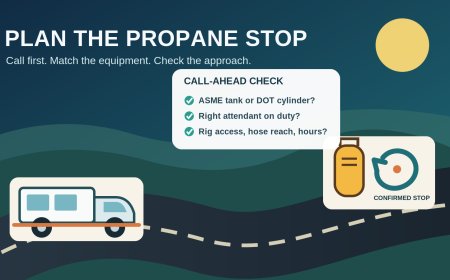
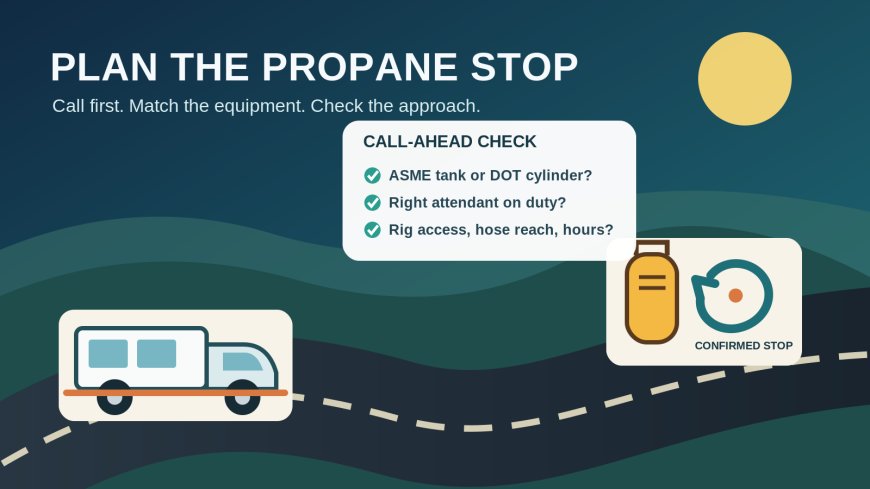
The safest propane stop is one you have confirmed before you leave the highway. First identify what the RV carries: a permanently mounted ASME tank that must arrive with the motorhome, or removable DOT cylinders that travel as secured cargo. Then call the actual location, not a chain's national number, and verify that the site fills that container type, an appropriately trained attendant will be there, and your full rig can reach the hose and get out again.
A map pin marked "propane" does not answer any of those questions. It may point to an exchange cage, an autogas dispenser, a cylinder-only counter, or a yard that can fill motorhome tanks but cannot fit your motorhome.
Identify the container before searching
Motorhomes commonly have a horizontal propane tank fastened to the frame. That is usually an ASME tank. It stays on the vehicle and is filled through an exterior connection. Winnebago's 2026 Solis manual, for example, describes its tank as permanently mounted and says the motorhome must go to a propane dealership for filling; owners should not try to remove it.[4]
Travel trailers and fifth-wheels commonly carry removable DOT cylinders. PERC's dispenser manual describes DOT cylinders as portable containers used on many RVs, while its separate motorhome module covers vehicle-mounted ASME tanks.[1] The distinction changes the entire stop:
| What you have | What moves to the dispenser | What to confirm |
|---|---|---|
| Permanently mounted ASME tank | The motorhome | The station fills motorhome/vehicle-mounted ASME tanks, has the correct connection and hose reach, and can admit the complete vehicle |
| Removable DOT cylinder | The cylinder, secured for transport | The station fills that cylinder size and service type; if not, whether it offers a compatible exchange |
| Unsure | Nothing yet | Send the operator a clear photo of the container, data plate or collar markings, valve area, and how it is mounted |
Do not call every propane container a "tank" and expect the counter staff to infer the rest. Say "permanently mounted motorhome ASME tank" or "removable 30-pound DOT cylinder." PERC trains these as different dispensing applications, and its motorhome course requires specific preparation beyond the small-cylinder material.[1]
This is a routing guide, not another cylinder inspection lesson. A DOT cylinder still has to be in qualification and acceptable to the filler. PHMSA says an overdue cylinder must not be refilled.[3] Check the date and condition before building a travel day around one location, but leave the fill/no-fill decision to the operator.
Build a shortlist, then qualify each stop
Use a propane locator, the campground office, an RV dealer, or a local propane supplier to create two or three candidates. PERC provides a refueling locator, but its own consumer direction is to contact the local supplier for refill or exchange information.[5] Treat directory entries as leads rather than promises.
Screen candidates in this order:
- Container capability. Does this exact location fill mounted ASME motorhome tanks, removable DOT cylinders, or both? An exchange cage is not a refill station. An autogas pump is not proof that the operator fills an RV appliance-supply tank.
- Attendant availability. Ask when the person who performs that fill will be on duty. OSHA requires a competent attendant to remain at the dispenser while LP-Gas is transferred into a vehicle fuel container.[6] PERC's training likewise separates small-cylinder and motorhome/ASME work.[1] A store can be open while propane service is unavailable.
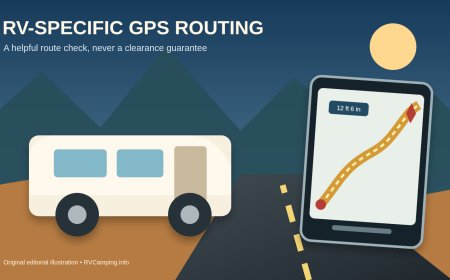
- Physical access. Give the RV's actual length, height, width, and whether a car or trailer is attached. Ask about the entrance, turning room, overhead clearance, grade, hose reach, exit path, and whether backing is required.
- Fill-side alignment. Tell the operator which side of the RV holds the fill port and roughly where it sits between the axles. "Passenger side, just behind the rear axle" is more useful than "underneath."
- Operating window. Confirm propane-service hours, last-fill time, lunch closures, appointment rules, and likely wait. Ask whether high wind, lightning, extreme heat, delivery activity, or staffing can suspend service.
- Payment and minimums. Ask how the location bills, what payment it accepts, and whether a minimum charge applies. The answer affects budgeting, not the safety decision.
For a large motorhome, look at satellite imagery only after the call. It can reveal a median, narrow gate, canopy, or one-way yard, but an old image cannot confirm today's construction, parked delivery trucks, hose location, or site policy. The operator gets the final word.
Use this call-ahead worksheet
Copy this into your trip notes and complete one sheet for each candidate. Do not mark a stop "confirmed" until a named employee or the location's dispatch desk answers the equipment and access questions.
Your RV and container
- RV type: ________
- Overall length, including attached toad/trailer: ________
- Height / width: ________
- Propane setup: mounted ASME tank / removable DOT cylinder / unsure
- Capacity or cylinder size: ________
- Fill connection location: driver side / passenger side / rear; position: ________
- Can the toad or trailer be disconnected before arrival? yes / no
- Owner-manual travel valve instruction checked? yes / no
- Any odor, hissing, visible damage, alarm, or known system fault? yes / no
If yes, this is not a routine refill trip. Stop and contact emergency services or a qualified propane/RV service provider from a safe location.
Questions for the station
- "Do you refill a [mounted motorhome ASME tank / removable ___-lb DOT cylinder] at this location?"
- "Will an operator qualified for that type be on duty on [day] around [time]?"
- "What is the latest time you will start a propane fill?"
- "My rig is [length] long, [height] high, and the fill port is on the [side/location]. Can I reach the hose and leave without entering a low canopy or making an unsafe turn?"
- "Should I enter from [road/driveway], and where should I wait before the attendant signals me forward?"
- "Must I disconnect my toad or trailer? If so, where may I do that?"
- "Do you require every person and pet to leave the RV during the fill? Where should they wait?"
- "Do you fill by appointment, first come, or only during set propane hours?"
- "If service is unavailable when I arrive, which nearby location handles this same container type?"
Confirmation record
- Business and exact branch: ________
- Street address and entrance: ________
- Phone: ________
- Employee/dispatcher: ________
- Date and time called: ________
- Confirmed service window: ________
- Access instructions: ________
- Backup stop: ________
Call again on the travel day if the stop is remote, weather is poor, you are arriving near closing, or the first conversation depended on one employee's schedule.
Plan the approach before the attendant touches the hose
Choose a stop before the tank is nearly empty. A half-day margin lets you use the backup without losing heat, hot water, or cooking at the next campsite. In cold weather, on a holiday weekend, or before a long no-service stretch, move the refill earlier. The useful number is not distance to the nearest map pin; it is distance to the nearest confirmed, accessible fill during staffed hours.
Arrive with enough time to follow the site's directions rather than squeezing in at closing. Park in the designated waiting spot, set the brake, and keep clear of the transfer area until the attendant directs you. Do not nose into a fenced dispenser, move cones, or stretch a hose route yourself.
For a mounted tank, know how to shut down every propane appliance and igniter before arrival. PERC's motorhome procedure says no one should remain in the vehicle, the ignition should be off, and appliance pilots and electronic ignition systems should be off before filling.[1] Winnebago gives the same appliance-and-igniter warning for refueling.[4] Turn off the generator too if the operator or owner manual requires it, and follow the site's directions about battery disconnects, doors, and passenger waiting areas.
The attendant may refuse the fill after inspecting the tank, valves, hose, markings, or data plate. PERC's motorhome material tells operators not to fill a damaged vehicle-mounted tank or one with a missing or illegible ASME data plate.[1] A confirmed appointment confirms capability and access, not acceptance of the container.
Set the valve state for the trip, not from folklore
The correct pre-trip instruction comes from the manual for the exact RV and installed system. Do not copy a forum rule from a different coach. Winnebago's 2026 Solis manual says to turn off its main tank shutoff switch for travel and warns that some roadways and tunnels restrict vehicles carrying propane.[4] If your manual says to close the supply for travel, do it before moving. Also check tunnel, ferry, bridge, and local restrictions on the planned route.
A detached DOT cylinder has a clearer cargo rule. PERC says to close the valve whenever the cylinder is disconnected and brace the cylinder upright against tipping or rolling. Keep it out of the passenger space if possible.[2] Make the refill run without extra stops, then take the cylinder out of the vehicle as soon as you reach the unloading point. Never transport a leaking cylinder.[2]
That means a cylinder refill should be the last errand before unloading or reinstalling it, not the first stop in an afternoon of groceries and sightseeing. Keep the cylinder in the orientation intended by its design and use the RV's approved rack and restraint when it returns to service. Do not improvise a passenger-compartment storage spot.
Leave with a clean handoff
Before moving, wait for the attendant to finish the post-fill check, replace protective parts, and release the vehicle. Confirm that the fill-area door is latched, loose cylinders are back in their approved restraints, and everyone is clear. Ask the attendant whether the main supply valve or switch was left open or closed; set it only as your owner manual directs.
Record the gallons or pounds added, odometer, date, gauge reading after the fill, and any refusal or service note. That small log helps you choose the next stop earlier and tells you which branch truly handled your setup.
A reliable en-route propane plan has two confirmed options, a truthful description of the equipment, and enough schedule margin to walk away. The refill itself belongs to the attendant. Your job is to arrive at the right dispenser, from the right direction, with the RV and propane system ready for a safe transfer.
Sources
What's Your Reaction?