























Taking an RV on Washington State Ferries: the booking, fare and propane worksheet
Plan a Washington State Ferries RV crossing by separating the vehicle reservation, length-and-height fare, propane limits and terminal check-in deadline.

Taking an RV on Washington State Ferries: the booking, fare and propane worksheet
An RV ferry crossing gets expensive and stressful when three different questions are treated as one. A reservation holds vehicle space on only two parts of the Washington State Ferries system. A ticket pays the fare. Fuel rules decide whether the propane and gasoline you carry can board. Work those questions separately, then join the answers into one travel-day plan.
This guide is specific to Washington State Ferries (WSF), not county ferries or private operators. It was checked against WSF's official rider, ticket and reservation pages on October 16, 2026.
Start with the route, because most WSF routes do not take reservations
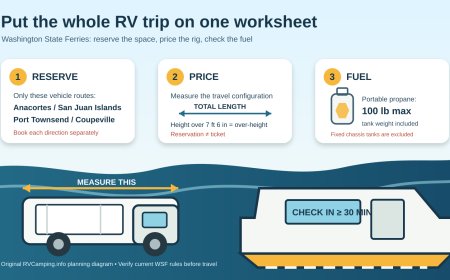
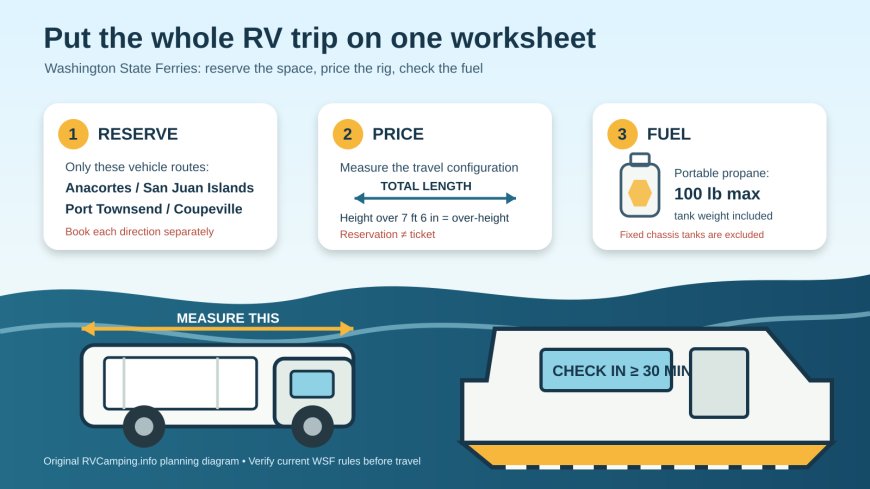
WSF limits vehicle reservations to two corridors. One is Anacortes/San Juan Islands; the other is Port Townsend/Coupeville. The San Juan reservation routes serve Friday Harbor, Orcas, Shaw and Lopez. Every other WSF route uses a vehicle line rather than a reserved vehicle space.[2][4]
That distinction changes the plan:
- Anacortes/San Juan Islands or Port Townsend/Coupeville: search for a vehicle reservation in each direction, then build the rest of the trip around its check-in window.
- Any other WSF route: check the schedule, fare and terminal conditions, but do not waste time hunting for a reservation that WSF does not offer.
- Lopez or Shaw eastbound to Anacortes: the reservation page says those specific return movements do not take vehicle reservations; vehicles load first-come, first-served.[4]
A reservation is one-way. An out-and-back RV trip therefore needs two reservation decisions, not one. WSF also warns that stand-by room is limited and may require waiting for a later sailing.[4]
A dated booking note for late 2026
As of October 16, WSF's reservation page says bookings are open through December 26, 2026, and winter-season reservations are scheduled to open October 27 at 10 a.m. Pacific. It also flags some unavailable Orcas and Lopez dates in February and March 2027 due to vehicle-transfer-span construction.[4] Treat that as a dated planning lead, not a permanent calendar. Recheck the reservation page before choosing campground nights.
For Anacortes/San Juan Islands sailings, WSF normally releases space in phases. Its current page says 90 percent of tall, non-standard vehicle space, the category that includes RVs, is released when the season first opens. Standard-vehicle space follows a different staged pattern.[4] An RVer who waits for the later standard-car releases may be waiting for inventory that was largely offered earlier. If a sailing appears full, keep checking for changes and cancellations, but make the campground cancellation deadline part of that decision.
Measure the travel configuration, not the RV brochure
WSF bases vehicle fares on length, height and width. A standard vehicle is under 22 feet. At 22 feet and longer, the fare moves into length-based categories and increases with length and height; anything being towed counts. WSF treats vehicles over 7 feet 6 inches tall as over-height.[3]
For a motorhome, record the bumper-to-bumper travel length. For a truck and trailer, record the entire connected combination. Include anything that changes the travel envelope: hitch-mounted bike rack, rear cargo tray, front carrier, spare-tire rack or a towed car. Do not use the trailer model number as a measurement.
Make a simple rig card and keep it with the reservation confirmation:
- total connected length in feet and inches;
- maximum travel height, including fixed rooftop equipment;
- widest fixed point;
- whether the rig has low ground clearance;
- number and type of portable fuel containers;
- reservation confirmation number for each direction.
Width and clearance can move a rig out of ordinary handling. Once a vehicle's width exceeds 8 feet 6 inches, WSF charges twice the applicable length fare. Its oversized-travel process is required for vehicles wider than 8 feet 6 inches, taller than 13 feet 4 inches, heavier than 80,000 pounds GVW, or with less than 14 inches of ground clearance. WSF asks for two business days to process that request.[2] Few conventional camping rigs approach the weight threshold, but wide slide-topper hardware, unusual conversions and low-slung trailers make the tape measure more reliable than assumptions.
Build the fare estimate in layers
A vehicle reservation does not include a ferry ticket. It saves vehicle space; the fare is still purchased separately.[4] For an RV budget, price these layers:
- Vehicle and driver: choose the route, date, direction, actual connected length and over-height status.
- Additional adult passengers: add everyone riding in the vehicle who is not included as the driver.
- Direction rules: most vehicle-and-driver tickets are one-way. The exceptions WSF lists are the San Juan runs from Anacortes plus Fauntleroy/Vashon, Southworth/Vashon and Point Defiance/Tahlequah.[3]
- Season and payment: WSF applies a peak-season surcharge to full-fare vehicles and drivers from May 1 through September 30. Starting March 1, 2026, credit and debit card purchases carry a 3 percent cost-recovery fee.[3]
The cleanest budget record is a screenshot or note from WSF's fare calculator for the actual date and direction. Do not carry a remembered car fare into the RV column. Tickets in the 22-foot-and-longer category are not sold online, according to WSF, so plan to pay at the tollbooth or to an attendant.[3]
Children and youth under 19 ride free when they are passengers, but a teenager driving a vehicle pays the adult vehicle-and-driver fare. Reduced passenger fares for eligible seniors and riders with disabilities require in-person purchase and proof of eligibility.[3] Those details matter in a family fare estimate even though they do not change the RV's length class.
Treat the propane rule as a weight rule
WSF permits propane tanks with restrictions. The total weight of portable propane tanks, including the tanks themselves, may not exceed 100 pounds. WSF's example says two nominal 20-pound propane tanks weigh about 76 pounds in total. Permanently installed tanks fixed to the vehicle frame or chassis do not count toward that portable-tank limit.[1]
"Twenty-pound cylinder" describes propane capacity, not the cylinder's full carried weight. Count the actual cylinders and their total gross weight rather than adding only the propane labels. If you carry a grill cylinder, spare cylinder or another portable tank, it belongs in the same tally.
The mixed-fuel rule deserves its own line on the worksheet. When a vehicle carries both propane tanks and gasoline containers, WSF limits the combined amount to 12 gallons of water capacity.[1] That phrasing is the operator's rule. If your combination is unusual or the cylinder markings are unclear, contact WSF Customer Service before travel rather than trying to convert labels at the terminal.
Gasoline for a camp stove, lantern or generator must travel in the vehicle. WSF allows no more than two portable containers with a maximum capacity of six gallons each. Each must be red, sound, fitted with a non-spill spout, and approved by either UL or the U.S. Coast Guard. Quick-pour containers are not allowed.[1]
Before leaving camp, secure portable cylinders upright in the RV's designed storage area or another code-compliant mounting location. Close appliance flames and follow the RV manufacturer's travel instructions. The WSF page supplies boarding limits, not a substitute for the cylinder, appliance and RV manuals.
Protect the reservation at the tollbooth
WSF recommends arriving 30 to 45 minutes before a Port Townsend/Coupeville reservation and 45 to 60 minutes before an Anacortes/San Juan Islands reservation. The hard check-in point is at least 30 minutes before the reserved sailing. A late check-in loses the reserved space and moves the vehicle to stand-by.[4]
That means "terminal arrival" should mean checked in with the tollbooth or attendant, not entering the access road. A long RV line, a fuel stop, traffic through Anacortes or a slow campground departure can consume the margin. Set two times in the trip plan:
- target at the terminal entrance: early enough to absorb a queue;
- latest completed check-in: 30 minutes before sailing.
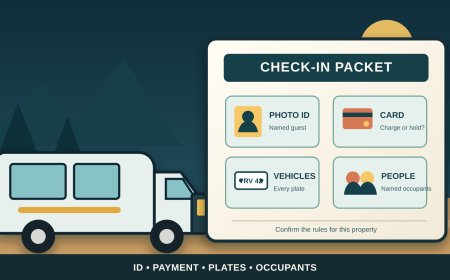
Bring the mobile or printed barcode, or the confirmation number. There is no separate pre-tollbooth reservation line; reservation holders move to holding lanes after the tollbooths.[4]
If plans change, WSF says to change or cancel by 5 p.m. Pacific on the previous day; missing that deadline can lead to a no-show fee. One final change is allowed after that cutoff, but cancellation after that final change triggers the fee. No changes or cancellations are accepted within two hours of sailing. Roundtrip travelers must handle both one-way reservations.[4]
A five-minute RV ferry audit
Run this audit before locking in island campground nights:
- Confirm that the route actually accepts reservations.
- Measure the complete travel configuration and book the matching length and height.
- Save separate outbound and return confirmations where reservations apply.
- Price the vehicle, driver and passengers with the official fare calculator for the travel date.
- Count portable propane by gross cylinder weight; list gasoline containers separately.
- Check for an oversized-travel request based on width, height, clearance or weight.
- Put the target arrival and the 30-minute check-in cutoff in the day's route plan.
- Keep a stand-by or campground-change plan for service disruption.
The useful document is not just a reservation email. It is a one-page trip record that shows the rig dimensions used, what fuel is aboard, what the fare estimate includes, and when the tollbooth check-in must be complete. That record gives the driver something concrete to verify before the RV leaves the campsite.
Sources
- Washington State Ferries: What you can bring aboard — portable propane, mixed-fuel and gasoline-container restrictions; retrieved October 16, 2026.
- Washington State Ferries: Commercial and oversized vehicles on ferries — reservation routes, length-based fares and special-arrangement thresholds; retrieved October 16, 2026.
- Washington State Ferries: Ticket information — vehicle fare classes, direction rules, peak surcharge and card fee; retrieved October 16, 2026.
- Washington State Ferries Vehicle Reservations — release timing, one-way reservations, arrival windows, check-in and change rules; retrieved October 16, 2026.
What's Your Reaction?