























Big Meadows or Loft Mountain? A late-season RV comparison for Shenandoah
Compare Big Meadows and Loft Mountain for an RV stay in Shenandoah, including 2026 closing dates, reservations, dry-camping services, generators, and exact-site fit.

By Romana
Big Meadows is the safer choice for most first-time Shenandoah RV trips. It stays open later in 2026, puts the central district's visitor services and trail network close by, and allows you to reserve a specific site rather than gamble on arrival. Loft Mountain makes more sense when the south district is the trip, you are approaching from Rockfish Gap or Swift Run Gap, or you want a chance at a first-come site.
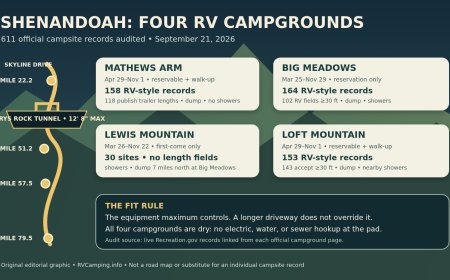
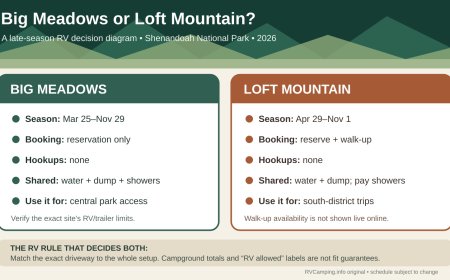
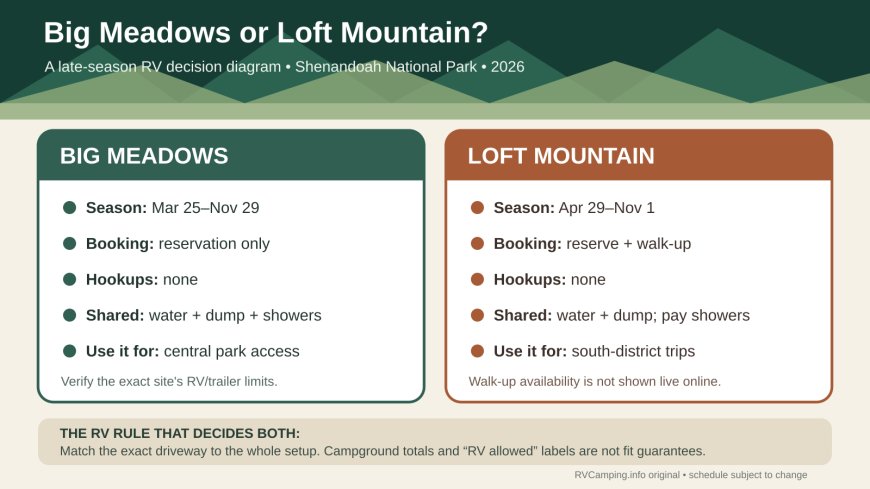
The late-season calendar separates them sharply. Shenandoah's current operating table lists Loft Mountain Campground and its campstore closing November 1. Big Meadows Campground, the nearby wayside, and Big Meadows Lodge are scheduled through November 29.[1] Those dates were published after an earlier RVCamping.info three-campground guide noted that 2026 closing dates were still undetermined. They are the material update behind this two-campground comparison.
Both campgrounds are dry: no campsite hookups, but each has a dump station and potable-water fill. Both require an exact-site fit check. “RV accepted” does not mean every driveway can hold every motorhome, trailer, tow vehicle, slide, or rear rack.
The short answer
Choose Big Meadows for a central park base, a guaranteed reservation, nearby lodge/wayside/visitor-center services, and a camping season that extends four weeks beyond Loft Mountain's scheduled closing. It is also the simpler choice if you do not want a first-come arrival plan.
Choose Loft Mountain for a south-district itinerary, especially if most of your hiking starts around Big Run or the southern end of Skyline Drive. Loft also keeps some first-come inventory, but the official listing warns that walk-up sites commonly disappear on weekends and are seldom open by Saturday.[4]
Neither is a hookup campground. Recreation.gov lists potable-water dump/fill facilities at both, flush toilets at both, showers at Big Meadows, and pay showers near Loft Mountain's campstore.[3][4]
At-a-glance RV decision table
| Decision | Big Meadows | Loft Mountain |
|---|---|---|
| Skyline Drive location | Mile 51.2, central district | Around mile 79.5–80, south district |
| 2026 campground dates | March 25–November 29 | April 29–November 1 |
| Booking model | Reservation only | Reservable plus first-come sites |
| RV hookups | None | None |
| Dump and potable water | Available | Available |
| Toilets and showers | Flush toilets; showers listed | Flush toilets; pay showers by the campstore |
| Generator baseline | Morning 8–10; afternoon 4–7; generator-free areas exist | Morning 8–10; afternoon 4–7; 60 dB limit |
| Best use | First visit, central hikes, later fall stays | South-district trip, southern approach, calculated walk-up attempt |
| Biggest planning trap | Reserving the wrong equipment size or following GPS toward Tanners Ridge Road | Treating first-come inventory as guaranteed or arriving after the campstore closes |
Operating dates can change, and Skyline Drive may close in bad weather even though the park itself remains open.[1] A reservation protects a campsite, not the driving conditions needed to reach it.
Why Big Meadows works better for most first visits
Big Meadows sits near the park's middle. Recreation.gov places Byrd Visitor Center about a mile away by trail or sidewalk, Big Meadows Lodge roughly a five-minute walk from camp, and the wayside beside the visitor center.[3] That cluster matters in an RV because every errand that can be done without moving the rig is useful.
Its reservation-only model removes one major uncertainty. NPS says reservable sites at Big Meadows and Loft Mountain are released in stages: half at six months, another quarter two weeks before arrival, and the last quarter four days before arrival.[2] A full-looking calendar six months out is therefore not necessarily the final word. Set reminders for the later releases rather than repeatedly refreshing at random.
Big Meadows is not a full-service RV park. There are no electrical, water, or sewer connections at the pad. Recreation.gov lists a common dump/fill station and potable water, while the campground's facility summary includes flush toilets and showers.[3] Campers still need a battery plan and enough fresh- and waste-water capacity to reach the service point without turning every day into a pack-up day.
The exact reservation controls rig fit. Recreation.gov tells campers to read each site's equipment guidance and distinguishes a self-propelled RV from any camping unit towed by another vehicle. Its trailer-length fields assume room for a tow vehicle up to 20 feet on the site driveway; longer trailers may force the tow vehicle to overflow parking.[3] Entering a fifth-wheel as an “RV” can filter the wrong inventory and produce a reservation that does not match the setup.
Arrival routing is another Big Meadows-specific concern. The official listing says not to use Tanners Ridge Road and directs campers to a signed Shenandoah entrance before joining Skyline Drive.[3] Save the intended entrance in the route, not just the campground pin.
When Loft Mountain is the better RV base
Loft Mountain is on Big Flat Mountain near mile 80. From Rockfish Gap, the official route runs roughly 25 miles north; from Swift Run Gap, it runs roughly 15 miles south.[4] For a trip built around the southern district, that geography can save substantial Skyline Drive time compared with returning to Big Meadows after every outing.
The campground has 207 sites in the official Recreation.gov summary, with flush toilets, water and dump facilities, and pay showers near the campstore.[4] As at Big Meadows, “water” means a shared facility, not a spigot at the RV. The listing states plainly that there are no RV hookups.[4]
Loft's mixed booking model gives flexible travelers another path. Some sites can be reserved, while others are claimed in person. The campground warns that online inventory shows the size of the walk-up pool, not live occupancy, because internet service at the campground is unreliable. Staff cannot hold those sites, and the camper must be present to occupy one.[4]
That makes a Friday-evening walk-up attempt weak, especially during fall color. If you use this strategy, arrive with enough daylight to inspect the driveway and a legal outside-the-park backup. NPS prohibits sleeping in an RV at overlooks, trailheads, or other parking areas. When park campgrounds are closed or full, vehicle campers must stay at a campground outside Shenandoah.[2]
Loft also loses services sooner this fall. The campground and campstore are scheduled to close November 1, while the Loft Mountain Wayside is listed through November 8.[1] Do not infer that an open wayside means the campground is still operating.
Dry-camping reality: neither site wins on power
For RV systems, the two campgrounds are more alike than different. Both are nonelectric. Both have shared potable water and a dump station. Recreation.gov permits generators during a morning window from 8 to 10 and an afternoon window from 4 to 7; Big Meadows also marks some areas generator-free, and Loft Mountain states a 60-decibel ceiling.[3][4]
Build the power plan before choosing a loop:
- Estimate the overnight load for furnace controls, lights, water pump, refrigerator electronics, fans, device charging, and any medical equipment.
- Reject a generator-free site if the stay depends on generator charging.
- Assume the generator will be unavailable outside the posted windows, even if batteries run low.
- Check propane before entering the park. Big Meadows' listing says there is no propane refill in the park.[3]
- Keep generator exhaust away from neighboring windows, doors, tents, and occupied areas; a legal hour does not make a poor exhaust position safe.
Late October can make the furnace, battery state, and propane supply more important than the shower location. A rig that needs shore power for safe occupancy is a poor match for either campground.
How to book the exact site, not the campground name
Campground totals do not tell you whether one driveway fits your equipment. Use this sequence:
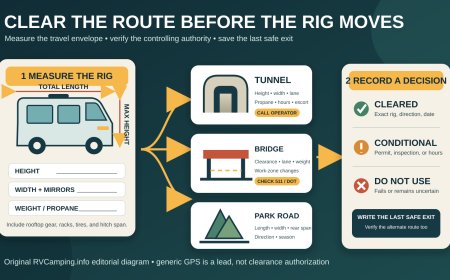
- Measure the motorhome or trailer in travel configuration, including hitch gear, spare tire, bike rack, cargo tray, and anything mounted at the rear.
- For a towable, record trailer length and the full connected combination separately.
- Filter by the correct Recreation.gov equipment type. A motorhome is an RV; a travel trailer or fifth-wheel belongs in the trailer category.[3]
- Open the individual site record and check its maximum equipment length, driveway type, surface, grade, and whether the listing is tent-only.
- Sketch the parked rig with slides, steps, awning, tow vehicle or toad, and a clear traffic lane.
- Save the reservation details offline. Cell service is limited, and Loft warns that campground internet is unreliable.[3][4]
Do not reserve a short site on the theory that staff can move you. Big Meadows says only the selected site is guaranteed, and changes depend on available inventory.[3]
A late-season departure check
Two days before the trip, confirm five items:
- The campground's operating date and the dates for the services you plan to use. NPS marks the schedule as subject to change.[1]
- Skyline Drive status and the forecast. Severe weather can close sections of the road.[1]
- The reservation record, exact site number, and equipment entry.
- Freshwater, holding-tank, battery, generator-fuel, and propane status.
- A legal backup outside the park, particularly for a Loft Mountain walk-up attempt.
On October 16, both campgrounds are inside their published 2026 seasons. That does not mean every service remains constant, every road stays open, or every first-come site is available. Check the live NPS alerts and Recreation.gov record again on departure day.
Bottom line
Big Meadows is the better default for an RV camper choosing between these two. It combines central geography, nearby services, reservation certainty, and a 2026 season scheduled through November 29.[1][2][3]
Loft Mountain wins when the southern park is the actual destination or when a flexible traveler wants to try for a walk-up site. Its shorter 2026 season, limited live availability information, and campground-specific arrival gamble make it less forgiving.[1][4]
The final choice is still site-specific. Neither campground has hookups, and neither campground name guarantees room for the whole setup. Pick the district first, then verify the exact driveway against the RV as it will arrive.
Sources
- National Park Service: Operating Dates & Hours — 2026 facility schedule; accessed October 16, 2026.
- National Park Service: Campground Reservations — booking release pattern, walk-up guidance, and prohibition on vehicle boondocking; accessed October 16, 2026.
- Recreation.gov: Big Meadows Campground — facilities, equipment-entry rules, generator schedule, and routing notes; accessed October 16, 2026.
- Recreation.gov: Loft Mountain Campground — facilities, walk-up policy, generator schedule, and access notes; accessed October 16, 2026.
What's Your Reaction?