























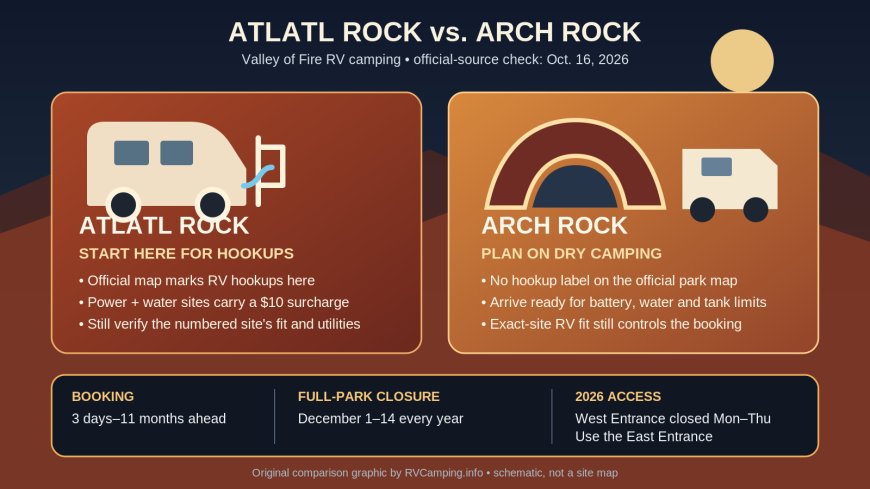
Atlatl Rock vs. Arch Rock: the Valley of Fire RV choice in 2026
Compare Valley of Fire's Atlatl Rock and Arch Rock campgrounds for RV hookups, dry camping, site fit, reservations, fees, and current 2026 access closures.

By Romana
Atlatl Rock and Arch Rock share the same red-rock corner of Valley of Fire State Park, but they are not equal choices for an RV. Atlatl Rock is the practical first choice when shore power or a water hookup matters. Arch Rock is the dry-camping alternative, and its value depends on whether the exact reservable site fits the RV without forcing the trip into a hookup-dependent plan.
There is also a date that can overrule the whole comparison: Valley of Fire closes to everyone every year from December 1 through December 14. Camping reservations are unavailable during that maintenance closure.[1] A December trip must end by November 30 or begin December 15 at the earliest, subject to the reservation calendar.
Status check: October 16, 2026. The official park page currently describes two campgrounds and sends campers to reservations; it does not post a campground-specific closure for Atlatl Rock or Arch Rock.[1] That is not proof of a vacancy or proof that every utility is operating. Check the live Reserve Nevada inventory for the exact dates and site before driving in.
The short answer
| If this describes your trip | Better starting choice | Why | What still needs confirmation |
|---|---|---|---|
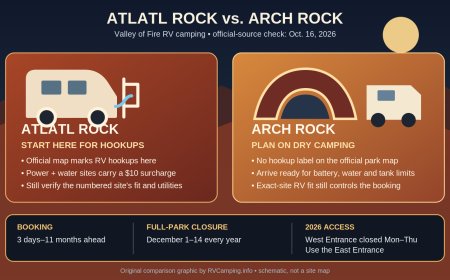
| You need power and water at the campsite | Atlatl Rock hookup inventory | The official park map identifies RV hookups at Atlatl Rock, and the park confirms that power-and-water RV sites exist.[1][5] | The exact site's utility type, length, parking, and availability |
| You can dry camp and prefer a non-hookup site | Arch Rock | It avoids paying the utility surcharge and keeps the trip simple if the battery, water, and tanks are ready | The exact site's vehicle limit and whether the booking system accepts your equipment |
| Your RV is long, tall, or has several slides | Whichever exact listing fits, usually start with Atlatl | Campground names do not establish clearance or pad dimensions | Site-specific dimensions and photos in Reserve Nevada |
| You will arrive inside 72 hours | An unreserved site, if staff confirms one | Online reservations normally stop three days before arrival | Same-day inventory is only one night at a time and is not guaranteed.[2] |
| Your dates touch December 1–14 | Neither | The entire park is closed for annual maintenance.[1] | Move the stay outside the closure |
What the official material proves, and what it does not
Nevada State Parks says Valley of Fire has two campgrounds. The current park page reports 72 combined units, while the 2025 official brochure says 73 sites.[1][5] That one-site discrepancy is a warning against building a trip around a remembered total. The live reservation listing is the controlling place to see which numbered sites are offered for the dates you need.
The official map is clearer about utilities. It marks RV hookups at Atlatl Rock Campground, while Arch Rock is shown as a separate campground without that hookup label.[5] The park page separately confirms that some RV sites have both electrical and water connections, and it lists a $10 nightly utility-site surcharge.[1] Taken together, those records support a narrow conclusion: choose from Atlatl's hookup inventory when the RV needs campground power or water. They do not support assuming that every Atlatl site has hookups.
The same caution applies to Arch Rock. The official sources reviewed for this comparison do not publish one campground-wide maximum RV length. Do not turn an absence of hookups into an assumption that an exact Arch Rock site is tent-only, and do not turn the word "campground" into permission for a 40-foot coach. Enter the actual RV or trailer type in Reserve Nevada, open the numbered site's details, and compare the listed parking limit with the rig in travel configuration.
Atlatl Rock: the easier RV systems choice
Atlatl Rock should be first on the screen for an RVer who needs external power, wants to refill through an assigned water connection, or does not want to make battery capacity the main trip constraint. The park's utility-site fee is $10 on top of the nightly camping charge.[1] On the rates posted October 16, that makes a utility site $30 per night for a Nevada vehicle or $35 for a non-Nevada vehicle, before the reservation transaction fee.[1][2]
That arithmetic is useful, but it is not a quote for every checkout. The reservation policy adds a nonrefundable $5 transaction fee per reservation, and the booking screen is where the complete total should be checked before payment.[2]
Atlatl also has the operational facilities that matter after several dry nights. Nevada State Parks says the park has showers and a dump station, and its official map associates showers and RV camping with the Atlatl campground area.[1][5] Treat those as shared facilities, not campsite hookups. A dump station can close for maintenance, and a shower building does not solve a full gray tank at 10 p.m. Arrive with enough capacity to get through the first night even if a shared facility is temporarily unavailable.
Atlatl is not automatically the best site for every RV. A hookup pedestal does not prove that the parking spur is long enough, level enough, or clear of sandstone for a slide and awning. Confirm the numbered site's allowed equipment, parking length, back-in geometry, and utility description. If the listing does not answer a clearance question, call the park at the number on the official page before reserving.[1]
Arch Rock: choose it as a dry site, not a cheaper Atlatl
Arch Rock makes sense for an RV that can camp without a pedestal and does not need to use the site as a service stop. Start the stay with the freshwater tank at the level you need, the gray and black tanks ready, the house battery charged, and a realistic energy plan for overnight furnace use.
The distinction matters even on a short stay. A propane furnace still needs 12-volt power for its blower and controls. Lights, a water pump, vent fans, device charging, and an inverter can turn a two-night booking into an early departure when the battery plan was only "we will conserve." Arch Rock is a good choice only when dry camping is a deliberate setup.
The official park page says campsites have shaded tables, grills, water, and restrooms.[1] Read "water" as a campground amenity unless the exact site listing explicitly promises a connection. The same page separately identifies power-and-water RV hookup sites and charges extra for them.[1] A shared spigot is not permission to run a hose across a road, and it is not a substitute for arriving with potable water.
Arch Rock can still work for an RV. The safe booking test is site-specific:
- Select RV, trailer, or camper van as the equipment type rather than reserving under a tent profile.
- Compare the site's stated parking length with the full vehicle that must occupy it.
- Check whether the tow vehicle stays on the same spur and whether an extra vehicle fee applies.
- Look for obstacles where slides, steps, doors, and the awning would deploy.
- Reject the site if the listing is silent and the park cannot confirm the fit.
That is less romantic than choosing a campsite from a wide-angle photo. It is also much cheaper than arriving with nowhere legal to place the truck.
Reservations: book early, but understand the three-day cutoff
Nevada's reservation window runs from three days to 11 months before arrival. New inventory opens at 8 a.m. Pacific on a rolling 11-month calendar.[2] The official Valley of Fire brochure states the same basic rule as a 72-hour advance requirement.[5]
The policy also leaves a narrow path for spontaneous travel. Reservable campsites that remain unreserved may be paid for first come, first served, one night at a time. Campers may ask park staff to extend the stay.[2] This is not a parallel pool of guaranteed walk-up sites. It is leftover inventory, and an extension depends on what remains available.
Use this sequence:
- For a fixed itinerary, reserve the exact campground and numbered site at least three days ahead.
- For a stay 0–2 days away, call the park and ask how unreserved inventory is handled that day.
- Save the confirmation and the unit details offline; cell service should never be part of the check-in plan.
- If arrival will slip by a day, contact the park. Nevada says a reserved site is held until check-in time on the day after scheduled arrival, but a no-show who makes no effort to contact the park can lose the reservation without a refund.[2]
Check-in begins at 2 p.m. and checkout is by 11 a.m.[2][3] The Valley of Fire limit is 14 days in a 30-day period.[1]
The 2026 west-entrance construction changes arrival planning
A current access notice matters more than the small distance between these two campgrounds. Nevada State Parks says the West Entrance is closed Monday through Thursday for construction that began August 3, 2026. The entrance remains open Friday through Sunday, and the state expects the work to last until 2026 ends.[4]
For a Monday-through-Thursday arrival, approach the East Entrance from SR 169 or SR 167.[4] Do not let a navigation app route the RV to a closed booth simply because the west approach is shorter from Las Vegas. Fuel, turnaround options, and daylight should be planned for the official entrance that is open.
This construction notice does not say the campgrounds are closed. It changes the legal approach. The annual December 1–14 shutdown is different: it closes the entire park, including camping.[1]
Rules that change how an RV site works
Valley of Fire permits camping only in designated campground sites. After sunset, park activity is limited to the campgrounds and group camping area.[1] An overflow shoulder, trailhead, or scenic pullout is not a late-night backup.
Fires belong only in designated grills and fireplaces, and current fire restrictions can narrow that permission.[1][5]
Pets must stay on a leash no longer than six feet and cannot enter the visitor center.[1][5]
Off-road driving is prohibited inside the park, and drones are not allowed under the posted park rules.[3]
Motorhomes towing a car get one useful fee clarification: the park rules say a towed vehicle is exempt from entrance and camping fees.[3] That does not answer whether both vehicles physically fit the assigned site. Parking capacity remains a site-level question.
A booking card for either campground
Before paying, record these details from the exact unit page:
- campground and site number;
- permitted equipment type;
- maximum vehicle or driveway length and what that number measures;
- hookup type: none, electric, water, or both;
- number of vehicles and where the tow vehicle parks;
- back-in or pull-through layout;
- generator or quiet-hour rules shown for the unit;
- cancellation deadline and nonrefundable fees;
- arrival entrance for the day of the week;
- a screenshot of the listing and confirmation.
Then add the RV's own measurements: body length, total towing combination length, height, width with slides out, and the side on which the utility connections sit. If any one of those does not match the listing, choose another numbered site rather than hoping the sandstone leaves extra room.
Bottom line
Atlatl Rock is the stronger default for RVers who need hookups or want the simplest systems plan. Arch Rock is a dry-camping choice that can work when the exact site accepts the rig and the RV can operate without campsite utilities. Neither campground can be chosen safely by name alone.
For travel on October 16, 2026, the official park page does not announce a campground-specific closure. The live constraints are reservations, exact-site fit, the Monday-through-Thursday West Entrance closure, and the full-park maintenance shutdown from December 1 through December 14.[1][2][4] Check Reserve Nevada and the park alert page again just before departure.
Sources
- Valley of Fire State Park — Nevada State Parks — Current park facilities, fees, annual closure, camping limits, and field rules; checked October 16, 2026.
- Reservations — Nevada State Parks — Booking window, first-come handling, fees, check-in, checkout, and no-show policy; checked October 16, 2026.
- Valley of Fire State Park park rules — Nevada State Parks — RV towing fee treatment, check-in times, off-road rule, and drone rule; checked October 16, 2026.
- Temporary Closure of the West Entrance at Valley of Fire — Nevada State Parks — July 28, 2026 construction notice and East Entrance routing.
- Valley of Fire 2025 brochure and map — Nevada State Parks — Official campground map, reservation timing, site-count statement, and field notes; archived October 16, 2026.
What's Your Reaction?