























Generator hours are a four-coordinate rule: park, campground, loop and season
Use four official NPS examples to check generator hours by exact campground, loop or site type, and season before reserving an RV campsite.

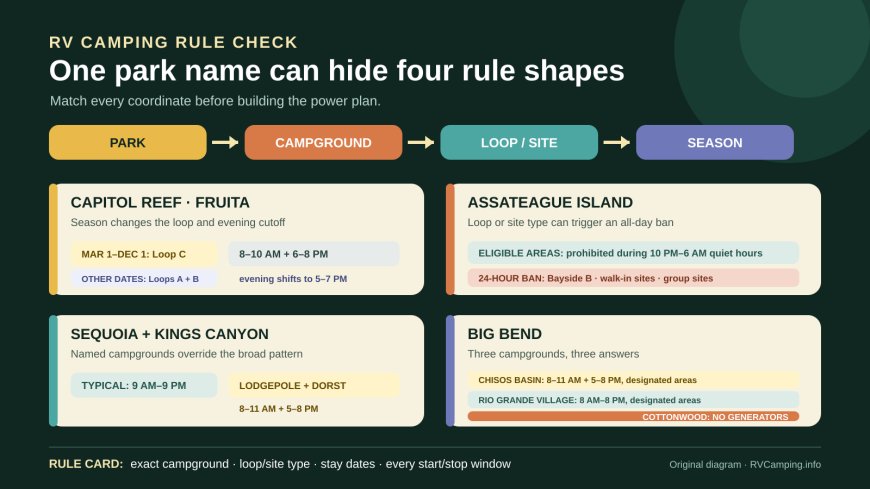
An NPS campground may allow generators in one loop, bar them in the next, or change the permitted loop and evening cutoff with the season. Plan from the rule attached to your reservation, not from a park-wide search result.
By Romana | October 16, 2026
"Generators allowed" is almost useless as a trip-planning note. It does not say which campground, which loop or site type, which dates, or which hours. Four current National Park Service examples show every one of those details can change the answer.
The safest planning unit is the exact reservation: park + campground + loop or site type + stay dates. Add the posted operating windows only after those four coordinates match. If one coordinate is missing, the rule check is unfinished.
Four NPS examples, four different rule shapes
| NPS destination | What changes the rule | Posted operating pattern | Booking consequence |
|---|---|---|---|
| Capitol Reef, Fruita Campground | Season and loop | Two daily windows; the evening window shifts with the time-of-year schedule | A loop that works for a fall trip may be the wrong loop for a winter trip |
| Assateague Island National Seashore | Loop and site type | Outside quiet hours in eligible areas; 24-hour bans in named areas | "Oceanside" or "Bayside" alone is not specific enough |
| Sequoia & Kings Canyon National Parks | Individual campground | Broad park pattern, with narrower split windows at two campgrounds | Do not transfer the general park schedule to Lodgepole or Dorst Creek |
| Big Bend National Park | Campground and designated area | Split windows, a continuous daytime window, or no generator use | The park name cannot predict the rule |
Capitol Reef: both the loop and season move
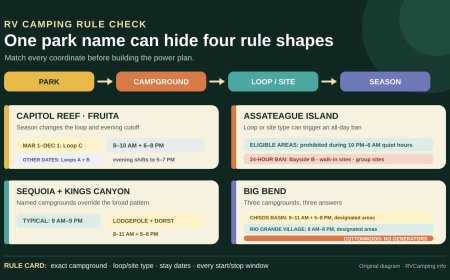
Capitol Reef posts two generator windows at Fruita Campground.[1] Under its Mountain Daylight Time schedule, a two-hour morning slot opens at 8, followed by a two-hour evening slot opening at 6. Under the Mountain Standard Time schedule, the morning slot is unchanged and the evening slot opens at 5.[1]
The permitted loops also change. Loop C is the sole generator-permitted loop for the period beginning March 1 and ending December 1. For the remainder of the year, the page allows them in Loops A and B.[1] That is a genuine seasonal switch, not a small-print variation in quiet hours.
A November or early-March stay deserves extra care because the page presents time-zone month ranges and loop-date ranges in different forms. Do not invent a boundary from the summary. Match the reservation dates to the current page, then ask the park if the exact transition day is unclear.
Assateague: a site category can carry a 24-hour ban
Assateague designates 10 p.m.–6 a.m. as quiet time; generator use is prohibited during that interval.[2] It also bars vehicle idling for battery charging during quiet hours.[2]
That does not make every other hour available at every campsite. Generator use is prohibited all day in Bayside Loop B, Oceanside walk-in sites, and group camping sites.[2] An RVer who reads only the general quiet-hours sentence could reserve the wrong loop. A camper using a group site could make the same mistake without ever crossing a loop boundary.
This is why the "site" field matters even when a numbered campsite does not have a unique rule. A reservation can belong to a generator-free site class, such as walk-in or group camping. Record the site type along with the loop.
Sequoia and Kings Canyon: the campground overrides the broad pattern
Sequoia and Kings Canyon post a typical generator period of 9 a.m.–9 p.m.[3] They then name an exception: at Lodgepole and Dorst Creek, the morning block starts at 8 and closes at 11; the evening block begins at 5 and closes at 8.[3]
The practical difference is large. A traveler carrying the broad 9-to-9 rule into Lodgepole would wrongly assume generators may run through the middle of the day and for an extra hour in the evening. The park-level sentence is only the starting point; the named-campground exception controls the booking decision.
Big Bend: three campgrounds, three answers
Big Bend compresses the whole problem into one park. In designated areas at Chisos Basin, the morning period opens at 8 and closes at 11; the evening period runs from 5 until 8.[4] Rio Grande Village permits them in designated areas from 8 a.m.–8 p.m. Cottonwood allows no generators.[4]
Big Bend also counts an idling vehicle engine as a generator for this rule.[4] Charging the house battery from a parked tow vehicle or motorhome engine is therefore not a workaround there.
A search result that says "Big Bend generator hours" cannot answer the campsite question. The correct result might be two short windows, a continuous daytime span, or a complete prohibition.
Build a rule card for the reservation
Save one compact rule card beside the campsite confirmation. Use the official wording rather than rewriting it as "daytime only."
| Field | What to record |
|---|---|
| Park | Full NPS unit name |
| Campground | Exact campground, not a nearby village or concession facility |
| Loop | Letter or name, including any "generator-free" designation |
| Site | Number and type: standard, group, walk-in, tent-only, RV, accessible, or other listed class |
| Stay dates | Arrival and departure, including any seasonal boundary |
| Permitted windows | Every start and stop time; keep split windows separate |
| All-day restriction | Any loop, site type, or campground where generators are never allowed |
| Related wording | Whether idling, built-in units, portable units, decibel limits, or "designated areas" are mentioned |
| Evidence | URL, access date, and a screenshot or saved PDF |
| Recheck | A reminder shortly before departure and again at check-in |
Do not merge split windows into one span. A morning slot that closes at 11 plus an evening slot running 5–8 p.m. does not create continuous daytime permission. Do not turn a quiet-hours rule into generator permission either. Assateague's page gives both a quiet-hours restriction and separate 24-hour bans for named camping areas.[2]
Resolve conflicting pages without guessing
Campground rules can appear on a park regulation page, an individual campground page, a reservation listing, a confirmation email, and an arrival bulletin. They may not have been updated on the same day.
Use this order when the wording differs:
- Confirm that every page describes the same park, campground, loop or site type, and dates.
- Treat a clearly applicable, narrower restriction as the working limit. A named-loop ban is more specific than a general statement that generators are permitted outside quiet hours.
- Check the page's update date and current park alerts, but do not assume the newest timestamp automatically cancels a more specific rule.
- Ask the campground a closed question: "For site 42 in Loop C from November 28 to December 2, what generator windows apply each day?"
- Save the answer with the reservation. Recheck before travel because a saved rule is evidence of what you planned from, not a guarantee that conditions cannot change.
If staff cannot resolve a conflict, plan to comply with the more restrictive reading or choose a site that does not depend on generator access. Do not arrive expecting an exception.
Convert the rule into an operating plan
Once the rule card is complete, work backward from the shutoff times.
- Finish high-draw charging early enough to shut down by the posted cutoff.
- Keep each split window separate on the day plan.
- Make sure the RV can cover the entire closed interval without engine idling.
- Choose hookups or another campground if required electrical service cannot tolerate that gap.
- If continuous power supports medical equipment, confirm the site's power arrangement and backup plan before booking. Do not assume a medical need creates an unstated generator exception.
For detailed load calculations, use RVCamping.info's overnight RV battery-budget worksheet. For placement and exhaust hazards, see the portable-generator carbon-monoxide campsite guide. A legal operating window does not make every generator location safe.
The 60-second checkout test
Before paying, answer these questions from the exact rule text:
- Can I name the campground, loop, site or site type, and dates?
- Is generator use permitted there at all?
- Are the hours continuous or split into windows?
- Does the evening cutoff change during my stay?
- Does the rule treat vehicle idling as generator use?
- Is a separate noise or quiet-hours rule more restrictive?
- Have I saved the official page and scheduled a recheck?
If any answer is missing, pause the reservation. The examples above are not a menu of national standards. They show why there is no single NPS generator-hours rule to memorize.
At Capitol Reef, the season changes both the evening window and eligible loops.[1] At Assateague, a loop or site class can prohibit generators all day.[2]
At Sequoia and Kings Canyon, named campgrounds replace the broad schedule with split windows.[3] At Big Bend, moving between campgrounds changes the answer from limited windows to a full prohibition.[4]
Plan from all four coordinates: park, campground, loop or site, and season. The generator schedule belongs to the reservation, not to your memory of the park.
Sources
- National Park Service: Campground Regulations, Capitol Reef National Park — accessed October 16, 2026.
- National Park Service: Campground Regulations, Assateague Island National Seashore — accessed October 16, 2026.
- National Park Service: Campground Regulations, Sequoia & Kings Canyon National Parks — accessed October 16, 2026.
- National Park Service: Campground Regulations, Big Bend National Park — accessed October 16, 2026.
What's Your Reaction?