























Before you book: carbon-monoxide and fire questions for mixed glamping groups
Booking questions for mixed RV, cabin, yurt and tent groups to verify venue-provided heat, wood-stove care, CO and smoke alarms, exits, and emergency response.

Before you book: carbon-monoxide and fire questions for mixed glamping groups
By Romana

A cabin with a wood stove, a heated yurt, two canvas tents, and an RV site can look like one reservation. For safety planning, it is five separate sleeping environments. Each has its own heat source, alarm coverage, exits, and exposure to exhaust or sparks from the units around it.
That makes this a venue-selection problem, not a project for guests to solve after arrival. The useful question is not simply, "Does the unit have heat?" It is whether the property can describe the installed system, its inspection routine, the alarms and exits that protect sleepers, and the staff response when something goes wrong.
CPSC warns against operating portable heaters or lanterns while people sleep in enclosed tents, campers, or vehicles.[1] NFPA's heating guidance says portable heaters should be off when a room is empty or occupants go to bed, and it calls for a three-foot separation between heating equipment and combustible material.[2] A booking that depends on an unattended portable heater running beside bedding is therefore a poor fit, even if the listing calls the unit "four-season."
Source note: This booking framework uses CPSC and NFPA safety guidance, U.S. Fire Administration escape-planning guidance, and Oregon State Parks' published cabin and yurt rules. It does not certify a particular property, heater, alarm, chimney, or RV.
Start with a unit-by-unit heat inventory
Ask the venue to name the primary overnight heat in every reserved sleeping unit. "Heated" is too vague. A useful reply distinguishes an installed electric heater from a vented propane appliance, a guest-operated wood stove, or a portable heater placed by staff.
Record the answer in a shared reservation note:
| Sleeping space | What the venue should identify | What the group needs in writing |
|---|---|---|
| Cabin or tiny house | Installed furnace, electric system, fireplace, or wood stove | Operating limits, who may tend or refuel it, inspection status, alarm coverage, and after-hours help |
| Yurt or canvas glamping unit | Installed heat, staff-supplied portable heat, or no active heat | Whether overnight operation is allowed, required clear space, ventilation rules, and the cold-weather fallback |
| Guest tent | Usually an unheated sleep system unless the venue explicitly provides something else | A clear ban or permission statement for guest heaters and a relocation option if the forecast exceeds the booking's limits |
| RV or rental RV | The RV's installed furnace or electric heat | Who maintains the rental, how alarms are checked, where exterior exhaust terminates, and who responds to a fault |
Published accommodation rules can be quite specific. Oregon State Parks says its rustic cabins and yurts include electricity, heat, and lights; it also prohibits cooking inside rustic units. In deluxe facilities, only the provided microwave may be used indoors, with no outside appliances allowed.[4] That is a useful model for booking language because it tells guests both what the venue supplies and what guests may not substitute.
If a host cannot identify the heater type before the cancellation deadline, treat the unit as unheated. Do not make a nonrefundable reservation on the assumption that somebody can bring a heater later.
For a wood-stove unit, book the managed system, not the romance
A wood stove deserves more than a photograph of a tidy fire. Ask who installed it, who inspects and cleans the stove and chimney, and when that work was last completed. NFPA advises annual inspection and cleaning of heating equipment and chimneys by a qualified professional.[2] Guests do not need to become stove technicians, but they do need a credible answer from the party responsible for the building.
Then ask how the stay is managed:
- Does staff light the stove, or may guests operate it?
- Is fuel supplied, and is any other fuel prohibited?
- Where are the written operating rules in the unit?
- Is there a fixed guard or defined keep-clear zone around the stove?
- Where is firewood stored so it does not narrow an exit?
- How are ashes handled, and are guests expected to handle them at all?
- What happens if the stove smokes, drafts poorly, or cannot keep the unit warm?
NFPA calls for at least three feet between heating equipment and anything that can burn.[2] In a small cabin or yurt, that distance can collide with beds, bags, curtains, drying clothes, pet bedding, and the only walking path. Ask for a current interior photo or floor plan that shows the stove, beds, and doors together. If the stated sleeping capacity only works by filling the keep-clear area with luggage or a rollaway bed, the unit is functionally too small for the group.
Do not ask the host for instructions on modifying a flue, improving draft, adding a detector, or moving the stove. Those are owner responsibilities. The booking decision is whether the venue's installed system, maintenance record, and operating policy are adequate as offered.
Ask what protects sleepers, not merely whether alarms exist
"Smoke and CO detectors provided" leaves several gaps. For each cabin, yurt, tent, and rental RV, ask:
- Are smoke alarms and carbon-monoxide alarms both present where the unit's equipment and local rules call for them?
- Where are they in relation to the sleeping area and any fuel-burning equipment?
- Are the alarms hardwired, battery powered, or part of a monitored system?
- When did staff last test them, and how does the venue document routine checks?
- Who receives a monitored alert, if anyone?
- What exact action does the venue tell guests to take when an alarm sounds?
- Will staff move the party to another unit after an alarm or heating failure?
An alarm answer should cover the actual unit, not a policy copied from the main lodge. A detector in the cabin does not warn people sleeping in a detached yurt. The RV's alarms do not cover the tent beside it.
Carbon monoxide can be produced when fuels such as wood or propane burn incompletely. CPSC describes it as colorless and odorless. Its symptom list includes headache and dizziness, along with weakness, nausea, vomiting, unusual sleepiness, and confusion.[1] The group's rule should be simple: if a CO alarm sounds or several people develop suspicious symptoms, everyone leaves for fresh air, the group accounts for every guest, and emergency services are called. Nobody re-enters to troubleshoot equipment.
Draw the risk zones before assigning beds
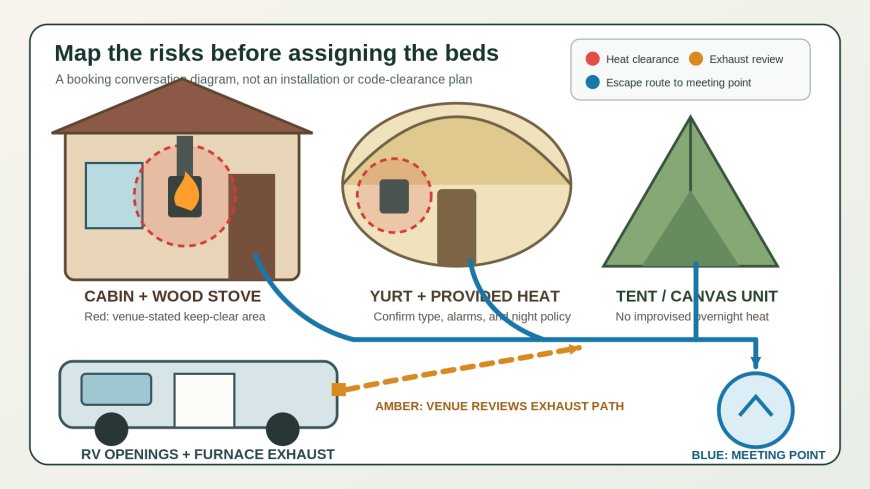
The original diagram for this article treats each occupied unit as a protected sleep zone surrounded by three things that can affect it:
- a heat-clearance zone around a wood stove, fireplace, or portable heater;
- an exhaust pathway from a furnace outlet, generator, vehicle, or other combustion source toward doors, windows, and vents;
- an escape path from each sleeping area to an outdoor meeting point.
Send the venue a marked site plan or ask staff to annotate one. You are looking for conflicts, not trying to calculate code compliance. A parked RV may put a furnace exhaust close to a yurt opening. A cabin's decorative chair may sit in the stove's keep-clear area. A fire ring or parking space may occupy the route that tent guests would use at night.
The diagram uses red, amber, and blue to keep the conversation concrete. Red means no bedding, bags, chairs, or drying gear within the venue's stated heater clearance. Amber marks the area where exhaust sources and occupied openings must be reviewed by the venue. Blue is the unobstructed route to the meeting point. Exact dimensions and equipment placement must come from the venue, the installed equipment instructions, and applicable requirements; the drawing is not an installation plan.
Build one fire plan across separate accommodations
A mixed group needs a common response even though it sleeps in separate structures. The U.S. Fire Administration recommends finding two ways out of every room, keeping doors and windows unblocked, choosing an outdoor meeting place, and practicing the plan.[3] Translate that guidance into booking questions:
- Can every sleeping room or unit provide two usable ways out, where applicable?
- Do windows intended for escape open without a special key or staff member?
- Are tent zippers, cabin doors, steps, ramps, and paths usable after dark?
- Where is the outdoor meeting point, and is it away from vehicle traffic and likely smoke?
- Can emergency responders identify each unit by a visible number or name?
- What number reaches on-site staff after hours, and should guests call 911 first?
- How will the group wake or assist children, older adults, people with disabilities, and anyone who may sleep through an alarm?
Choose one adult to carry the booking roster, not to sweep burning buildings. At the meeting point, that person accounts for people by assigned sleeping unit and tells responders who is missing and where that person was expected to sleep. Nobody goes back for phones, pets, medicine, or gear unless emergency personnel say it is safe.
Ask the venue whether alarms are interconnected between rooms or buildings. If they are not, agree on a group alert that does not require somebody to approach the hazard, such as calling the other units while moving to the meeting point. Do not assume that shouting from a distant cabin will wake sleepers inside an RV.
Portable heat should never be the booking's missing system
A host may say, "We can leave a space heater if it gets cold." That answer needs the same scrutiny as any installed system: exact heater type, approved location, electrical supply, clearances, shutoff rules, and whether it may run while people sleep. NFPA says portable heaters should be turned off at bedtime.[2] CPSC separately warns against sleeping with portable heaters or lanterns operating in enclosed camping spaces.[1]
The safest booking response is to select a unit whose supplied, managed overnight system fits the expected conditions without a guest workaround. If the yurt is sold as unheated, bring appropriate passive sleep insulation or reserve different lodging. If a cabin's primary heat fails, use the venue's relocation or emergency plan rather than moving an outdoor heater inside.
This boundary also protects the host. Guests should not arrive with an extension-cord heater, propane appliance, or improvised stove after receiving a vague answer. Get the permitted-equipment policy in writing and share it with everyone before packing.
The message to send before the cancellation deadline
Copy this into the reservation thread and replace the bracketed text:
Our party will sleep in [units/sites]. Please identify the venue-provided overnight heat in each unit, including whether any wood stove or portable heater is guest operated. For each unit, please confirm smoke- and CO-alarm coverage, the most recent staff test or inspection routine, required heater clearances, and what guests must do if an alarm sounds or heat fails. Please also mark primary and alternate exits, the outdoor meeting point, and any furnace, generator, or vehicle-exhaust locations near occupied doors, windows, tent openings, or vents. Finally, send the written policy for guest-supplied heaters and cooking appliances, plus the after-hours emergency contact.
A complete reply may show that one property is well managed even if its accommodations are simple. A vague reply can reveal that a polished listing is relying on guests to fill safety gaps.
A five-part go/no-go review
Approve the reservation only when all five statements are true:
- Every unit has a named overnight heat plan. "Heated" has been replaced by the system type and operating policy.
- Venue-managed equipment has a maintenance answer. The host can describe inspection, cleaning, testing, and fault response without asking guests to repair anything.
- Each sleeping space has a credible warning and escape plan. Alarm coverage, exits, paths, unit identifiers, and the meeting point are known.
- The site map has no unresolved conflict. Heater clearances, exhaust pathways, openings, parking, fire features, and escape routes have been reviewed together.
- Failure does not trigger improvisation. The venue can relocate guests, dispatch staff, or direct an emergency response; the party is not depending on an unapproved portable heater.
If one answer remains unclear, ask once in writing. If the venue still cannot answer, choose another unit or property. Mixed glamping works best when comfort equipment and emergency planning are part of the accommodation being sold, not chores handed to the guest at check-in.
Sources
- Portable Heaters & Camping Equipment (accessed 2026-10-16).
- Heating Safety (accessed 2026-10-16).
- Home Fire Escape Plans (accessed 2026-10-16).
- Cabins and Yurts (accessed 2026-10-16).
What's Your Reaction?