







30A, 50A or 20A? Verify the exact campsite before you book
Confirm the exact campsite's 30A, 50A, or 20A electrical service by comparing booking fields, site notes, and a direct campground answer before you pay or arrive.


30A, 50A or 20A? Verify the exact campsite before you book
By Romana | October 10, 2026
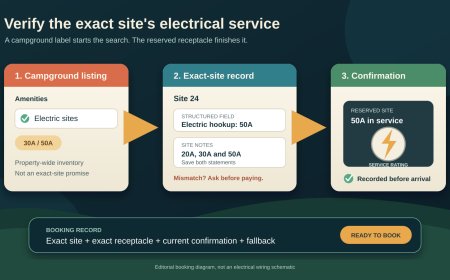
A campground search result can say "electric," a filter can say "50 amp," and the site notes can say "20/30/50." Those descriptions may all refer to the same campsite, but they do not answer the question an RV owner needs answered: Which receptacle will be available at the exact site I am reserving?
That distinction matters before payment and again before departure. The goal is not to diagnose a pedestal from home. It is to turn a vague amenity label into a written, site-specific service record that matches the RV and the trip's power needs.
Source note: This RVCamping.info guide draws on the 2023 National Electrical Code text reproduced with permission by Leviton, an exact-site Recreation.gov record, and Keystone RV's owner guidance. It focuses on reservation interpretation and confirmation, not pedestal inspection, cord damage, or adapter selection.
Write down what the RV requires
Start with the RV, not the campground's amenity list. Check the owner's manual, the shore-power inlet label, or the original equipment documentation and record:
- the RV's native service: 30A or 50A;
- the plug and cord supplied for that service;
- whether a lower-amperage stay is acceptable;
- which loads would have to remain off on reduced service;
- whether continuous power supports a medical, accessibility, refrigeration, or climate-control need.
Keystone describes a typical RV shore connection as either a 120-volt 30-amp, three-prong outlet or a 50-amp, four-prong outlet.[3] The physical difference is useful when identifying service, but a booking decision should begin with the rating in the manual for the exact RV. Do not infer it from RV size, number of air conditioners, or what a previous owner carried in the electrical bay.
A 20A listing needs special care. It may refer to the familiar straight-blade receptacle included at an electrified RV site, not to a 20A version of a 30A RV connection. The NEC text reproduced by Leviton says every RV site with electrical supply must have at least one 20-amp, 125-volt receptacle. It separately sets requirements for 30A and 50A receptacles.[1] In other words, "20 amp available" and "this site provides the RV service I need" are different statements.
Treat campground-level service as an inventory clue
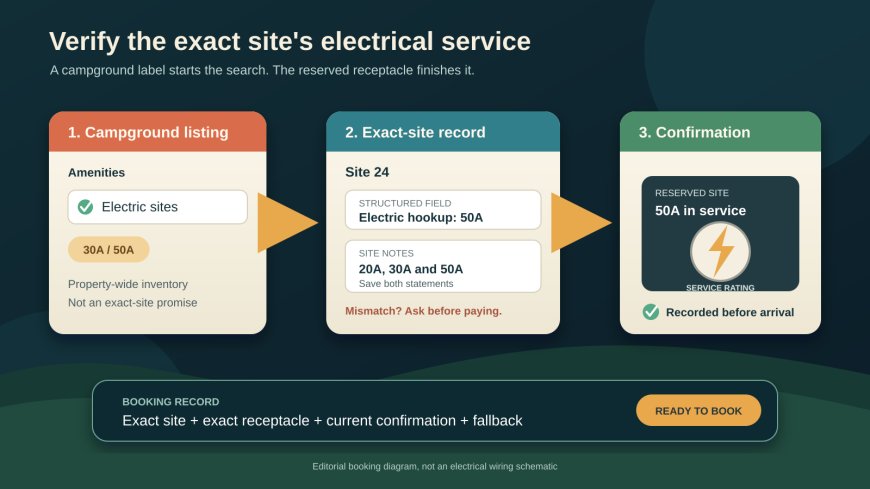
A campground page often describes the property as a whole. "30- and 50-amp sites" may mean some sites have 30A while others have 50A. It does not, by itself, promise both at every site.
The electrical-code percentages make that distinction easier to understand. The cited 2023 NEC language says at least 70 percent of electrified RV sites must have a 30A receptacle. It requires 50A receptacles at a smaller share of existing sites and a larger share of new sites. It also says a site equipped with a 50A receptacle must have a 30A receptacle.[1] Those are requirements for park electrical installations. They are not a substitute for checking the reservable inventory, the code edition adopted locally, later field changes, or the status of one assigned site.
Use a campground-level description to answer one question: "Is it worth looking here?" Use the exact-site record to decide whether to pay.
Read every electrical field on the exact-site page
Reservation systems do not always reduce a site's service to one tidy value. Recreation.gov's record for Highland Ridge Site 01 is a good example. The structured Site Details field says "Electric Hookup: 50." Farther down, the Need to Know text says the site has "50, 30 and 20 amp hookups."[2]
That is not a reason to assume the page is wrong. It is a reason to preserve both statements and ask what they mean. The short field may classify the site's highest service, while the note may describe separate receptacles on the equipment. A search filter could show only the 50A classification and hide the rest of the useful detail.
The same Highland Ridge record directs readers with questions to the ranger staff, which is the right escalation when its structured field and free-text note do not tell the same story.[2]
When a page contains more than one description, read the full record in this order:
- campground overview and amenity legend;
- loop or site-type description;
- exact site number and its Site Details fields;
- warnings, alerts, and Need to Know text;
- the cart or checkout description;
- the confirmation email or account record after payment.
Capture the exact site number alongside the amperage. A screenshot titled "Campground X electric" is weak evidence if it does not show whether the reservation is for Site 01, a 30A site type, or an unassigned electric category.
Decode "20/30/50" without inventing a promise
A notation such as "20/30/50" usually communicates that the site record recognizes all three amperages. It still leaves practical questions unanswered:
- Are there three separate receptacles at the reserved site?
- Is the 20A outlet part of the same site equipment?
- Does each receptacle have its own breaker?
- May more than one receptacle be used at once?
- Is the equipment dedicated to this site or positioned between sites?
- Is any listed receptacle temporarily out of service?
- Does the campground permit two camping units or shared power at that site?
Do not turn a multi-receptacle label into permission for two RVs to share a pedestal. Electrical availability and occupancy permission are separate. If the trip involves a second RV, a tent air conditioner, mobility equipment, or another continuous load, tell the campground exactly what will be connected and ask whether the reservation and site rules allow it.
The same caution applies to a slash in a private campground's rate table. "30/50 amp" may mean both are present, either can be selected, or the row combines two site classes. The legend, booking choice, price line, and confirmation should agree. If they do not, call or email before paying.
Ask a question staff can answer
"Do you have electric hookups?" invites a campground-wide answer. A useful confirmation request names the reservation and the receptacle.
Try this:
I am booking Site 24 for October 18-21. My RV has a native 50A shore-power connection. The booking page shows "electric" in one place and "20/30/50" in another. Will Site 24 have an in-service 50A receptacle for my dates? Is that receptacle dedicated to the site? Please add the answer to the reservation if possible.
For a 30A RV, replace the rating and ask about 30A. If 20A is all you need, describe the intended use rather than calling it a full RV hookup. Keystone advises calling ahead to check the amperage available at the campsite.[3] Its guidance also says a 50A RV connected to 30A service is limited to the lower service.[3]
Ask for the staff member's name, the date, and the channel used. Email or a message inside the booking system is easier to retain than a phone memory. A verbal answer is still useful; put it in your trip note immediately and ask whether staff can annotate the reservation.
Separate required service from acceptable service
Many booking errors happen because "preferred" quietly becomes "required" after arrival. Decide the boundary at home.
| Booking answer | Decision before payment |
|---|---|
| Exact site confirms the RV's native service | Continue if the rest of the site fits |
| Exact site confirms lower service that the RV can use | Accept only with a written reduced-load plan |
| Campground has the service, exact site is unknown | Contact the campground or choose another site |
| Listing says only "electric" | Treat amperage as unknown |
| Structured field and site notes disagree | Save both and request clarification |
| Required service is promised only "if available" | Decide whether the trip can work without it |
| Staff cannot confirm an essential power need | Do not book that site for that need |
A reduced-load plan should name what stays off. "We will be careful" is not a plan. Write something concrete, such as no second air conditioner, no electric water heating, or no simultaneous microwave and hair dryer. Follow the RV manufacturer's instructions for the exact model and electrical configuration.
If power supports a health need, treat uncertain service as a stop condition rather than a minor amenity risk. Ask about outage procedures and identify a different site or campground that can meet the requirement. A reservation note cannot prevent a utility outage, but it can prevent a booking based on a misunderstood filter.
Recheck before arrival
Campground infrastructure, site assignments, and operational status can change after booking. Reconfirm when the service is trip-critical, especially if the reservation was made months ahead or the campground assigns the site at check-in.
Use a short pre-arrival check:
- Open the current reservation in the official account.
- Verify the site number or site type has not changed.
- Compare the current exact-site record with the saved booking record.
- Call if the electrical wording changed or disappeared.
- Ask whether the promised receptacle is currently in service.
- Record the answer and a fallback decision.
The fallback belongs in the plan before the travel day. It might be accepting 30A with specified loads off, moving to another confirmed site, using the RV's approved off-grid systems within campground rules, or choosing another campground. It should not depend on discovering an unverified workaround after check-in.
Keep a compact service record
One trip-note block is enough:
- campground and reservation number;
- exact site number or assigned site type;
- RV native service;
- listing's structured amperage field;
- amperage stated in site notes;
- receptacle confirmed by staff;
- confirmation date and staff name;
- required loads and reduced-service limits;
- fallback if the confirmed service is unavailable.
The point is not paperwork for its own sake. It is to keep four different things from collapsing into the word "electric": the campground's inventory, the exact site's receptacles, the RV's native connection, and the service that will be usable on the arrival date.
Filters find candidates. The exact-site page narrows the answer. A direct confirmation settles the ambiguity that remains. Book only after those three layers tell the same story.
Sources
- Leviton Captain Code 2023: Receptacle Requirements at RV Parks - 2023 NEC Article 551 excerpts covering 20A, 30A, and 50A receptacles at RV sites; accessed October 10, 2026.
- Recreation.gov: Site 01, Highland Ridge - exact-site record whose structured field lists 50A while the site note lists 50A, 30A, and 20A hookups; accessed October 10, 2026.
- Keystone RV: How to Connect Your RV Shore Cord - manufacturer guidance on 30A and 50A shore connections, lower-service limits, and calling ahead; accessed October 10, 2026.
What's Your Reaction?