












Before You Tow: Verify Campground Pet Rules and Pack the Right Records
Verify campground pet rules, vaccination and health-document requirements, site restrictions, offline records, and emergency veterinary options before an RV trip.

Before you tow: verify campground pet rules and pack the right records
By Romana | Category: RV Camping
"Pet friendly" tells you almost nothing about the paperwork or the places your animal may go. A campground may welcome dogs at an RV site yet require vaccination records at check-in, prohibit pets on the trail beside that site, or bar an unattended dog from remaining outside the rig. The useful question is not whether the property accepts pets. It is whether your exact animal, site, dates, and daily plan comply with the current rules.
This is a records-and-rules check for an RV trip, not a general guide to finding pet-friendly lodging. Do it before the cancellation deadline, then repeat the parts that can change shortly before departure.
Start with four rule layers
A single campground web page is not the whole rulebook. Check these layers separately:
- the destination state or territory's animal-entry requirements;
- the park, forest, county, or other land manager's pet rules;
- the campground operator's property policy;
- restrictions tied to the reserved loop, site type, trail, beach, shuttle, or amenity.
USDA APHIS says each receiving state or territory controls its own rules for pets crossing state lines. Depending on the destination, the traveler may need a health certificate, current vaccinations, tests, or treatments; APHIS directs owners to the destination requirements and recommends contacting a veterinarian once travel details are known.[2] That is a route-level check, separate from campground admission.
The property can ask for more. RVontheGO's posted policy, for example, requires office registration and says staff may ask to see vaccination paperwork. It also says only ordinary companion animals are accepted, giving dogs and cats as examples.[4] This is an operator example, not a nationwide campground standard. It shows why carrying a record is different from assuming every desk will request it.
Land-manager rules can narrow the trip even after the site is acceptable. California State Parks warns that visitors may have to present appropriate immunization proof and current licenses. Its general dog rules use a six-foot maximum leash, prohibit leaving dogs unattended, and keep dogs out of many trails, undeveloped areas, buildings, and beaches unless a location is specifically open to them.[3] The agency also tells visitors to check the rules for the specific park and call ahead.[3]
Ask for an answer tied to the reservation
Save the reservation number, campground name, site number or site type, dates, and the pet's species and count in one note. Then contact the operator with questions that can be answered precisely:
- Is this animal allowed on this site for these dates?
- What vaccination, rabies, license, health-certificate, or other record could staff request at check-in?
- Does a tag count, or must I carry the veterinarian's certificate?
- Does the document need to show an expiration date, veterinarian details, microchip number, or a particular form?
- What leash length and physical-control rule applies at the site and elsewhere?
- May the pet remain inside the RV without a person present? If so, under what conditions?
- Are tie-outs, portable pens, fences, or ground stakes allowed on this site?
- Which trails, beaches, buildings, shuttles, dog parks, and water-access points are open to the pet?
- Are there species, number, size, breed, behavior, or noise restrictions?
- Have temporary wildlife, disease, fire, construction, or water-quality conditions changed pet access?
Ask for the answer by email or save a screenshot of the current policy. Record the date and the name or department of anyone who clarified an ambiguous rule. A phone answer is useful, but a short written confirmation is easier to show another staff member after a shift change.
Do not phrase the question as "Can my dog come?" That can produce a truthful but incomplete yes. A better question is: "Can our one dog stay on RV site B14 from October 18 through 21, what records might check-in request, and where can the dog go outside that site?"
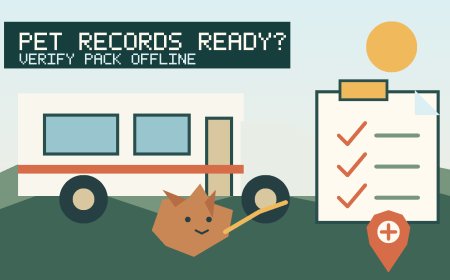
Build a compact pet record packet
Carry only what has a job to do. For a typical domestic RV trip, the packet can include:
- current rabies vaccination certificate and other vaccination record requested by the destination or property;
- license record if required;
- health certificate when the destination rule or operator requires one;
- medication list with dose and schedule, plus clear photos of current prescription labels;
- veterinarian name, daytime number, and patient number if the clinic uses one;
- microchip number and registry contact information;
- recent front and side photos that show identifying markings;
- a one-page medical summary for chronic conditions, allergies, prior reactions, and handling cautions;
- emergency contact authorized to make decisions if the owner cannot;
- campground policy confirmation and the reservation details.
A vaccine reminder email is not necessarily the same thing as an official rabies certificate. Likewise, a health certificate is not a generic document that stays current forever. Ask the destination authority, campground, and veterinarian what form is required and what timing applies. Do not guess from an old trip.
Before scanning anything, check that the animal's name and description are consistent, the owner's contact details are current, and each relevant vaccine entry shows the product or vaccine, administration date, and expiration or due date when the original document provides it. If a required field is missing, call the veterinary office before leaving; do not alter the record yourself.
Carry paper and offline digital copies
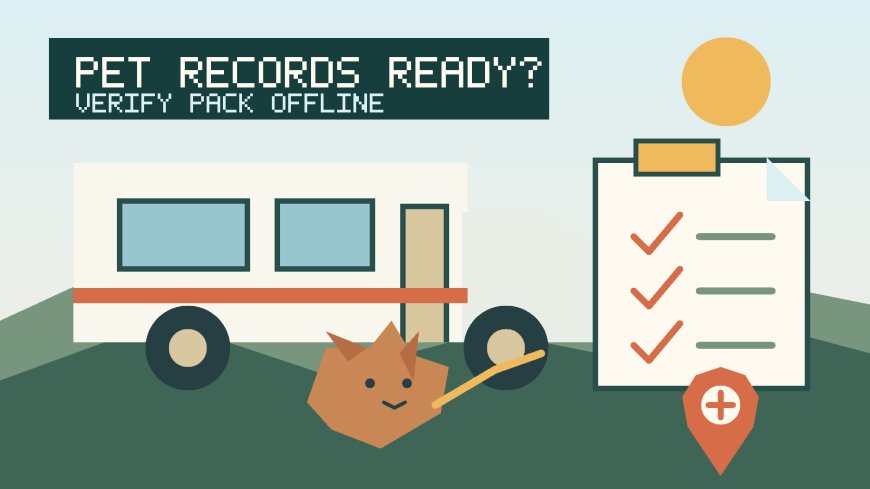
Cell service often weakens precisely where a campground trip ends. A portal login is not an offline copy, and a photo stored only in a cloud account may be unreachable at a ranger station, check-in lane, or emergency clinic.
Ready.gov recommends keeping copies of registration information and other relevant pet documents in a waterproof container and making them available electronically.[1] For an RV trip, use that as a two-copy minimum:
- Place paper copies in a labeled waterproof pouch near the cab or tow-vehicle exit, not in a locked exterior bay.
- Save digital copies as ordinary PDF or image files on a phone so they open in airplane mode.
- Give the traveling partner access, or put a second encrypted copy on another device.
- Keep original documents separate when an authority specifically requires originals.
Test the files. Turn on airplane mode and open each one. Use filenames that identify the animal and document, such as milo-rabies-exp-2027-04.pdf, rather than a row of camera numbers. Lock the phone and protect sensitive files; the packet contains addresses, phone numbers, account details, and sometimes signatures.
A small cover sheet makes the packet usable under pressure. Put the pet's photo and name at the top, followed by species, color, weight, microchip number, regular veterinarian, medications, emergency contact, and the file names of the supporting documents. The cover sheet is an index, not a substitute for the certificate.
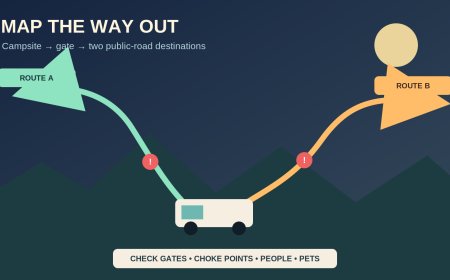
Map the pet's allowed day, not just the campsite
Read the rule as an itinerary constraint. If the dog is allowed in the campground but not on the park trail, beach, shuttle, visitor center, or restaurant patio, decide who stays with the dog before arrival. An unattended-pet rule can make an otherwise attractive reservation unworkable.
Draw a simple site plan with four labels: RV site, relief area, allowed walking route, and vehicle exit. Add restricted spaces in a different color. Confirm whether a leash must be hand-held, whether a pen or tie-out counts as control, and whether stakes can damage utilities or irrigation. The operator's written rule wins over a product label that calls a fence "campground approved."
Recheck conditions two or three days before departure. Temporary closures and wildlife activity may not appear in the reservation confirmation. At check-in, ask whether the posted pet map or access rule changed, then keep the answer with the packet.
Choose emergency veterinary care before you park
Save one daytime clinic and one after-hours option near the campground. Verify the address, phone number, current hours, species treated, and whether the facility accepts walk-ins. Do not rely on a search result that says "open" without calling or checking the clinic's own current information. Rural emergency coverage can be far from the campground, and an RV or trailer may not fit a clinic parking lot.
Store the route offline and note a safe place to leave or stage the RV if the tow vehicle must make the trip alone. Keep the carrier, leash, records pouch, medications, and payment method where they can move into the vehicle quickly. Ready.gov also advises keeping microchip contact details current and including an out-of-area emergency contact.[1]
If the animal becomes ill, call a veterinarian for case-specific advice. This planning packet helps the clinic identify the animal and understand its history; it does not diagnose a problem or replace veterinary care.
Run a five-minute departure check
Before pulling out, confirm five things:
- The destination-state check matches the states or territories on the actual route and stay.
- The exact campground and site still accept the animal.
- Required certificates are current through the return date, not merely valid on departure day.
- Paper and offline files both open and match the pet traveling.
- The emergency clinic information and route were verified recently.
Put a reminder on the calendar for the first record that expires. For a multi-stop trip, attach each campground's rule confirmation to that stop rather than treating the strictest policy as proof that every other property was checked.
The goal is a small packet and a specific answer: this pet may occupy this site on these dates, these documents are ready, these areas are permitted, and this is where the group will go if veterinary care is needed. That is far more useful than a pet-friendly icon.
Sources
What's Your Reaction?