

















Test your trailer brake controller and breakaway system before a trip
A manual-first trailer brake checklist for inspecting wiring, testing low-speed controller response, checking the independent breakaway circuit and deciding when not to tow.

Test your trailer brake controller and breakaway system before a trip

By Romana
A brake-controller display that says “connected” is only the start of a pre-trip check.[3]
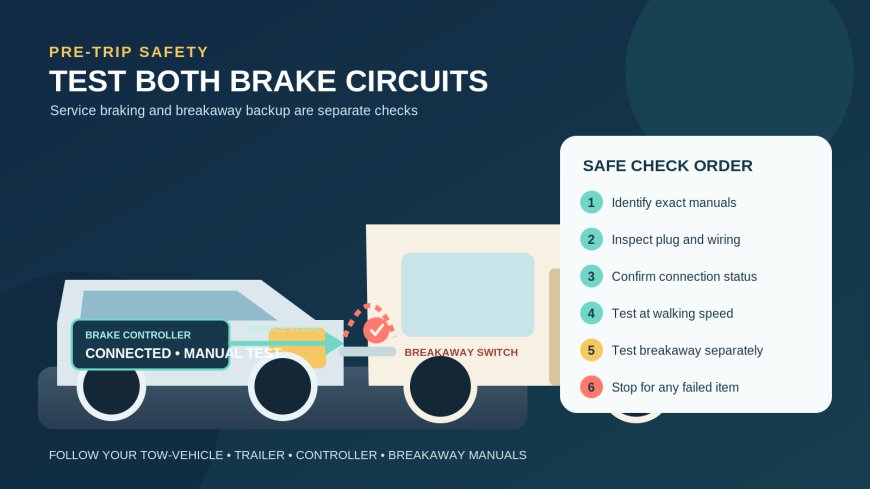
Before towing, confirm the plug and wiring look sound, the controller recognizes the trailer, the manual control produces real trailer braking at walking speed, normal pedal braking feels coordinated, and the separate breakaway system passes the exact test in its manual.[1][3][4]
Do not copy another owner's gain number. Do not perform a road-speed setup test in traffic. And do not pull a breakaway pin while the trailer is still electrically connected to the tow vehicle unless the manuals for your exact equipment expressly allow it; both Tekonsha and CURT warn that this can damage a brake controller.[3][4]
This checklist is for conventional RV trailers with electrically activated brakes.[1][3][4]
Electric-over-hydraulic systems, wireless controllers, surge brakes and proprietary integrated systems can require different modes and tests.[1][3]
Your tow-vehicle manual, trailer manual, brake-controller manual and breakaway-kit manual control.[1][2][3]
Know which system you are testing
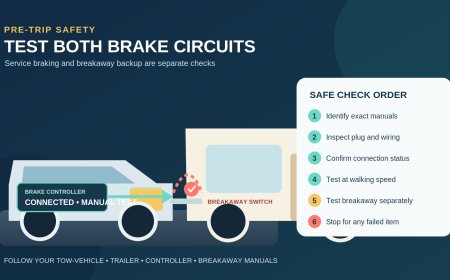
The service-brake circuit and the breakaway circuit share the trailer brakes, but they do different jobs.[1][3][4]
The brake controller uses tow-vehicle inputs to command the trailer brakes during normal towing. Many aftermarket controllers also have a manual lever or knob that lets the driver command trailer braking without pressing the vehicle brake pedal.[1][3]
The breakaway system is an emergency backup. If the trailer separates, removing the switch pin closes a circuit so a trailer-mounted battery can apply the trailer brakes.[1][4]
It is not the trailer's parking brake, and CURT says its model 52042 kit will not hold a trailer indefinitely.[4]
Keeping the two tests separate prevents a common mistake: seeing a healthy controller display and assuming the independent battery, switch and lanyard are ready too.[3][4]
One passing circuit does not prove the other.[3][4]
Build an equipment-specific test card
Bring all four manuals to the rig, not just a generic towing checklist.[1][2][3]
Record:
- tow vehicle year, make, model and installed towing package;
- trailer VIN, loaded condition and brake type;
- brake-controller make, model, selected trailer profile and brake mode;
- breakaway-kit make, model, battery type and test instructions;
- the controller's normal connected indication and every warning message;
- the manufacturer's setup surface, speed and loading conditions;
- the breakaway maker's required battery check and functional-test procedure;
- any trailer-brake inspection or adjustment interval that is due.
NHTSA's towing brochure says tow-vehicle and trailer braking systems must be compatible, while Oregon DOT calls its general booklet no substitute for the manufacturers' towing guides and owner's manuals.[1][2]
That is why this article does not prescribe a universal gain, boost level, test speed, battery voltage or pin-out.
Even products that look similar differ. The Tekonsha P3 manual requires the user to select electric or hydraulic brake type and gives a model-specific setup sequence.[3]
CURT's 52042 breakaway manual, meanwhile, describes a push-to-test battery box and a test procedure specific to that kit.[4]
Start parked: inspect before energizing anything
Choose level ground away from traffic.[3][4]
Chock the trailer wheels.[4]
Put the tow vehicle in Park, set its parking brake, shut down unnecessary loads and keep people clear of the coupler, wheels and the space between vehicles.[3][4]
Walk the circuit from front to back.[3][4]
- Controller: Confirm it is secure, visible and reachable from the driving position. Look for a loose mount, damaged harness or warning stored on the display.
- Tow socket and trailer plug: Look for bent or pushed-back contacts, moisture, dirt, heat damage, green corrosion, a cracked housing or poor strain relief. Never probe unfamiliar pins or bypass fuses on guesswork.
- Trailer wiring: Follow only the portions you can safely see. Stop for crushed insulation, loose junction-box covers, hanging cable, damaged axle wiring or suspect grounds.
- Breakaway switch: Confirm the housing is secure and the pin is fully seated. The cable must move freely and must not be frayed, kinked or worn from dragging.[4]
- Breakaway battery: Inspect its case, hold-down, terminals and charger wiring. Treat swelling, leakage, heat damage, heavy corrosion or an unidentified battery as a service problem.
- Brake hardware: If inspection or adjustment is due, or a wheel-end problem is suspected, use a qualified trailer technician. A controller setting cannot repair worn friction material, bad magnets, contaminated brakes, a hydraulic fault or poor adjustment.[3]
Do not crawl beneath an unsupported trailer.[3][4]
A wheel-off-ground breakaway test requires rated lifting equipment, correct support points and jack stands; if that work is outside your tools or training, have a qualified shop perform it.[4]
Verify the service-brake circuit at very low speed
Connect the trailer normally, start the tow vehicle as its manual directs and confirm the controller shows the expected trailer-connected state.[3]
A connection icon is useful, but it does not prove that every brake is producing the correct force.
Move to a vacant, level, dry area with no pedestrians, curbs or traffic.[3]
At walking speed, apply the controller's manual control gradually while keeping the tow vehicle ready to stop.[1][3]
A useful first result is unmistakable drag from the trailer, followed by a clean release when the manual control is released.[3]
Stop immediately for no response, a disconnect warning, a short-circuit warning, smoke, odor, wheel lock, harsh grabbing, delayed release or a pull to one side.[3]
Next, make gentle low-speed stops with the brake pedal.[3]
The combination should slow in a controlled, coordinated way without the trailer shoving the tow vehicle or jerking it backward.[3]
Tekonsha describes the desired result for the P3 as unified braking, but its detailed power-setting procedure belongs only to that controller and must be followed as written.[3]
Do not turn gain upward until an underlying defect disappears.[3]
Tekonsha states that boost is not a substitute for trailer-brake adjustment or repair, and it notes that inability to reach expected braking can indicate a need for inspection.[3]
When to adjust gain
Adjust only under the conditions and sequence required by the exact controller and tow-vehicle manuals.[2][3]
Loading, road condition and brake temperature can affect the appropriate setting.[3]
The number is a starting point for a particular combination, not a transferable specification.[3]
Recheck after a meaningful load change, brake service, controller-profile change or other condition named by the manufacturer.[3]
Make settings while stopped if the manual requires it, then repeat the prescribed low-risk verification.[3]
Never chase deliberate wheel lock unless the controller manual specifically uses a controlled just-below-lock procedure and you can meet every listed condition.[3]
The P3 manual warns that excessive output causing trailer-wheel skid can reduce directional stability.[3]
Test the breakaway system as its own circuit
Park again on level ground, chock the wheels and read the exact breakaway and controller instructions before touching the pin.[3][4]
For CURT's 52042 kit, the manufacturer says to check battery state with the trailer's 7-way disconnected, then test activation by pulling the switch cable.[4]
It also warns that testing while connected to the tow vehicle can severely damage the electric brake controller.[4]
Tekonsha gives the same disconnect warning for the P3.[3]
That warning is product-specific but important: if your manuals disagree or the installed parts cannot be identified, stop and ask the equipment manufacturers or a qualified trailer service technician.[3][4]
Do not assume a social-media demonstration applies to your wiring.[3][4]
Use the functional test your breakaway maker specifies.[4]
That may be a supported, wheel-off-ground rotation test, a manufacturer-approved restrained pull test or another procedure.[4]
CURT's post-installation procedure for model 52042 calls for supporting the trailer on jack stands, spinning a wheel, removing the pin and confirming the wheel stops and remains held for the stated test period; it then requires recharging the battery.[4]
Do not export that procedure or duration to a different kit.[4]
After any test, restore the system in the order its manuals require.[3][4]
- reinsert the correct pin fully;
- release the brakes and verify the wheels are not being held;
- recharge or service the breakaway battery as its manual directs;
- reconnect the 7-way only after the manual's sequence is complete;
- confirm the controller again recognizes the trailer;
- perform the service-brake low-speed check again.
Leaving the pin out can keep the brakes energized, discharge the breakaway battery and overheat components.[4]
If the pin sticks, the switch housing is cracked, the brakes do not apply or release, or the battery fails its prescribed check, the trailer is not ready to tow.[4]
Route the lanyard for an actual separation
A functional switch can still fail its job if the cable is attached to the wrong place, can snag during a turn or is too long to pull the pin after separation.[4]
Follow the breakaway manufacturer, trailer manufacturer and hitch instructions for the attachment point and routing. CURT's 52042 manual says its cable should attach to a suitable location on the tow-vehicle frame and specifically says not to connect it to the trailer ball, safety chains or mounting hooks.[4]
That rule is authoritative for this CURT kit; use your own kit's instructions for your rig.
Turn clearance matters.[4]
With a spotter and the combination stationary, check the cable through the expected articulation range only as the manuals permit.[4]
It must not pull the pin during normal turns, bind around the coupler or drag on the road.[4]
Keep it independent from the safety chains so one failed component does not automatically defeat another.[4]
Use a firm no-go list
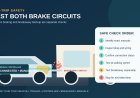
Do not depart until qualified service resolves any of these findings.[2][3][4]
- controller reports no trailer, overload, short, power loss or another unresolved fault;
- manual control produces no verified trailer braking or the brakes fail to release;
- braking is one-sided, erratic, harsh, weak or accompanied by heat, odor or noise;
- plug, socket, grounds, wiring or axle leads show damage or overheating;
- brake type or controller mode cannot be verified;
- breakaway battery fails its maker's check, cannot hold charge or shows physical damage;
- switch pin, housing, cable or attachment point is damaged or uncertain;
- breakaway brakes fail the maker's functional test;
- a required brake inspection, adjustment or repair is overdue;
- the manuals cannot be found or the installed parts cannot be identified.
Oregon DOT says brakes that came on a trailer must be kept in good working order and tells travelers to check the requirements of every state they will visit.[2]
NHTSA likewise notes that state and municipal towing requirements vary.[1]
Confirm current rules with each state's motor-vehicle or highway authority; a working brake system does not by itself prove legal compliance everywhere.
The departure checklist
Before the wheels move onto a public road, confirm each item.[1][2][3]
- [ ] Correct tow vehicle, trailer, controller and breakaway manuals are on hand.
- [ ] Controller mode and trailer profile match the installed brake system.
- [ ] Plug, socket, visible wiring, grounds and connectors pass inspection.
- [ ] Controller shows the expected connected status with no unresolved warning.
- [ ] Manual control creates clear trailer braking at walking speed and releases cleanly.
- [ ] Gentle pedal stops are smooth and coordinated in a safe test area.
- [ ] Gain was set only by the exact manual, for the trailer's current loaded condition.
- [ ] Breakaway switch, pin, battery and cable pass their model-specific checks.
- [ ] Breakaway test was performed with the tow vehicle disconnected if the manuals require it.
- [ ] Pin is fully reinstalled, battery is ready, brakes release and the 7-way is reconnected.
- [ ] Lanyard is attached and routed exactly as its instructions require.
- [ ] Current laws for the entire route have been checked.
A failed box is not a note for later.[2][3][4]
Park the trailer and have the brake system diagnosed by a qualified service provider before the trip.[2][3][4]
Sources
- NHTSA: Towing a Trailer—Being Equipped for Safety — accessed September 14, 2026.
- Oregon DOT: Towing a Trailer in Oregon — accessed September 14, 2026.
- Tekonsha P3 Electronic Brake Control Manual — accessed September 14, 2026.
- CURT 52042 Breakaway Kit Installation Manual — accessed September 14, 2026.
What's Your Reaction?