






Keep the fresh hose fresh: preventing RV campsite cross-connections
Prevent RV fresh-water contamination by verifying campsite taps, protecting backflow controls, separating hoses, and keeping potable fittings clean.

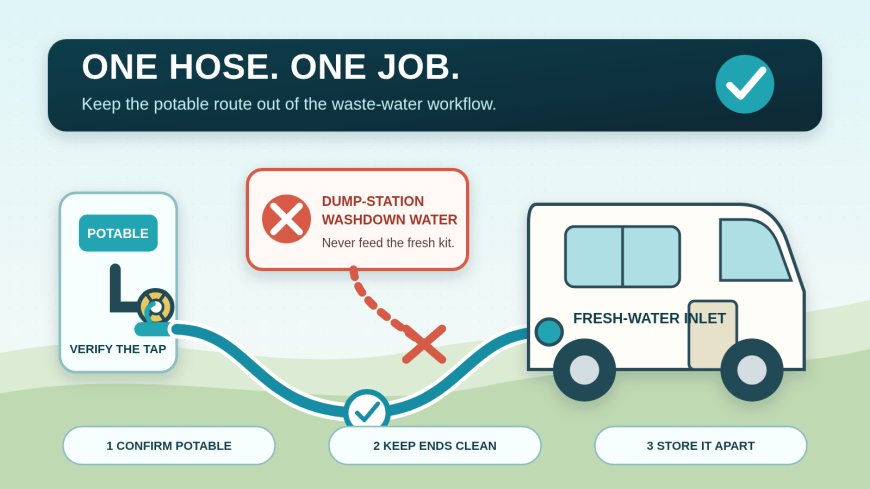
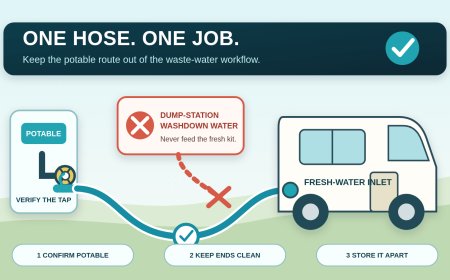
A safe campground tap can still become part of an unsafe setup. The trouble starts when a hose or fitting creates a path between drinking water and something that is not drinking water: a dump-station washdown outlet, a black-tank flush, a bucket, standing water, or a hose that has handled waste gear.
EPA calls that path a cross-connection. Backflow is water moving the wrong way through it, and it can happen when pressure on the supply side drops below pressure in connected plumbing.[2] For an RVer, the useful rule is simple: give drinking water one dedicated route from a confirmed potable outlet to the RV, and never lend any part of that route to a dirty job.
This is a campsite hookup routine, not a replacement for sanitizing the RV tank and plumbing. CDC treats source safety and system cleaning as separate tasks. It advises RV users to confirm with campground management that water is safe to drink before connecting, then follow the RV maker's instructions for draining, disinfecting, and flushing the onboard system.[1]
Know the two water outlets that may be nearby
A threaded faucet is not proof that the water is potable. Dump stations often have water solely for rinsing the pad or waste equipment. Virginia, for example, requires a dump-station washdown outlet to be protected against cross-connection or backsiphonage and marked as unsafe water for washdown only.[5] Ohio likewise requires dump-station water to be labeled for flushing and cleaning rather than human consumption.[4]
That distinction changes the hookup decision:
- Use only the campsite's confirmed potable outlet for the city-water inlet or fresh-tank fill.
- Treat every "nonpotable," "unsafe water," "washdown," or "flush only" outlet as waste-side equipment.
- If a label is missing, damaged, or ambiguous, stop and ask the campground. Do not decide by the faucet's color, thread size, location, or apparent cleanliness.
- Never stretch a potable hose over to a dump-station faucet "just this once." Ohio's campground rule goes as far as requiring separation between drinking-water outlets and dump stations and limiting hose reach between them.[4]
The law varies by place, so these state rules are examples of the hazard controls a camper may encounter, not a nationwide code summary.
Build two hose systems that cannot be confused
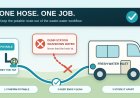
Use one hose only for water you intend to drink, cook with, or send through the RV's fresh plumbing. Ohio requires hoses used for human consumption at a campground to be rated for potable-water use.[4] Look for the actual potable-water marking or applicable certification on the hose or packaging; "white" or "blue" by itself is not evidence.
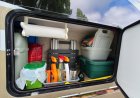
Keep a different, unmistakably marked hose for black-tank flushing or sewer-equipment cleanup. Store it with waste gear, not in the fresh-water bin. Caps on the fresh hose ends help keep the fittings from touching compartment floors, insects, dust, or damp waste equipment. Replacing a lost cap is cheaper than pretending an exposed fitting stayed clean.
Those color-coding, capping, and separate-bin steps are RVCamping.info hygiene recommendations. They apply the cross-connection principle to RV handling; they are not presented as CDC rules.
Inspect the hookup before opening the tap
Use this order at the campsite:
- Confirm the source. Ask whether the exact outlet is approved for drinking and whether any current advisory affects it. CDC specifically says to confirm potability with campground or RV-park management before hookup.[1]
- Read every label. A nearby washdown faucet belongs to the waste workflow even if it looks identical to the campsite spigot.
- Look for protection at the outlet. A hose-bibb vacuum breaker or another approved backflow device may be built in or attached. Do not remove, defeat, or improvise around it. Device selection depends on the hazard and local requirements; EPA notes that acceptable assemblies and repair rules vary by state and municipality.[2]
- Keep the hose end out of hazards. Minnesota health guidance says to keep hoses out of containers and bodies of water, with the free end clear of possible contaminants.[3] At camp, that also means not laying the fresh fitting on the sewer cap, dump pad, mud, or pooled water.
- Connect only fresh to fresh. Attach the dedicated potable hose and the RV-side fittings used only for fresh water. Follow the RV manual for regulator placement, pressure limits, fill mode, and valve positions.
- Check for leaks and odd conditions. If the outlet, backflow device, or connection leaks heavily, will not stay secure, or appears damaged, shut the water off and ask staff for another approved outlet. A camper should not repair campground plumbing.
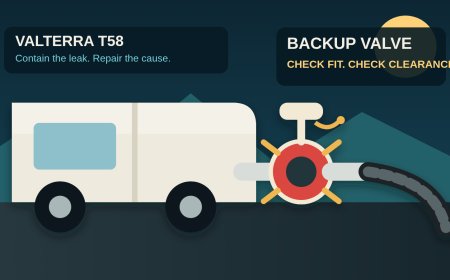
Do not add a Y-splitter ahead of the campground's protection or swap in a hardware-store valve because it fits. A fitting that controls pressure, improves taste, or stops drips is not automatically an approved backflow device.
A filter does not fix a cross-connection
An inline filter can have a narrow, useful job, but it does not make the hookup arrangement safe by itself. CDC warns that many filters sold to improve taste do not remove germs and tells users to check the label for the specific germs or chemicals a filter removes.[1] A sediment or taste filter is not a license to connect to an unconfirmed source. A pressure regulator protects plumbing from excessive pressure; it is not a substitute for backflow protection either.
Think in layers: the campground confirms the water source, proper plumbing protection limits reverse flow, the RVer keeps potable equipment away from contamination, and any filter does only what its label claims.
Disconnect without contaminating the clean kit
Turn off the water, relieve pressure as the RV manual directs, and disconnect without letting either fresh fitting fall onto the ground. Drain the hose away from the sewer connection. Once the exterior is dry enough to store, cap both ends and return the hose and fresh-only fittings to their clean bin.
Waste-side gloves, adapters, flush hoses, sewer supports, and rinse fittings go somewhere else. If one compartment is all you have, use closed, washable containers that keep the two kits physically apart.
A fresh hose that accidentally touched sewage, served a tank flush, or connected to an unsafe washdown outlet should come out of potable service. Do not rely on a quick rinse or a taste-and-smell check to prove it safe.
If you suspect backflow or cross-contamination
Stop using the water and disconnect from the suspected source without spreading contamination to the potable kit. Tell campground management which outlet and equipment were involved. Do not drink the water, cook with it, make ice, brush teeth with it, or give it to pets until the responsible water authority or campground provides instructions.
EPA's incident guidance calls for eliminating the cross-connection, systematic flushing or cleaning, and testing affected drinking water after corrective work.[2] That is utility-level guidance, not a do-it-yourself recipe for an RV. For the RV side, follow the vehicle maker's contamination or sanitizing procedure and any directions from the campground, local health department, or water system. Replace filter cartridges or hoses only as those instructions require.
The best time to prevent the problem is before the tap opens: verify the outlet, preserve the backflow protection, and keep the fresh-water kit completely out of the waste-water workflow.
Sources
- CDC, "Safe RV Water from Tank to Tap" (PDF; accessed September 21, 2026).
- EPA, "Protecting Water Quality through Cross-Connection Control and Backflow Prevention" (PDF; October 2021; accessed September 21, 2026).
- Minnesota Department of Health, "Cross Connections" (accessed September 21, 2026).
- Ohio Administrative Code Rule 3701-26-04, "Responsibilities of the licensee" (accessed September 21, 2026).
- Virginia Administrative Code 12VAC5-450-90, "Sewage disposal" (accessed September 21, 2026).
What's Your Reaction?