



Replace an RV water filter by its label, gallons, and warning signs
Use the exact filter label, a simple gallon log, and stop-use triggers to decide when an RV water filter needs replacement.
Replace an RV water filter by its label, gallons, and warning signs
An RV water filter does not earn a full camping season just because the calendar says so. The replacement decision belongs to the first applicable limit on the exact filter label, the water that has passed through it, or a warning sign.
First, identify what the filter claims to do
CDC warns that many filters sold to improve taste do not remove germs. It also says to check the label for the germs or chemicals the filter removes and to replace filters according to their instructions.[1] Treat “better taste” and “microbiological protection” as different claims.
Certification language needs the same care. NSF explains that NSF/ANSI 42 covers non-health-related effects such as taste and odor, while NSF/ANSI 53 covers specified health-related contaminant reductions. The claim varies by product; a standard number is not a promise to remove everything.[2]
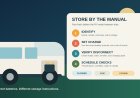
Write down four items from the exact label or manual: model, claimed reductions, rated gallons if one is given, and maximum service time. If one is missing, mark it “not stated.” Do not borrow a capacity from a similar-looking cartridge.
Keep a gallon log without installing a flow meter
A practical estimate can come from tank fills plus known city-water use:
estimated gallons = tank fills × gallons added per fill + metered or estimated city-water gallons
Suppose a 30-gallon fresh tank is filled six times, but each fill averages 25 gallons because the tank was not empty. Add four city-water days estimated at 12 gallons per day:
6 × 25 + 4 × 12 = 198 gallons
That 198-gallon figure is an estimate, not laboratory metering. Round upward when a fill is uncertain. If the filter label says 500 gallons or 90 days, replacement is due at the earlier limit. At 198 gallons and 47 days, neither numeric limit has arrived, but a stop-use trigger can still end the run.
A product may publish neither a dependable gallon rating nor a fixed service interval. Clear2O says one inline model’s life and capacity vary with local water conditions and volume used, and the same product must not be allowed to freeze.[3] Its FAQ says replacement timing varies with water quality and use; for one inline model it points to a noticeable flow slowdown or stoppage.[4]
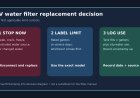
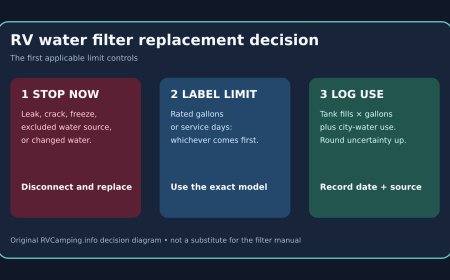
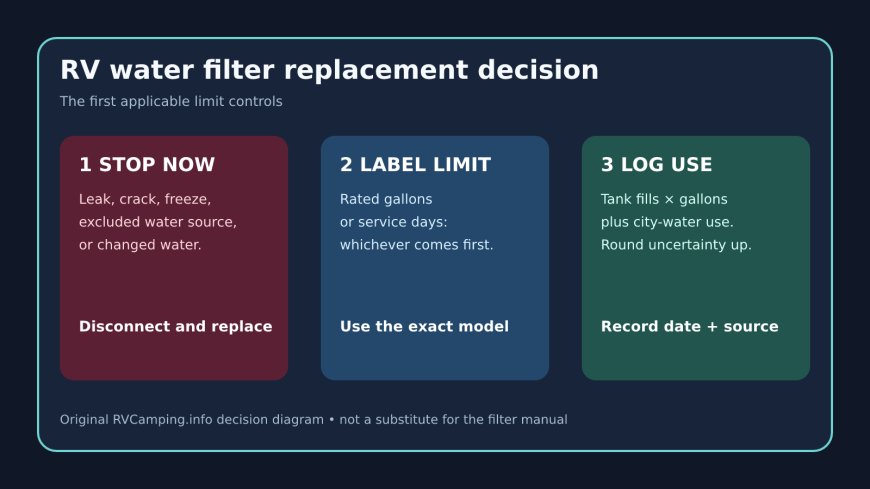
A three-line decision card
Use this order at every hookup:
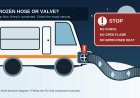
- Stop now: the housing froze, cracked, leaked, was connected to water the label excludes, or the filtered water developed a new odor, taste, color, or cloudiness. Disconnect it. Follow the manufacturer’s disposal and replacement directions; do not assume flushing repairs damaged media.
- Replace by the label: the rated gallons or calendar limit has arrived. When both are stated, the first one reached controls.
- Continue and log: no stop condition is present and the label limits remain open. Record the date, source, and estimated gallons.
The flow check needs context. A weak shower can come from the campground supply, a regulator, a kink, or the filter. Compare flow with the same spigot and regulator configuration before blaming the cartridge. Do not remove a filter and drink from a source that has not been identified as potable merely to restore pressure.
Storage can end the filter’s life early
CDC notes that germs can live and multiply in poorly maintained filters.[1] A used cartridge left wet and warm for weeks is not reset by subtracting the days it sat in storage. Follow the product’s storage directions, cap or drain it only as directed, and never let a filter remain in service after freezing if its manufacturer forbids freezing.
The log is useful because it exposes uncertainty. If the model cannot be identified, its claims are unclear, or the start date is missing, replacement is the conservative choice. A new, correctly labeled cartridge costs less than pretending an unknown filter still has capacity.
Source credit: RVCamping.info reviewed the linked government, standards-body, and manufacturer materials on 2026-10-26. The gallon log and three-line decision card are original editorial tools.
Sources
- CDC: Preventing waterborne germs at home — Accessed 2026-10-26.
- NSF: NSF/ANSI 42, 53 and 401 filtration standards — Accessed 2026-10-26.
- Clear2O CRV1005 inline RV water filter — Accessed 2026-10-26.
- Clear2O RV filter FAQ — Accessed 2026-10-26.
What's Your Reaction?