














How to wash campsite dishes when water is limited
A low-water campsite dishwashing workflow that separates cleaning from sanitizing, blocks raw-food cross-contamination, and keeps scraps and wastewater out of the site.

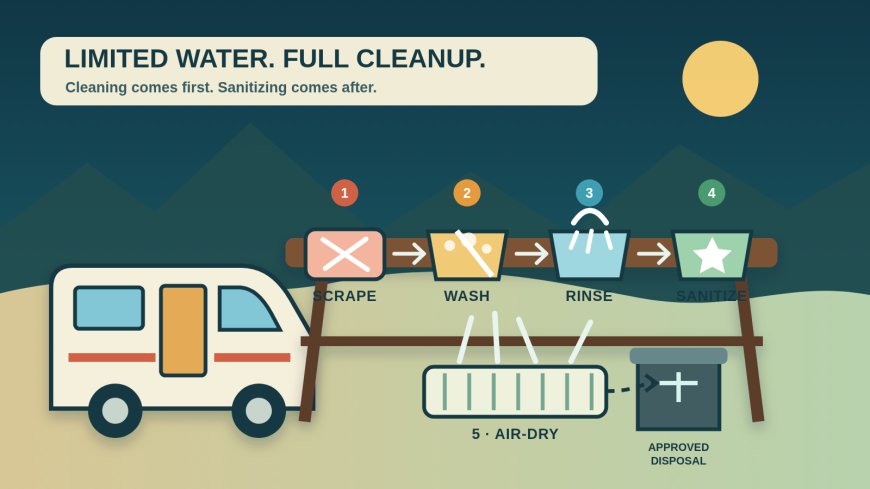
How to wash campsite dishes when water is limited
By Romana
Category: Cooking
Limited water does not call for a token rinse. It calls for a tighter sequence: keep food scraps out of the wash water, clean every surface before trying to sanitize it, rinse with potable water, follow a food-contact sanitizer's label, air-dry, and send the wastewater only where the campground permits.
The water-saving move is to remove food before it reaches a basin. The food-safety move is to keep dirty tools moving in one direction, away from hands, drinking water, and ready-to-eat food. Those two ideas fit together.
This guide draws on current CDC, USDA, and National Park Service guidance. It does not provide a homemade bleach concentration. Product formulations and permitted food-contact uses differ, so any chemical sanitizer must be labeled for the job and used at its stated dilution, contact time, temperature, and rinse requirements.
Decide where the water comes from and where it goes
Before dinner, identify two endpoints:
- a safe water supply for handwashing, food preparation, dishwashing, and rinsing; and
- the approved destination for dishwater.
USDA tells campers not to depend on lake or stream water for drinking, meal preparation, or cleaning, even when it looks clean. The agency recommends bringing bottled or tap water and replenishing from tested public systems when possible.[1] If a campground faucet is posted nonpotable or a drinking-water advisory is active, do not quietly assign that water to the dish basin. Follow the notice and campground staff's instructions.
Do the same homework on disposal. A utility sink, a gray-water collection point, and an RV dump station are not interchangeable merely because each accepts some kind of liquid. Read the campground rules or ask the host which one accepts portable dishwater. If the answer is the RV dump station, use the equipment and procedure the campground requires rather than carrying an open basin through the dump area.
Glacier National Park shows why a universal disposal rule is risky. In its developed campgrounds, all dishwashing wastewater must be contained and taken to a utility sink or RV dump station. Under the park's primitive-status rules, campers must filter out food scraps and may scatter the water at least 100 feet from campsites, lakes, and streams.[4] Other lands set different distances or prohibit ground disposal. "Scatter it 200 feet away" is not a substitute for checking the rule where you are camped.
Cleaning and sanitizing are separate jobs
Cleaning removes food, grease, dirt, and many germs with detergent, water, and friction. Sanitizing comes afterward and reduces the germs left on an already clean surface. CDC states that cleaning always comes before sanitizing or disinfecting.[3]
That order matters at camp. A sanitizer is not a shortcut around a skillet crust, a greasy film, or chicken juice trapped under a cutting-board edge. Dirt can keep the sanitizer from contacting the surface as intended. A perfunctory dip in soapy water is not sanitizing either.
For dishes and food-preparation tools, use this one-way sequence:
scrape and wipe -> wash -> potable-water rinse -> sanitize -> air-dry
Set the stations in that order. Keep the finished end away from the raw-food cooler, garbage bag, ground, and splash from the wash basin. If space forces the same basin to do more than one job, finish a stage, empty it at the approved disposal point, wash the basin, and refill it. Do not turn cloudy wash water into rinse water by renaming it.
Set up before the pan gets cold
A small kit prevents most improvised mistakes:
- two or three nesting basins, or one basin plus clean containers dedicated to rinsing and sanitizing;
- a scraper and a few paper towels or other pack-out wipes for grease;
- a narrow-spout water container that can deliver a controlled stream;
- dish detergent;
- a sanitizer whose label specifically permits use on food-contact surfaces;
- any measuring device and test strips the sanitizer label requires;
- a mesh strainer;
- a drying rack or clean mesh bag that keeps dishes off the table and soil;
- disposable towels for hand drying; and
- sealable trash storage that meets local wildlife rules.
Keep handwashing water separate from the dish allotment. CDC advises washing hands with soap and water for at least 20 seconds before, during, and after food preparation and before eating.[2] A cook should not have to choose between clean hands and a rinsed plate because all the water went into one oversized wash tub.
At home, rehearse the setup with the exact cookware and water containers you plan to carry. Mark the container after a realistic meal. That gives you a trip-specific water budget without pretending a single gallon figure works for a mug-and-bowl breakfast and a greasy group cookout.
The limited-water wash sequence
1. Protect the clean side
Put leftovers away before dishwashing begins. Close the potable-water container between pours. Move bread, produce, clean utensils, and serving dishes out of splash range. CDC recommends separate boards or plates for raw animal foods and foods that will not be cooked, and sealed storage that prevents raw juices from leaking onto other food.[2]
Wash your hands, then handle clean items only by rims, handles, or other non-food-contact areas. If a supposedly clean plate lands on the ground or catches wash-basin spray, send it back through the process.
2. Dry-clean the dishes first
Scrape edible leftovers into a closed food container or the trash. Wipe grease and sticky residue into the trash as well. Pack those solids out or place them in the campground's designated refuse system. Do not burn food scraps unless the site explicitly allows it, and do not leave strained particles at the disposal point.
This step saves more water than making the wash basin smaller. It also prevents bits of dinner from being spread around camp in wastewater. Glacier tells campers to secure food, coolers, grills, and other scented items from wildlife, and to put food scraps in garbage rather than the fire.[4]
3. Wash in sensible batches
Use warm, soapy potable water and enough room to scrub every food-contact surface. CDC calls for hot, soapy water on utensils, cutting boards, and counters after each food is prepared.[2]
Start with low-soil items such as cups and eating utensils, then plates, then cooking tools and pots. Put anything that touched raw meat, poultry, seafood, or eggs in its own final batch. Replace the wash water when it becomes greasy, holds visible food, loses useful suds, or receives raw-food contamination. Saving a cup of water is not a win if it spreads raw juices across the whole kit.
Disassemble equipment as its instructions allow. Scrub seams, handles, lids, knife joints, thermometer probes, and the underside of board edges. Cracked, deeply scored, or absorbent gear is hard to clean reliably and is a poor choice for a low-water camp kitchen.
4. Rinse; do not wipe detergent around
Rinse with clean, potable water. A narrow stream over a catch basin usually uses less than filling a large rinse tub, and it carries loosened soil and detergent away instead of redistributing them.
Keep the rinse water clean. Do not dip a raw-chicken cutting board into the same small rinse basin that will receive mugs and flatware. If using a shared rinse basin, process the raw-contact batch last and replace the water whenever it is visibly soiled.
5. Sanitize by the product label
Only clean, rinsed items move to the sanitizer stage. Use a product labeled for food-contact surfaces and follow that label exactly. Check the required dilution, water temperature, full contact time, whether complete immersion is required, whether a potable-water rinse is required afterward, and how to verify concentration. Never mix cleaning products or improvise a stronger batch.
Hand sanitizer is for hands; it is not a dish sanitizer. Dish detergent cleans; it does not automatically sanitize. A disinfectant is not automatically suitable for a fork or cutting board. The label must permit the surface and use.
If you cannot provide the water, equipment, measurement, and contact time the label requires, change the meal plan rather than fake the step. Use cookware that stayed clean, switch to foods that do not require raw preparation, or use single-service items and pack them out. Do not prepare raw animal foods with a cleanup system you cannot complete.
6. Air-dry without recontaminating
Place sanitized items on a clean rack with space to drain and air-dry fully. Do not towel-dry food-contact surfaces with the cloth that wiped the picnic table or your hands. Keep the drying rack out of dust, insects, smoke, wastewater splash, and reach of pets.
Once dry, store the kit in a clean, closed tote or the campground's required wildlife-resistant storage. A sanitized spoon set on a food-stained table is dirty again.
Keep wastewater from becoming a second contamination route
Strain every basin into the approved wastewater container or disposal fixture. Seal the captured food particles with the rest of the trash. Carry dishwater in a lidded container if the disposal point is not beside the site; an open pan invites spills along the route.
Never wash dishes directly at a drinking-water spigot. It can block access and leave food, grease, or contaminated splash where people fill bottles. Glacier explicitly prohibits using campground faucets for dishwashing or food preparation.[4] Do not pour dishwater into a storm drain, vault toilet, fire ring, vegetation, lake, or stream unless the managing authority names that exact method or fixture.
Back at the RV, do not assume the interior sink makes the waste question disappear. Dishwater sent down the drain enters the gray tank, reduces remaining capacity, and must still be discharged lawfully. A portable outside station can conserve tank space, but it does not create permission to dump on the ground.
A two-minute check before cooking
The cook should be able to answer these questions before raw food comes out:
- Is the water safe for food and cleaning use?
- Is enough water reserved for handwashing, rinsing, and the sanitizer label's directions?
- Which side is dirty, and which side stays clean?
- What item touched raw animal food?
- Where will scraps go?
- Where does this campground require dishwater to go?
- Can the sanitized dishes air-dry without touching a dirty surface?
If any answer is missing, simplify dinner while everything is still clean. The best limited-water dishwashing plan begins with fewer greasy pans, fewer raw-food tools, and an approved disposal route, not with trying to rescue a contaminated basin after the meal.
Source credit: This original RVCamping.info field guide was developed from current CDC hygiene and food-safety guidance, USDA camping food-safety guidance, and Glacier National Park sanitation rules. The station design, water rehearsal, and contamination-control decisions are RVCamping.info editorial analysis.
Sources
- Food Safety While Hiking, Camping & Boating | USDA Food Safety and Inspection Service (archived September 4, 2026)
- Preventing Food Poisoning | CDC (retrieved September 14, 2026)
- The Difference Between Cleaning, Sanitizing, & Disinfecting | CDC (PDF retrieved September 14, 2026)
- Camping Information | Glacier National Park, National Park Service (updated September 3, 2026; retrieved September 14, 2026)
What's Your Reaction?