




















Shelf-stable until opened: read the package before it enters the RV fridge
Compare cans, retort pouches, aseptic cartons and jars by their after-opening label, then close, date and chill them correctly at camp.

Shelf-stable until opened: read the package before it enters the RV fridge
By Romana | October 13, 2026 | Cooking
A carton of broth, a tuna pouch, a jar of sauce and a can of beans may all ride to camp without ice. That does not give them the same rule after the seal breaks. "Shelf stable" describes the unopened product under stated storage conditions. Opening removes the protected state that made room-temperature storage possible for many foods.[1][2]
Quick answer: Before opening any shelf-stable package, find the storage instruction and decide whether you can finish the product or refrigerate what remains. Use clean utensils, close or transfer the remainder as the label directs, mark the opening date, and move food that requires refrigeration to a measured 40°F-or-colder space promptly. If the label says "Keep Refrigerated," the package was never a pantry item. If it says "Refrigerate After Opening," the pantry permission ended when the seal broke.[1][2][3]

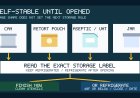
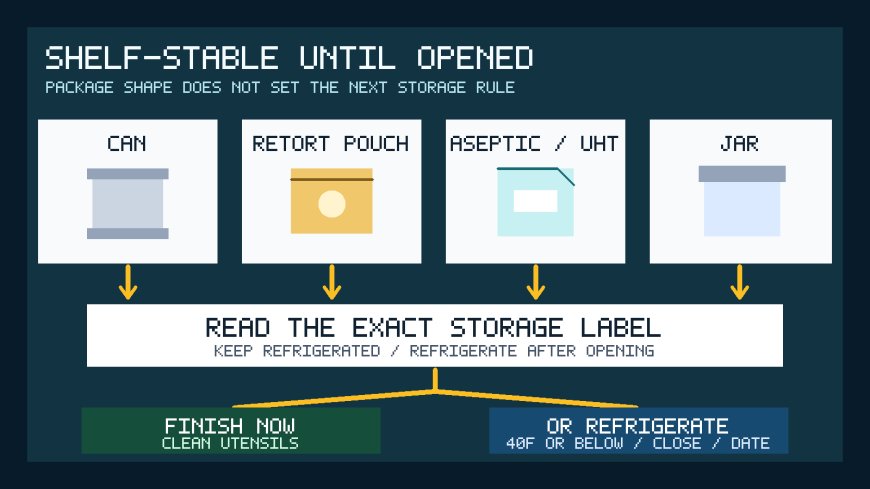
The package shape does not decide the storage rule. The exact label does. Original RVCamping.info decision diagram.
Start with the words, not the container
Campers often sort food by package: cans in one bin, pouches in another, cartons beside the drinks. For food safety, first sort by label language.
- "Keep Refrigerated" applies before opening as well as afterward. USDA notes that not every canned product is shelf stable and gives certain canned hams and seafoods as exceptions that bear this wording.[1]
- "Refrigerate After Opening" means the sealed product may sit on the shelf, but the unused portion needs cold storage after the package is opened. FDA's labeling guidance identifies foods that are stable because of processing yet may become hazardous after opening unless refrigerated.[2]
- A quality-only instruction may use different wording. FDA distinguishes refrigeration needed for safety from refrigeration recommended to preserve quality. Read the complete statement rather than treating every cold-storage phrase as interchangeable.[2]
- No obvious instruction is not permission to improvise. Keep the package, check another label panel, and follow the manufacturer's directions. If the storage rule remains unclear, do not create a campsite leftover you cannot classify.
This is why a metal can is not the category. USDA treats cans, retort pouches and aseptic packages as different forms that can protect shelf-stable foods while sealed. The protection comes from the process and intact package, not from a camper's belief that flexible packaging is "less canned" or a carton is "just a box."[1]
What changes after opening
An unopened package can prevent microorganisms from entering after commercial processing. Once it is cut, peeled, punctured or unscrewed, that sealed barrier is gone. USDA says bacteria can enter opened canned food; its instruction is to put any uneaten amount in a clean container under refrigeration.[1] FDA's label guidance makes the broader point: some processed foods are shelf stable only until opened.[2]
The practical campsite consequence is simple. Treat opening as a status change:
- Read the storage instruction before breaking the seal.
- Note whether the package is single-use, reclosable, or needs another container.
- Serve with a clean utensil. Do not eat from the package and return a used spoon to it if food will be saved.
- Reseal as directed or move the remainder to a clean, covered food container.
- Write the product and opening date on the container.
- Refrigerate promptly when the label or product guidance requires it.
A screw cap, zipper or folded top may control spills, but it does not restore the unopened package. "Resealable" and "shelf stable" answer different questions.
Compare four common camp packages
Metal cans
The narrow can case has its own details, including dent and seam checks. Our guide to storing an opened can at camp covers that case. USDA says an unused portion may be refrigerated in the opened can, although a glass or plastic container is better for quality and flavor.[1]
For this broader package comparison, the useful lesson is that a can's pantry life belongs to its intact seal. Once opened, use the label and the food-specific refrigerated limit. Do not carry the old unopened "best by" date forward as the leftover date.
Retort pouches
A retort pouch is a heat-processed flexible package. USDA lists tuna and other seafood in retort pouches with an after-opening refrigerator period of three to four days; it gives the same three-to-four-day refrigerated period for meat or poultry retort products while directing consumers to use the manufacturer's unopened-storage recommendation.[1]
At camp, scissors, dirty knife tips and hands can touch the cut edge. Open the pouch on a clean surface. If it will not be finished, use a clean utensil, transfer or reseal exactly as directed, and refrigerate the remainder. A clip may stop a leak but does not prove an airtight or food-safe closure.
Aseptic or UHT cartons
Aseptic packaging combines a sterilized product with a sterilized package filled and sealed in a controlled environment. USDA explains that the package's layers block light and oxygen before opening.[1] That explains the room-temperature store shelf; it does not establish an after-opening exemption.
Broth, milk, plant beverage and juice cartons can look nearly identical while carrying different directions and use periods. Read the exact carton. When it requires refrigeration after opening, return it to verified cold storage right after pouring. Wipe a wet spout with a clean disposable towel rather than a used dishcloth, close the cap, and date the carton.
Glass or plastic jars
The lid may twist back on, but the original vacuum or tamper seal does not return. Use a clean spoon instead of dipping a knife that touched bread, meat or another food. Wipe the rim, close the lid, and follow the after-opening wording and stated time limit.
Do not assume that every sauce, spread or condiment follows one universal rule. Formulation matters, and FDA's guidance explicitly separates foods whose post-opening refrigeration protects safety from those where refrigeration protects quality.[2] The product label is a better authority than a campsite habit inherited from a different brand.
Make refrigerator space part of the opening decision
An RV refrigerator is small, and its control dial does not show the actual food temperature. FDA recommends a freestanding appliance thermometer and a refrigerator temperature of 40°F or below. It also warns against overpacking because cold air needs room to circulate.[3]
Before opening a family-size carton or pouch, ask:
- Is there measured 40°F-or-colder space for the remainder?
- Can the package stand or lie securely without leaking?
- Is there a clean covered container if the original package cannot be closed as directed?
- Will anyone know when it was opened?
- Can the group finish a smaller size instead?
If the answer to the first question is no, keep the large package sealed. Choose a single-meal size or another product. Shelf-stable packaging is most useful at camp when it avoids leftovers, not when it creates a warm half-package.
Use the clock when cold storage is delayed
Food that needs refrigeration should not wait on the picnic table while the refrigerator "catches up." FDA says foods needing refrigeration should be chilled quickly. Its consumer guidance uses a two-hour limit at room temperature and one hour when air temperature is above 90°F.[3]
Mark the opening time if service will continue. Return the package to cold storage between uses instead of leaving it beside the stove for the whole meal. If it remained above 40°F beyond the applicable limit, or nobody knows how long it was warm, discard it. Cooling it later does not erase that history.[3]
In a power interruption, use the refrigerator thermometer and time record. FDA says a refrigerated food can remain safe when its period above 40°F is no more than two hours, and advises discarding when that warm period is unknown.[3] The package's former shelf stability does not restart after it has been opened.
A 30-second package check
Use this sequence at the cabinet door:
- Read: Find "Keep Refrigerated," "Refrigerate After Opening," a use-within statement, or another storage direction.
- Plan: Confirm measured cold space and a clean closure before opening.
- Open cleanly: Wash hands, use a clean opener or scissors, and keep the cut edge off the counter.
- Serve cleanly: Use a clean utensil and avoid mouth or raw-food contact.
- Close and date: Follow the package direction; transfer when needed; record the opening date.
- Chill or finish: Refrigerate promptly if required. If reliable cold storage is unavailable, use the whole package now or keep it sealed for another meal.
The safest packing habit is not memorizing a master list of cartons, cans, jars and pouches. It is preserving the label, reading the after-opening sentence, and giving every opened package a visible date and a verified storage location.
Evidence note: USDA FSIS supports the distinctions among shelf-stable cans, retort pouches and aseptic packages, plus after-opening examples. FDA supports the meaning and safety purpose of post-opening refrigeration labels and measured refrigerator practice. The package-comparison layout, opening decision, and 30-second check are original RVCamping.info tools.
Sources
What's Your Reaction?