









Fresh fish at camp: a cold-chain plan from catch or counter to leftovers
Keep freshly caught or purchased seafood cold, separate raw and clean tools, cook by product, control serving time, and chill leftovers safely at an RV campsite.


Fresh fish at camp: a cold-chain plan from catch or counter to leftovers
By Romana
Category: Cooking
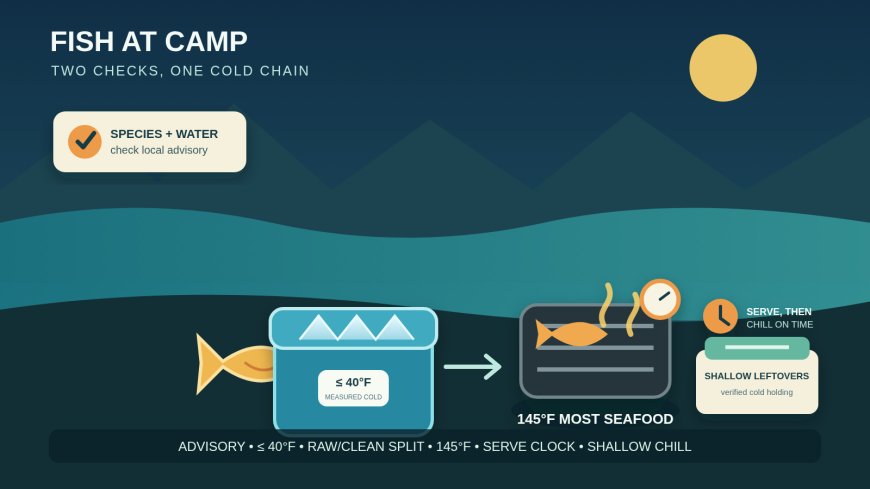
Seafood at an RV campsite needs two separate checks. First, decide whether that species from that water is recommended to eat. Then manage the food itself: keep it cold, contain raw juices, cook it, control serving time and chill leftovers. A clean cooler and a hot grill do not answer a local fish-consumption advisory, and an advisory-free catch still needs safe handling.
For most campsite meals, the working numbers are simple: hold seafood at 40°F or below, cook most seafood to 145°F, and refrigerate or discard perishables before two hours out of temperature control, or one hour when the outdoor temperature is above 90°F.[1][2] Those are boundaries, not estimates. Pack a cooler thermometer, a thin-tip food thermometer and enough ice to stay inside them.
Ask the species question before the food-safety question
A local advisory concerns what was caught, where it was caught and how often it may be eaten. Handling guidance concerns contamination and bacterial growth between harvest, purchase and the plate. Keep the two decisions on separate lines of the meal plan.
For a recreational catch, identify the waterbody and species before keeping fish for dinner. Check the state, tribal or local fish-and-shellfish advisory that applies to that exact location. FDA's fish advice says people eating fish caught by family or friends should check advisories for how often it can be eaten. If no advisory is available, its guidance says to eat only one serving and no other fish that week.[4] The FDA chart is aimed particularly at people who are or may become pregnant, people who are breastfeeding, and children; a local advisory may address a broader audience.
Do this check while you have service, not after the fillets are on the grill. Save the advisory page or take a screenshot, record the waterbody and species, and follow the stricter instruction if more than one relevant authority applies. If you cannot identify the fish or match the catch location to reliable guidance, choose purchased seafood with a known label for that meal.
Start the cold chain at the water or store
For purchased seafood, inspect before it enters the cooler. FDA advises buying fish only when it is refrigerated or displayed on a thick bed of fresh ice. Fish should smell fresh and mild rather than fishy, sour or ammonia-like. Frozen packages should be intact, and the product should still be hard rather than bendable.[1]
At the campsite, "fresh" means recently obtained; it does not mean free of germs. Put purchased seafood on ice or under verified refrigeration promptly. FDA says seafood intended for use within two days after purchase should be held in a clean refrigerator at 40°F or below; otherwise, freeze it.[1]
Treat a fresh catch as a perishable item as soon as you decide to keep it. Have the ice and a watertight food container ready before fishing. Move the catch into cold holding promptly, follow local harvest and cleaning rules, and keep meltwater and fish fluids away from drinks and ready-to-eat food. Do not rely on cool air, shade or cold-looking lake water as a measured holding method.
Pack raw seafood in a sealed bag or lidded container inside the food cooler. FDA's outdoor guidance says raw seafood should be securely wrapped so its juices cannot contaminate cooked food, produce or other food eaten without cooking.[2] A separate beverage cooler is useful because it keeps repeated drink stops from warming the perishable-food cooler.[2] Place a thermometer where you can read the food cooler's actual temperature and limit lid openings.
If the reading rises above 40°F, time matters. Do not reset the decision merely by adding new ice. Use the known time and temperature history and the federal discard rules in this guide; when that history is missing, the conservative campsite decision is not to serve the seafood.
Build raw and clean sides before opening the package
A small RV galley can turn one cutting board into the whole kitchen. Set the traffic pattern first:
- Put raw seafood, its container, the raw knife and raw tongs on one side.
- Put the cooked-food platter, clean tongs, thermometer supplies and garnishes on the other.
- Prepare salad, buns, fruit and sauces before opening raw seafood, then move them away.
- Keep the handwashing setup usable. FDA calls for at least 20 seconds with soap and warm water after handling raw food.[1]
Never return cooked fish to the raw tray. FDA's outdoor guidance says a platter or utensil that held raw seafood must not serve cooked food unless it has been washed first in hot, soapy water.[2] At a dry campsite, bringing a second set is easier and more reliable than trying to improvise a full wash station midway through cooking.
Marinade follows the raw path once seafood enters it. If some will become a sauce, reserve that portion in a separate clean container before raw contact. FDA's outdoor guidance says not to reuse marinade that held raw meat, poultry or seafood.[2]
People with open wounds need another boundary around raw coastal seafood. CDC says a wound can be exposed through contact with coastal water or raw seafood, drippings or juices. It advises people at increased risk to wear protective gloves while handling raw seafood.[3] A glove does not make a leaking cooler safe; it is an added barrier for the person wearing it.
Cook by the product, not by one blanket visual cue
FDA says most seafood should reach 145°F internally.[1] For a thick fish portion, place a clean thin-tip thermometer in the thickest edible section. Check more than one piece when portions differ in size or the camp grill has hot and cool zones. If the probe cannot sit correctly in a very thin fillet, use the agency's product-specific doneness cues as a backup rather than guessing from browned edges.
The cues differ:
- Fish should separate easily with a fork.
- Shrimp, scallops, crab and lobster should become firm, pearly and opaque.
- Clams, mussels and oysters should open during cooking; discard those that do not open.[1]
Raw and undercooked shellfish carry a particular Vibrio risk. CDC says most people get Vibrio infection by eating raw or undercooked shellfish, especially oysters.[3] For shellfish in the shell, CDC directs cooks to discard open shells before cooking, then either boil until the shells open and continue boiling for another 3 to 5 minutes, or add them to a steamer that is already steaming and cook for another 4 to 9 minutes. Eat only shells that open fully during cooking.[3]
Those CDC shellfish directions are specific cook methods, not a general timer for finfish, shrimp or every camp stove. Wind, altitude, starting temperature and batch size change how long other seafood takes. Use the 145°F measurement for most seafood where a thermometer can be used, and follow the cited shellfish method for the product it names.
Give the serving clock a visible start
Write the time on tape when the platter leaves active temperature control. FDA says seafood and other perishable food should not remain out more than two hours, or more than one hour when the temperature is above 90°F.[1] That limit is total exposure, so include prep or table time already spent outside verified cold or hot holding.
Serve smaller portions and refill from controlled storage rather than placing the whole catch on the table. Keep chilled seafood at 40°F or below until serving. If cold seafood will be out longer, FDA advises serving it on ice; the food still needs to stay properly cold rather than merely sitting near melting cubes.[1]
Keep cooked seafood away from the raw station. Use clean utensils for each refill. Do not top a picked-over platter with a fresh batch and restart the clock. The older food and the shared serving surface still carry the earlier time history.
Chill leftovers only while they are still eligible
Refrigeration does not rescue seafood that has already exceeded its serving limit. Before the deadline, divide cooked fish or shellfish into shallow, covered containers and move them promptly into a refrigerator or cooler that can maintain 40°F or below. USDA advises shallow containers for rapid cooling and says wrapped leftovers should be refrigerated or frozen immediately.[5]
An ice chest counts only while measurement shows that it is doing the job. Leave room for cold air or ice contact around the containers, keep raw catch physically separate from cooked leftovers, and avoid burying the thermometer where it cannot be checked. Label the container with the cook date and the time it entered cold holding.
USDA says refrigerated leftovers can be kept for three to four days and reheated leftovers should reach 165°F.[5] In an RV, that storage window assumes continuous refrigeration. A power interruption, warm cooler or unknown travel interval breaks the assumption. When you cannot establish the cold history, discard the leftovers.
The campsite handoff card
Before anyone eats, one person should be able to answer all six:
- Advisory: Is this species from this exact waterbody recommended for these diners?
- Cold: Has the seafood stayed at 40°F or below, with a known time history for any exception?
- Contained: Did raw liquid stay away from drinks, produce and cooked food?
- Cooked: Did most seafood reach 145°F, or did the named shellfish follow the cited product-specific method?
- Clocked: When did prep and serving time outside temperature control begin?
- Chilled: Did eligible leftovers enter shallow containers and verified cold holding before the deadline?
The point of the card is not to make dinner fussy. It prevents one missing answer from being hidden by five good ones. Species advice and safe handling are different checks, and the meal needs to pass both.
Sources
- FDA, "Selecting and Serving Fresh and Frozen Seafood Safely" (accessed September 19, 2026).
- FDA, "Handling Food Safely While Eating Outdoors" (accessed September 19, 2026).
- CDC, "Preventing Vibrio Infection" (accessed September 19, 2026).
- FDA, "Advice about Eating Fish" (accessed September 19, 2026).
- USDA FSIS, "Leftovers and Food Safety" (Wayback snapshot dated September 12, 2026; retrieved from the RVCamping.info source archive because the live page returned 403 to automated retrieval).
What's Your Reaction?