






















Cooked seafood leftovers at camp: make the fridge pass a capacity test
A capacity-first method for cooling cooked seafood in shallow containers, using an ice bath, checking temperatures, and deciding whether a small RV refrigerator can accept the load.

Cooked seafood leftovers at camp: make the fridge pass a capacity test
By Romana | October 13, 2026 | Cooking
A skillet of shrimp, grilled fish or a seafood boil can finish dinner long before a compact RV refrigerator is ready to cool the remains. The decisive question is not whether a lid fits the serving pan. It is whether the leftovers can be divided, chilled and placed where cold air can still circulate.
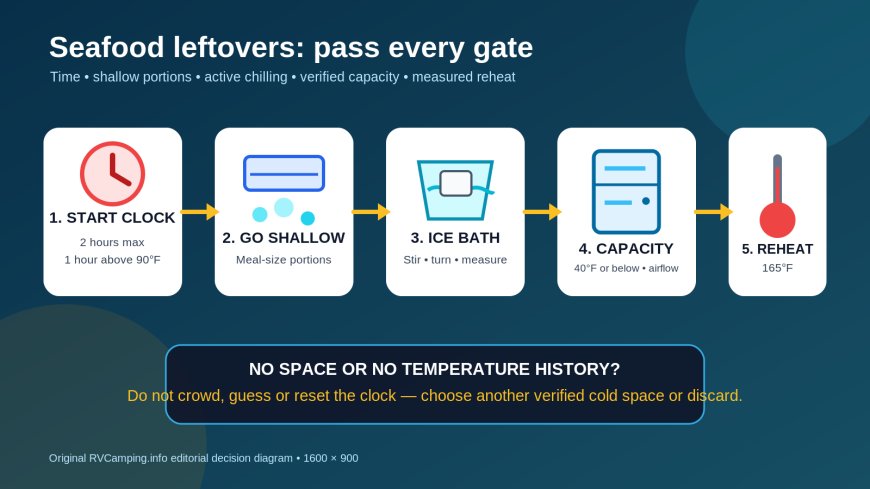
Quick answer: Start the clock when cooked seafood leaves heat control. Refrigerate it within two hours, or within one hour when the food is exposed to air above 90°F.[1][2] Portion it into shallow covered containers. If the containers are still carrying a large heat load, set them in an ice-water bath and stir or turn the food with a clean utensil before refrigerating. Confirm the RV refrigerator is holding 40°F or below with an appliance thermometer.[2][3] Reheat only the portion you will eat to 165°F, checking more than one spot.[1]

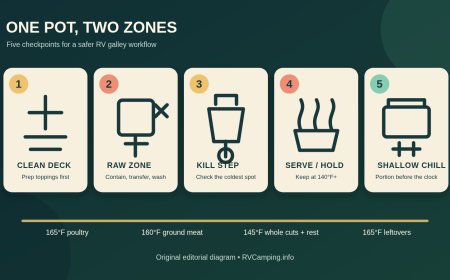
Cooling succeeds only when time, container depth and cold-storage capacity all agree. Original RVCamping.info diagram.
The thesis: refrigerator space is a safety control
A home refrigerator may absorb a few warm containers without much thought. A small RV refrigerator has less shelf area, less air volume and often a busy door. That does not create a new federal temperature rule. It creates a practical capacity boundary: if the seafood containers cannot sit without blocking vents, crowding the cooling fins or displacing already-cold perishables, the refrigerator is not ready for that batch.
FDA tells consumers to keep the refrigerator consistently at 40°F or below, use an appliance thermometer, refrigerate perishables promptly and split large quantities into shallow containers for faster cooling.[1][3] The camp-specific job is to turn those instructions into a load decision before the meal starts.
Do not reserve one deep stockpot-shaped gap. Reserve several shallow, stable spaces. If those spaces do not exist, reduce the planned batch, arrange a genuinely cold second appliance or cooler, or plan to discard what will not be eaten. An unverified cooler full of melting ice is not automatically equivalent to a refrigerator. Measure its food-zone temperature too.
Start with the exposure clock
Write down when the cooked seafood leaves the grill, stove, oven or controlled hot holding. FDA says seafood and other perishable food should not remain out of refrigeration more than two hours, with a one-hour limit when the surrounding temperature is above 90°F.[2] The shorter limit is based on the food's actual exposure, not the day's forecast alone.
The clock includes serving, conversation, cleanup and packing. Moving a platter into RV shade does not reset it. Putting late leftovers over ice does not erase an already-expired limit. When nobody knows the start time, do not invent a reassuring estimate.
Use three labels on a reusable card:
- OUT: time the seafood left temperature control;
- COLD: time the portions entered verified cold storage; and
- USE BY: a conservative meal plan within the cited storage window.
FDA's refrigerator chart lists cooked fish for three to four refrigerated days, but camp conditions argue for planning the next meal rather than using the last possible day.[3] Freeze promptly if the trip plan and appliance can support freezing; otherwise discard on schedule.
Portion for cooling, not for tomorrow's recipe
One large casserole dish is convenient to carry and slow to shed heat. Divide the seafood before refrigeration. FDA advises shallow containers for large amounts of leftovers and specifically recommends dividing hot seafood into smaller containers when it will be reheated later.[1][2]
Make portions meal-sized so the entire batch does not have to come out again. Spread dense items rather than stacking them. Separate seafood from a deep pool of sauce, rice or potatoes when that can be done cleanly; the goal is to reduce the depth and heat mass, not to make a decorative arrangement.
Use clean food-grade containers with intact lids. A loose cover during an active ice bath can admit meltwater; a sealed deep tub can trap a warm core. The workable compromise is a shallow container, protected from splash, with the food spread in an even layer. Close it for storage once the active cooling step is done.
Do not place the original serving platter in the refrigerator if guests have continued picking from it. Transfer the saved portion with clean utensils before service begins, or decide that the platter is the eat-now portion.
Use an ice bath as a heat-removal step
An ice bath is useful when shallow portions are still hot enough to impose a heavy load on a small refrigerator. Put each container in a clean basin with ice and water around the outside. Keep the bath level below the rim. Stir a sauce or loose seafood mixture with a clean utensil; turn larger pieces so heat can escape from different surfaces. Replace melted ice as needed.
The ice bath is not a campsite decoration and it is not cold storage by itself. Check the food with a cleaned and sanitized food thermometer in the thickest or slowest-cooling area. Also watch the exposure deadline. If the batch cannot be cooled and moved into verified refrigeration within the applicable limit, discard it rather than extending the experiment.
FDA's retail cooling material describes a two-stage benchmark for cooked time/temperature-control food: cool from 135°F to 70°F within two hours and to 41°F or below within six total hours, using methods such as shallow pans, smaller portions, ice-water baths and stirring.[4] That Food Code benchmark governs retail practice where adopted; it is useful here as a performance check, not permission for a camper to ignore the stricter consumer instruction to refrigerate perishables within two hours.[1][4]
Run the small-RV refrigerator gate
Before loading the containers, answer all five questions:
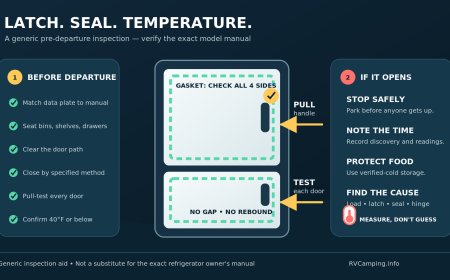
- Temperature: Does an appliance thermometer show 40°F or below?[3]
- Space: Can every container sit flat without being stacked while warm?
- Air path: Will the load leave the appliance's vents, cooling fins and stated clearances unobstructed?
- Existing food: Will adding this heat mass warm milk, deli food or other perishables?
- Power: Will the refrigerator remain on and operating in its approved mode through the cooling period?
The first question has a federal number. The remaining four are appliance and load-management questions. Follow the exact refrigerator manual for loading, ventilation, leveling, travel and power instructions. This article cannot determine those limits without the model number.
If any answer is no, do not wedge the containers in anyway. Continue active chilling only while the exposure deadline and sanitary setup remain valid, shift portions to another verified cold appliance, or discard them. Never move seafood to an unmeasured cooler merely to make the RV shelf look less crowded.
After loading, close the door and stop browsing. Check the appliance thermometer again after the temperature has had time to respond. If the refrigerator cannot maintain 40°F or below, treat that as failed cold storage and use the applicable time history to decide whether food must be discarded.[3]
Reheat one portion and measure several places
Take out only what the group will eat. FDA's safe-handling chart gives 165°F for leftovers.[1] On a stovetop, stir gently so the center and edges trade places. In a microwave, cover, rotate and pause to stir where appropriate. Check the thickest pieces and the coolest-looking part of a sauce, not just the steaming edge.
Seafood quality can deteriorate when repeatedly heated. The safety response is not to use a lower target; it is to make smaller refrigerated portions and reheat once. Discard food with an uncertain cooling history rather than using reheating as a rescue. Heat does not reconstruct a missing time-and-temperature record.
People who are pregnant, older, very young or immunocompromised face greater risk from foodborne illness; FDA specifically advises susceptible groups to avoid raw or undercooked fish and shellfish.[2] For them, a conservative discard decision is especially important.
The before-dinner capacity worksheet
Fill this out while the seafood is still raw or frozen:
| Decision | Write it down |
|---|---|
| Planned cooked quantity | ____ portions |
| Expected leftovers | ____ portions |
| Shallow containers available | ____ containers; depth ____ |
| Ice available after drinks are supplied | ____ lb / bags |
| Verified cold spaces | RV fridge / second fridge / measured cooler |
| Current appliance temperature | ____°F at ____ time |
| Exposure limit for conditions | 2 hours / 1 hour above 90°F |
| Backup if capacity gate fails | smaller batch / eat now / discard |
This is the article's distinct operating idea: leftovers are limited by verified cooling capacity, not by how much seafood the pot or grill can cook. The worksheet makes the limit visible before generosity becomes waste.
Stop and discard when the history breaks
Discard the cooked seafood when:
- it exceeded two hours out of refrigeration, or one hour when exposed above 90°F;[2]
- its time out of temperature control is unknown;
- the refrigerator or cooler was above 40°F long enough that safe history cannot be established;[3]
- meltwater or another contamination source entered the container;
- a clean thermometer cannot confirm the reheat reached 165°F;[1] or
- the group cannot identify when it was cooled and stored.
Smell, appearance and a vigorous reheat do not replace the record. The safe camp meal is the one whose clock, container, cold space and thermometer all tell the same story.
Sources
- Safe Food Handling — U.S. Food and Drug Administration
- Selecting and Serving Fresh and Frozen Seafood Safely — U.S. Food and Drug Administration
- Refrigerator Thermometers: Cold Facts about Food Safety — U.S. Food and Drug Administration
- Cooling Cooked Time/Temperature Control for Safety Foods — U.S. Food and Drug Administration
What's Your Reaction?