





















Campground stay rules: a four-part RV reservation worksheet
A practical worksheet for recording four campground stay-rule layers without treating a successful booking as proof that every limit has been satisfied.


Campground stay rules: a four-part RV reservation worksheet
By Romana | October 13, 2026 | RV Camping
A campground can accept your dates and still leave you with unfinished homework. The booking may satisfy the maximum length of one reservation while breaking a rolling occupancy cap. A three-night holiday minimum may lock in a night you cannot use. Changing the named guest may be prohibited even when changing the dates is allowed.
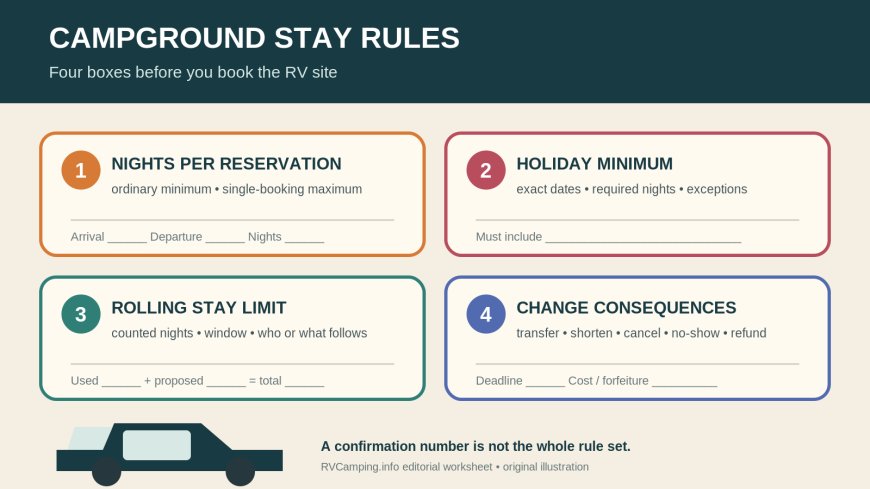
Those are different rules, so record them in different boxes.
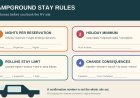
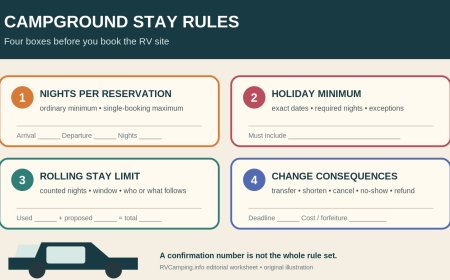
The worksheet below separates four questions: how many nights one reservation may contain, whether specific dates carry a minimum, how earlier or later stays count against a rolling limit, and what changing the booking costs. Official park systems use all four patterns. Washington, for example, limits a stay to 10 nights in one park within 30 days and also caps total use across its state parks at 90 nights in a calendar year.[2] Maryland uses a different calculation: 14 cumulative nights during any 21-day period, followed by seven nights out.[4]
The lesson is not that one formula is normal. It is that the reservation screen is only one part of the rule set.
First, name the four rule layers
1. Per-reservation night limits answer: "How short or long may this booking be?" A one-night minimum on ordinary weekdays, a 14-night maximum, and a rule requiring a weekend pair all belong here.
2. Holiday or event minimums answer: "Do these exact dates force a longer booking?" The holiday definition matters as much as the number. Maryland says holiday-weekend stays must include Friday, Saturday and Sunday.[4] North Carolina uses a two-night minimum between Friday and Sunday on holiday weekends from Memorial Day through Labor Day, but waives that minimum when the site is booked within seven days of arrival.[3]
3. Rolling stay limits answer: "How many nights can this camper, party or camping unit occupy within a moving period?" This is where a second reservation can fail even though each booking is individually short enough.
4. Transfer, change and refund consequences answer: "What happens if the named guest, dates, site or number of nights changes?" A modification may be allowed but expensive. Another change may require cancellation and rebooking. A no-show can erase the remaining stay.
Keep these lines separate. Writing "14-night limit" by itself does not say whether 14 nights applies to one booking, one park, the whole system, a calendar year, or a moving 30-day period.
Copy this RV reservation worksheet
Fill one copy for each campground and date range. Use the current property page, reservation terms and confirmation. If they conflict, ask the campground which rule controls and save the answer.
| Rule box | What to record | Your reservation |
|---|---|---|
| Property and site | Campground, park system, site number/type, reservation URL, date checked | ____________________ |
| Requested stay | Arrival date, departure date, total occupied nights | ____________________ |
| Ordinary minimum | Minimum nights for these weekdays or this site type | ____________________ |
| Single-reservation maximum | Maximum consecutive nights or nights per booking | ____________________ |
| Holiday/event trigger | Named holiday/event, exact controlled dates, required nights | ____________________ |
| Required date pattern | Must include Fri/Sat, Fri/Sat/Sun, fixed week, or another pattern? | ____________________ |
| Late-booking exception | Does the minimum disappear close to arrival? At what cutoff? | ____________________ |
| Rolling window | Example: 10 nights in any 30-day period | ____________________ |
| What is counted | Named guest, party, campsite, camping unit, account, park, or whole system | ____________________ |
| Earlier counted stays | Dates and nights already used inside the rolling window | ____________________ |
| Nights remaining | Limit minus counted nights, with dates shown | ____________________ |
| Required time out | Nights that must pass before returning | ____________________ |
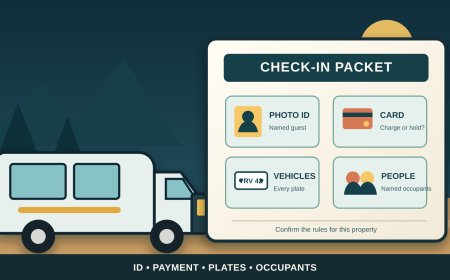
| Named-guest rule | Can the primary occupant be changed? Must that person check in? | ____________________ |
| Date/site changes | Allowed method, deadline and fee or penalty | ____________________ |
| Shortening the stay | Refundable nights, forfeited nights and change fee | ____________________ |
| Cancellation | Deadline, fee, holiday exception and refund method | ____________________ |
| No-show/late arrival | Hold-until time and amount forfeited | ____________________ |
| Early departure | Notice method, checkout cutoff and unused-night refund rule | ____________________ |
| Evidence saved | Confirmation, policy URL, screenshot/PDF, staff name and date | ____________________ |
Do the arithmetic on dates, not on reservation count. A four-night booking plus a six-night booking may be 10 nights inside the same rolling period. Moving the second stay to a new site may change nothing if the policy follows the camper, party or camping unit.
Work the requested dates before paying
Write the arrival and departure dates, then count occupied nights. The departure date is normally not an occupied night. A stay from Friday to Monday is three nights: Friday, Saturday and Sunday.
Now test that count against the ordinary minimum and maximum. North Carolina says a site may be reserved for no more than 14 consecutive nights within a 30-day period. It then applies the same 14-in-30 rule to the camper and requires 16 nights out after reaching the limit.[3] That sentence contains both a reservation ceiling and a rolling occupancy rule. Put each in its own row.
Washington's rule is another useful stress test. The state says one park may not be used for more than 10 nights within 30 days, and total nights across all Washington state parks may not exceed 90 in a calendar year.[2] Changing parks can affect the first number but does not reset the statewide annual total.
Do not assume the booking engine has checked prior stays, another household account or walk-in nights. The safest worksheet records what the rule says is counted, then lists every relevant stay.
Treat a holiday minimum as a date pattern
A minimum-stay rule often controls more than the total number of nights. It can require particular nights or prohibit a Saturday arrival or departure.
Maryland requires two nights for campground stays from Memorial Day weekend through Labor Day, and holiday weekends require three nights including Friday, Saturday and Sunday. The same policy blocks a Saturday check-in or checkout during a holiday period unless the reservation is for at least seven nights.[4] A three-night Tuesday-through-Friday stay would not satisfy that pattern.
North Carolina's rule is narrower: two nights between Friday and Sunday on holiday weekends during the Memorial Day-to-Labor Day season, with an exception for bookings made within seven days of arrival.[3] A traveler should therefore record:
- which holiday or event activates the rule;
- the exact dates the campground treats as the holiday period;
- the number of required nights;
- which nights must be included;
- whether arrivals or departures are restricted; and
- whether a late-booking exception exists.
Save the rule you saw at checkout. Holiday terms can be property-specific, and platform-wide policies may yield to a facility page. Recreation.gov says its standard rules apply to most locations while specific location policies supersede them.[1]
Calculate a rolling limit on a small calendar
A rolling window moves one day at a time. It is not the same as "this month."
Suppose a park allows 10 nights in any 30-day period. You stayed four nights from June 2 through June 6 and want seven nights beginning June 20. All four earlier nights still sit inside the 30-day lookback, so the proposed stay would bring the window to 11 nights. Two separate confirmation numbers do not turn 11 into 10.
Use this calculation:
- Mark every occupied night from the earlier stay.
- Mark every proposed occupied night.
- For each proposed night, look back across the policy's stated window.
- Count all marked nights that the rule says follow the guest, party, unit, park or system.
- Find the first proposed night where the total would exceed the cap.
Maryland makes the counted subject unusually clear: the limit applies to registered campers, members of their camping party and their camping units. The rule permits 14 cumulative nights in a 21-day period, then requires the campers and unit to leave Maryland state park campgrounds for at least seven consecutive days.[4] Switching the reservation name while the same party and RV continue camping would not match that wording.
If the terms are vague, ask a concrete question: "We occupied this RV in this park on these dates. How many of the proposed nights are allowed under your rolling rule?" Save the response with the worksheet.
Record change consequences before choosing a longer stay
Minimum-stay rules can encourage travelers to buy extra nights. That decision is less risky when the cancellation and shortening terms are written next to the minimum.
Recreation.gov's standard policy withholds a $10 service fee on cancellations. For an individual campsite cancelled the day before or on arrival day, it also forfeits the first night's use fee; a one-night reservation cancelled in that window forfeits the full amount. The page warns that location-specific rules can supersede these standards.[1]
Texas uses its own schedule. For individual campsites and screened shelters, reducing nights less than five days before arrival, on arrival or after arrival carries a $10 penalty per removed night up to $50. A cancellation less than five days before arrival uses the same per-night penalty, while a no-show forfeits the entire amount paid other than entrance fees.[5]
North Carolina states that camping cancellations carry a $15 fee. Under the same policy, a traveler receives no refund after failing to arrive, checking out early or cancelling once the arrival date has passed.[3] These terms make an "I'll book three nights and drop one later" strategy a financial decision, not a harmless placeholder.
Write the consequence as an equation:
Expected refund = amount paid - nonrefundable fees - cancellation or change penalty - forfeited nights.
Do not fill the worksheet with "refund available." Record the deadline, the fee, the number of nights forfeited, where the refund goes and whether holiday dates use a stricter rule.
Do not confuse a date change with a transfer
"Transfer" can mean moving dates, switching sites, moving to another park or replacing the primary guest. Those actions may have different rules.
Maryland says the primary occupant named on a reservation cannot be changed after booking and must be present with valid ID at check-in.[4] That is a transfer boundary even if the system allows date edits. Texas, meanwhile, describes changes to individual camping reservations with specific timing penalties, while its page expressly bars park-to-park transfers for lodging and group or day-use reservations.[5] The category matters.
Before paying for someone else, ask:
- Can the primary occupant be replaced?
- Must the original account holder or cardholder appear?
- Can the reservation move to another site in the same campground?
- Can it move to another park?
- Does a move preserve the original rate and cancellation deadline?
- Is the only path cancellation followed by a new booking?
If the answer is cancellation and rebooking, inventory can disappear between transactions. Record that risk instead of describing the booking as transferable.
Recheck after every modification
A change can alter more than the price. New dates can activate a holiday minimum. Shortening a stay can create a penalty. Extending can push the guest over a rolling cap. Switching parks can trigger a local rule that overrides the reservation platform's baseline.
After any edit, repeat four checks:
- Recount the occupied nights.
- Reapply the holiday date pattern.
- Recalculate the rolling window using earlier stays.
- Save the new cancellation, no-show and early-departure terms.
Keep both confirmations. Note the time of the change, the amount charged or refunded and the new policy link. If staff approved an exception, ask for it in writing.
The worksheet is finished only when every row contains a value, "not applicable," or "not stated; campground confirmation requested." A blank box is not permission. It is the next call to make.
Source note: This is a research-based planning worksheet, not legal advice or a claim of firsthand booking experience. The cited policies were reviewed on October 13, 2026 and can change. The current campground page, checkout terms and confirmation control your reservation.
Sources
- Rules and Reservation Policies | Recreation.gov - Platform-wide change, cancellation, no-show and refund rules, plus the warning that facility-specific policies supersede them; captured October 13, 2026.
- Park Rules and Regulations | Washington State Parks - Ten nights per park in 30 days and 90 nights system-wide per calendar year; captured October 13, 2026.
- Camping | North Carolina State Parks - Per-site maximum, 14-in-30 occupancy rule, holiday minimum, cancellation fee and no-refund cases; captured October 13, 2026.
- Maryland State Park Reservation Service | Maryland DNR - Fourteen cumulative nights in 21 days, required time out, holiday date pattern and primary-occupant rule; captured October 13, 2026.
- Changes, Cancellations & No-shows | Texas Parks and Wildlife - Campsite change, shortening, cancellation and no-show penalties, with category-specific transfer limits; captured October 13, 2026.
What's Your Reaction?