









Half a can at camp: where the rest goes and when it gets tossed
A two-lane campsite routine for inspecting cans, transferring opened food, labeling cold storage, and enforcing discard boundaries.

Half a can at camp: where the rest goes and when it gets tossed
By Romana | October 10, 2026 | Cooking
Opening a can changes the storage rules immediately. The unopened product may have crossed three states without ice. Once the lid comes off, the unused portion belongs in cold storage, with a date and a discard boundary.
Quick answer: Inspect the can before opening. Reject leaks, swelling, serious rust, cracks, punctures and deep or seam dents. Clean the lid. After opening, move unused food to a clean covered container for better quality and easier camp handling, then refrigerate at 40°F or below. USDA allows storage in the opened can, but recommends glass or plastic for quality. Use most low-acid canned foods within three to four refrigerated days and high-acid canned foods within five to seven days.[1][2][3]

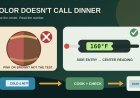
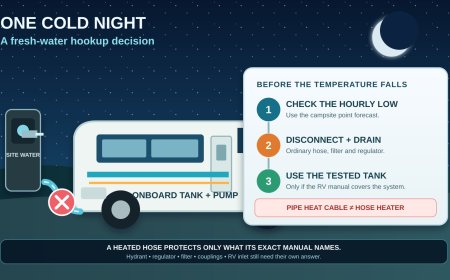
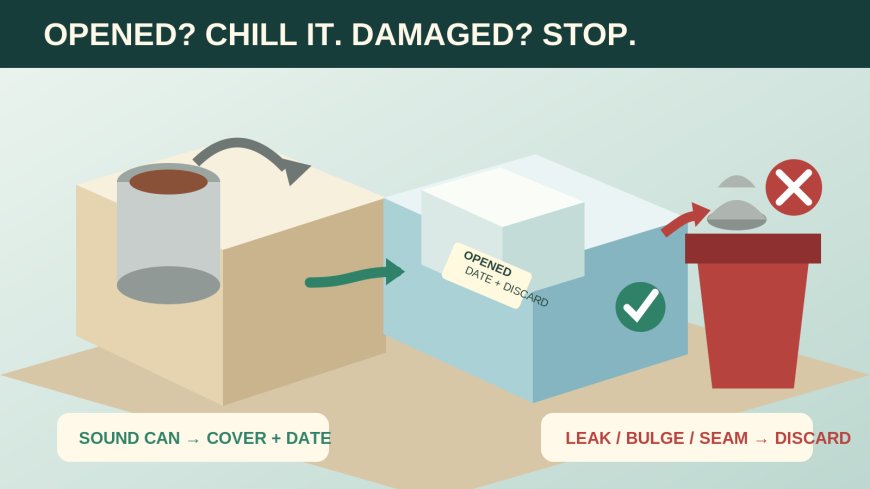
One path leads to a covered, dated container; the other stops before the opener. Original RVCamping.info illustration.
Opening ends shelf storage
Commercial canning gives an intact, shelf-stable product a sealed barrier. Once the can is opened, bacteria can enter. USDA directs consumers to refrigerate unused portions in clean containers.[1] The cabinet is no longer a safe parking place for the half can of beans, tomatoes or soup.
Not every metal can began as shelf stable. Some canned ham and seafood carry “Keep Refrigerated” labeling. Follow that instruction before and after opening.[1] Metal packaging is not enough to classify a product; the label controls.
At camp, decide before opening whether the meal will use the entire amount. If the RV refrigerator is struggling, the cooler has little ice, or no clean covered container is available, choose a smaller can or change the menu. Creating leftovers without reliable refrigeration is avoidable.
The transfer is about control, not fear of metal
USDA says unused food may be refrigerated in the opened can. The agency recommends a glass or plastic storage container to preserve quality and flavor.[1] That distinction matters: transferring is a useful campsite practice, but the source does not say food becomes poisonous merely because it remains in its can in the refrigerator.
A separate container still solves several RV problems. It covers the food, removes a sharp lid and rim, frees refrigerator space, and gives you a surface for a label. Use a clean food-safe container with a tight lid. Do not pour leftovers into a cup that held raw meat marinade or into a tub whose original contents cannot be identified.
Label three facts:
- what the food is;
- the date and time opened; and
- the discard date based on the applicable refrigerated range or a shorter package instruction.
Move the unused portion promptly. An ice chest counts only while it keeps the food at 40°F or below. FDA recommends an appliance thermometer because a refrigerator control setting does not prove the food compartment temperature.[3]
Use the product type to set the date
USDA separates commercially canned foods by acidity after opening.[1]
| Food group | Camp examples | Refrigerated boundary after opening |
|---|---|---|
| Low acid | meat, poultry, tuna, beans, corn, carrots, most soups, pasta products | 3 to 4 days |
| High acid | tomatoes, citrus juices, pineapple, berries, pickles, sauerkraut | 5 to 7 days |
The label can set a shorter period, so follow the shortest applicable direction. “Best by” on the unopened can is not a new after-opening clock. Write a fresh date when the seal is broken.
Mixed dishes need a conservative decision. If canned corn goes into a tuna mixture, the tuna and other perishable ingredients govern. If canned tomatoes become part of chili, treat the finished chili as a cooked leftover rather than extending it to the tomato range. A practical camp label uses the shortest limit among the food, the recipe and the manufacturer's instruction.
Inspect before the opener touches metal
Container damage is a pre-opening decision. USDA says to reject cans that are bulging, leaking, rusted or deeply dented.[1] FDA describes concern signs that include swelling, leakage, punctures, holes, fractures, extensive deep rust and crushing severe enough to interfere with normal stacking or opening. An unexplained sticky exterior can indicate a leak.[2]
Look at both ends, the side wall, and the seams around the top and bottom. FDA specifically warns against seam dents and seam rust in its consumer advice about salvaged food.[4] A sharp or deep dent at a seam is not a discount worth taking to camp.
CDC includes both home-canned and store-bought products in its contamination warning. A leaking, swollen or otherwise abnormal container, or food that spurts liquid or foam on opening, belongs in the trash rather than on a tasting spoon.[5]
Use this stop list:
- bulging or swollen end;
- active leak, pinhole or unexplained stickiness;
- deep rust or rust along a seam;
- puncture, crack or fracture;
- crushing that prevents normal stacking or opening;
- deep, sharp or seam-involved dent.
Discard a suspect can without tasting its contents. Do not feed it to a person or pet. Bag it so nobody retrieves it and follow campground rules for outside trash. Washing the exterior, chilling the can, boiling the contents or cooking the food into a casserole does not restore confidence in a failed container.
Stop again if opening looks wrong
A sound exterior is not permission to ignore what happens next. Clean the lid before opening; FDA calls this out as a canned-food practice.[3] Wash the opener wheel and the work surface too, especially after the can has ridden in a dusty storage bay.
A normal vacuum-packed can may make a small sound as the seal breaks. Stop if liquid or foam spurts out, the food has an unusual appearance, or there is an off odor. CDC warns that botulinum toxin cannot be reliably detected by sight, smell or taste, so tasting is never a safety test.[5]
Keep the product label until the food is gone. If a recall appears, the brand, product name, lot code and date may determine whether your can is involved. A clear container marked only “beans” loses that traceability.
Draw hard boundaries around the leftovers
Opened canned food gets discarded when any one of these conditions applies:
- It sat outside refrigeration beyond two hours, or beyond one hour in outdoor temperatures above 90°F.
- The refrigerator or cooler could not hold 40°F or below and the time above that limit is unknown.
- It reached the end of its after-opening range: generally three to four days for low-acid food or five to seven for high-acid food.[1][3]
- A shorter package direction expired.
- Raw food, dirty water, hands or utensils contaminated it.
- Nobody can say when it was opened.
- The container or food showed a warning sign before or during opening.[1][2][4][5]
Do not reset the clock by moving old food into a new container. Reheating is not a repair for an unknown cold-chain history. Smell cannot certify safety, and “just one taste” is exactly the experiment federal guidance tells consumers not to run.[5]
If power fails, keep the refrigerator door closed and check the appliance thermometer. FDA says refrigerated perishables are generally safe if power is out no more than four hours with the door kept shut; food that has been above 40°F for two hours or more should be discarded.[3] Use the agency's outage guidance and the product label for the actual event rather than guessing from how cold a container feels.
A two-lane can routine
Keep the campsite process visible:
Lane 1: unopened
- Read the storage label.
- Inspect ends, body and seams.
- Reject damage before opening.
- Clean the lid and opener.
Lane 2: opened
- Serve with a clean utensil.
- Transfer unused food to a clean covered container.
- Mark contents, opening time and discard date.
- Refrigerate at 40°F or below immediately.
- Discard at the first crossed boundary; do not taste to decide.
This routine is deliberately different from judging pantry heat exposure. Its focus is the moment the seal breaks: protect the food, preserve its identity, measure cold storage and know when the leftovers stop being eligible for dinner.
Evidence note: USDA supplies commercial-can storage and after-opening ranges. FDA supplies refrigerator temperature, lid cleaning and damaged-container descriptions. CDC supplies contamination warning signs and the no-taste boundary. The label format, mixed-dish rule and two-lane routine are original RVCamping.info planning tools.
Sources
- Shelf-Stable Food Safety — USDA Food Safety and Inspection Service
- Are You Storing Food Safely? — U.S. Food and Drug Administration
- Refrigerator Thermometers: Cold Facts about Food Safety — U.S. Food and Drug Administration
- Surplus, Salvaged, and Donated Foods — U.S. Food and Drug Administration
- Home-Canned Foods and Botulism Prevention — Centers for Disease Control and Prevention
What's Your Reaction?