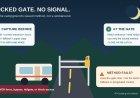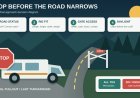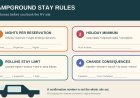




















Locked campground gate, no cell signal: the lawful access plan
Capture the exact campground gate procedure before cell service drops, then use a lawful fallback when a code, entrance, or after-hours method fails.

A campground entrance is the wrong place to discover that the gate code lives only in an email you cannot open. It is also the wrong place to treat a locked gate as a puzzle. Different parks use different systems: a reservation-specific code, an unlocked gate that campers slide open, a hard nightly closure, or no after-hours entry at all. A reservation does not turn those systems into interchangeable suggestions.
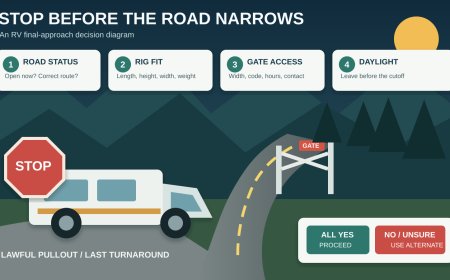
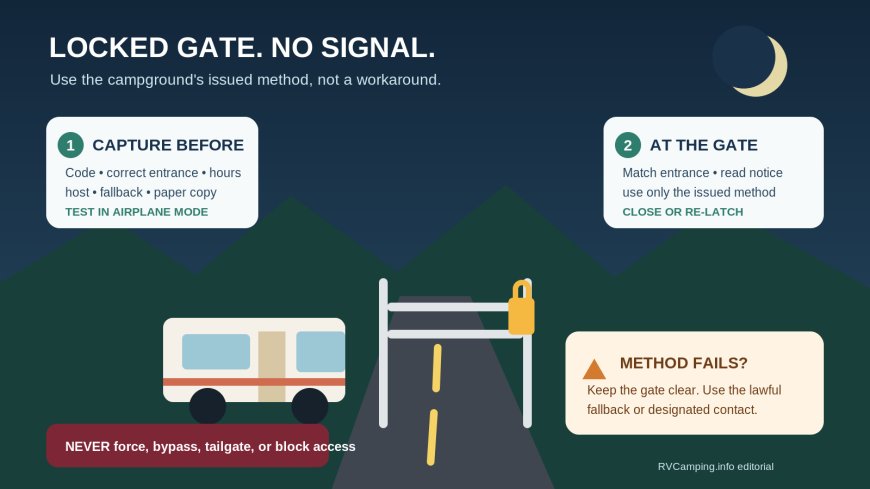
The fix starts before the RV loses service. Capture the instructions for the exact campground and travel date, learn which entrance campers may use, and decide where you will stop if the authorized method fails. This is a gate-access plan, not another general late-check-in checklist or offline route card. Its job is narrow: get a registered camper through the lawful entrance without guessing, and keep a closed entrance clear when entry is not authorized.
First identify the kind of gate you are dealing with
Do not reduce the campground's policy to "there is a gate." Find out which of these descriptions applies to your stay:
| Gate condition | What counts as authorized access | What to capture |
|---|---|---|
| Reservation code | The code delivered through the official reservation or park channel | Code, gate location, valid dates, entry steps, and check-in follow-up |
| Camper-operated gate | The park expressly tells arriving campers how to open and reclose it | Exact mechanism, latest permitted arrival, re-latching step, and next-morning registration |
| Staff-controlled entry | Staff or a host must admit you, issue instructions, or approve a late arrival | Office hours, call-ahead deadline, host location, and reservation-hold rule |
| Hard nightly closure | Vehicles cannot pass until reopening, except emergency responders under park procedure | Closing and opening times, legal overnight fallback, host contact, and emergency instruction |
Gulf Islands National Seashore provides a clean example of the first type: its FAQ says the entrance code accompanies the reservation confirmation and directs campers arriving after the office closes to a host or next-day check-in.[1] Washington State Parks describes a different method. Its statewide camping page says a late camper may operate the gate's slider bar, close the gate after entry, and register the next morning.[2] That is permission tied to that system, not a general license to handle any campground gate.
Silver Strand State Beach shows the opposite boundary. Its published rules state that once the nightly gates are locked, vehicles cannot enter or leave. The park publishes seasonal closing times, says emergency personnel can access the facilities, and tells campers with special circumstances to ask employees about parking or access options.[4]
Those examples settle the first planning rule: copy the procedure for your campground. Do not import one park's procedure into another park's lock.
Capture an access packet before the last reliable signal
A screenshot of a six-digit code is not enough. Build a small packet that still makes sense when the phone is offline and the driver is tired.
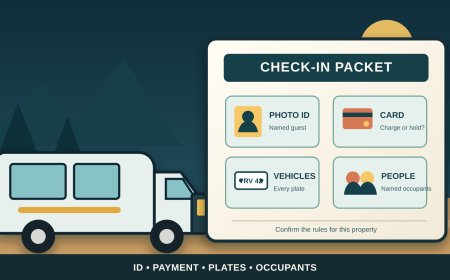
Save these items together:
- campground name, park name, and the street address or coordinates of the authorized camper entrance;
- reservation holder's name, reservation number, site number, and stay dates;
- gate code or exact opening procedure, if the park issued one;
- gate hours and the latest permitted camper entry time;
- instructions for after-hours registration or next-morning check-in;
- office number, park dispatch or ranger number if published, and the host site or kiosk location;
- a screenshot of the relevant confirmation paragraph, not merely the inbox subject line;
- a simple entrance sketch showing the final public road, legal turnaround, and any signed alternate entrance; and
- one lawful fallback that can accept the RV at the hour you expect to arrive.
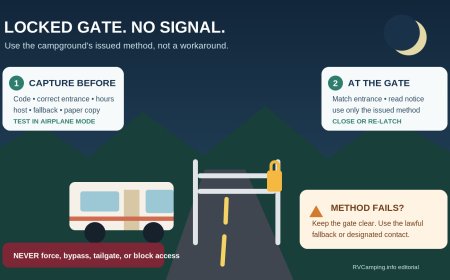
Store the packet in two forms. Put a local copy on each adult traveler's phone, then keep a paper copy in the cab. Test airplane mode before departure: open the file, enlarge the code, read the phone number, and confirm the map is available without a network request. Avoid placing a live gate code in a shared photo album, public trip board, social post, or windshield note. It is access information, not a travel souvenir.
Read the entire confirmation before extracting anything. Texas Parks and Wildlife says its confirmation includes current park information and directions, and it tells campers who expect to arrive after office closing to call during office hours. That call protects the reservation; the camper must still complete check-in by the stated next-day deadline.[3] A saved code cannot substitute for a required call.
Make the last connected stop your decision point
Choose a fuel stop, town, visitor center, or other safe place before the coverage gap. At that point, confirm four facts:
- The reservation is active for tonight and the named party is present as required.
- The gate procedure came from the park or reservation confirmation, not a review, forum post, or previous guest.
- The entrance shown in the packet is open to your type and size of RV.
- Your estimated arrival remains inside any gate or late-entry limit.
If one answer is unresolved, call while the call can still connect. Ask a concrete question: "We have site 42 tonight and expect the office to be closed. Which vehicle entrance may a 34-foot motorhome use, and what should we do if that gate is locked?" Record the employee's name if offered, the call time, and the instruction. Do not ask staff to text information if you know the route soon loses data; read it back while still connected.
This checkpoint also protects the fallback. A campground, commercial RV park, or other overnight location may have its own office deadline and vehicle restrictions. Confirm permission rather than assuming an empty lot is available.
If the entrance is locked and the phone has no service
Stop where the RV is fully out of the travel lane, but do not block the gate, shoulder access, fire lane, or turnaround. Turn on hazard lights if needed for immediate traffic safety. Then work through this order:
- Match the entrance. Compare signs, road name, coordinates, and your saved sketch. Service gates and emergency lanes may look convincing in the dark.
- Read the posted notice. A closure, weather order, changed code, or temporary entrance may supersede the older packet.
- Use only the issued method. Enter the reservation code or operate the gate only if the official instruction covers that entrance and your stay.
- Restore the gate. Close or re-latch it exactly as directed. Do not leave it open for an unknown vehicle.
- Find the designated human contact. If the park identifies a host site, kiosk, intercom, or after-hours station, approach safely and observe quiet hours.
- Leave for the fallback when authorization is missing or the method fails. A locked entrance is not permission to experiment.
If you need to move to regain a signal, use a public road and a legal pullout. Walking along an unlit access road can create a second problem, especially around a long RV, traffic, wildlife, or steep shoulders. Leave the rig only when it is legally and safely parked and an adult remains with it when appropriate.
Keep routine access trouble separate from an emergency
A late arrival, dead phone battery, rejected code, or desire to retrieve an item is normally an access problem. Use the fallback or the park's published non-emergency route. Do not call 911 merely to have a gate opened for convenience.
Threats to life, fire, a serious crash, or another immediate hazard are different. Follow the emergency instruction posted by that park. Silver Strand tells campers to call 911 and contact a campground host after closure; it also states that emergency personnel can get into the facility.[4] That arrangement is a reason to keep the entrance clear, not a reason to defeat the gate yourself.
Cell coverage can fail during the emergency too. Rocky Mountain National Park warns that some cellular 911 calls do not connect or may be weak and broken. It advises callers who do connect to give an exact location using park roads and campground maps.[5] Your paper packet should therefore include the campground name, entrance road, loop, and site number. If the call drops, that location may be the most useful information the dispatcher received.
If no call will connect, use the park's published on-site emergency method: host, emergency phone, call box, staffed building, alarm, or a trip to the nearest known signal point when it is safe to travel. Do not invent a universal procedure. The correct route depends on the park and the emergency.
What never to do at a locked campground entrance
- Do not ram, pry, cut, lift, dismantle, or drive around a locked gate.
- Do not follow another vehicle through unless your own reservation and the park's procedure authorize your entry.
- Do not try a code found in a review, campground group, old email, or previous stay.
- Do not ask another camper to disclose a code that the park did not issue to your party.
- Do not park across the gate while troubleshooting. Responders, staff, and exiting campers may need the lane.
- Do not drive onto the shoulder, vegetation, a pedestrian path, or an emergency road to bypass the entrance.
- Do not leave a gate open because the next RV "is probably camping here."
- Do not treat a reservation receipt as authority to ignore posted closures, evacuation orders, or staff direction.
- Do not use 911 as a routine gate service.
These are practical boundaries as much as legal ones. A bypass can damage the RV, start a fire in dry vegetation, trap the rig on soft ground, expose pedestrians to a moving vehicle, or obstruct emergency access. It can also put the driver in an area that was closed for weather, flooding, fire, wildlife, construction, or security.
A 60-second gate plan for the trip folder
Complete this block for every gated campground:
- Authorized camper entrance: ____________________
- Gate type and hours: ____________________
- Official access method: ____________________
- Reservation/site/stay dates: ____________________
- Required call before closing: yes / no; deadline: __________
- After-hours host or station: ____________________
- Next-morning check-in: ____________________
- Emergency location wording: park, road, loop, site: ____________________
- Last reliable-signal stop: ____________________
- Lawful fallback and latest arrival: ____________________
- Packet tested in airplane mode: yes / no
- Paper copy in cab: yes / no
The gate plan succeeds before the gate comes into view. The authorized method is saved, the closing boundary is understood, and the fallback remains reachable. If those pieces are missing, solve the problem while communication still works. A locked entrance after dark is a boundary to respect, not an invitation to improvise.
Sources
- Gulf Islands National Seashore FAQ: campground gate codes and after-hours contact — National Park Service; accessed October 13, 2026.
- Washington State Parks camping guidance: late arrival and gate procedure — Washington State Parks; accessed October 13, 2026.
- Texas State Parks reservation FAQ: confirmations and arrival after office closing — Texas Parks and Wildlife Department; accessed October 13, 2026.
- Silver Strand State Beach campground information and gate regulations — California State Parks; accessed October 13, 2026.
- Rocky Mountain National Park guidance on cellular 911 limitations — National Park Service; accessed October 13, 2026.
What's Your Reaction?