













Booking RV Sites and Glamping Tents During Wildfire Season: A Group Safety Checklist
Before booking RV sites and glamping tents in wildfire season, confirm exit routes, alerts, mobility and pet plans, plus written refund triggers.

Booking RV Sites and Glamping Tents During Wildfire Season: A Group Safety Checklist
A mixed group can book during wildfire season, but the property needs to answer harder questions than “What is your smoke policy?” Before anyone pays, get the exit route, alert process, vehicle plan and cancellation triggers in writing.
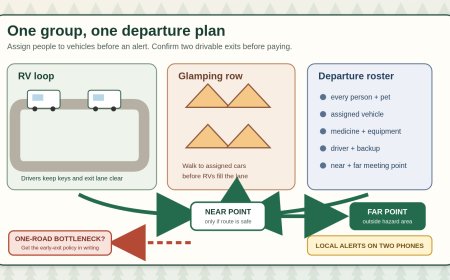
Wildfire planning gets complicated when half the group can drive away from an RV pad and the other half must walk out of a canvas tent, find their car and join a queue. Treat the campground as a small transportation problem. Every person, pet, prescription and vehicle needs a place in the plan.
The short version: do not book until you know whether the property has a second drivable exit, who tells guests to leave, how glamping guests reach their vehicles, where the group will meet off property and exactly what happens to everyone’s money if an order, warning or road closure interrupts the stay.

The 12 questions to ask before paying
Send these in one email. Ask the property to answer beside each number so the reply becomes part of the booking record.
- What is the property’s physical address, evacuation zone and county?
- Is there more than one drivable way out? If so, will both routes accommodate our longest RV and any tow vehicle?
- If the public road is blocked, is the second route usable by guests, or is it gated, private, unmaintained or reserved for emergency crews?
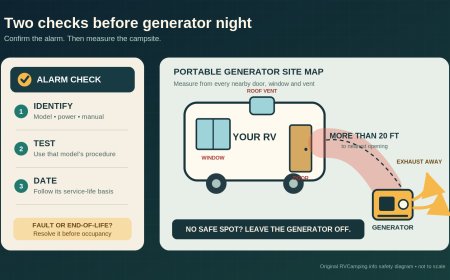
- How do you notify guests: text, call, siren, staff visit or another method? What happens after quiet hours?
- Which local alert system should every adult join, and can a visitor register the campground address?
- Where are glamping guests’ cars parked relative to their tents? Could pedestrians and departing RVs conflict on the same lane?
- Can RV guests keep tow vehicles attached or park facing out when fire conditions are elevated?
- Where is the property’s assembly point, and is it a gathering point or a place intended to withstand fire? Do not assume those are the same.
- What help can the property provide to a guest who needs accessible transportation or extra boarding time?
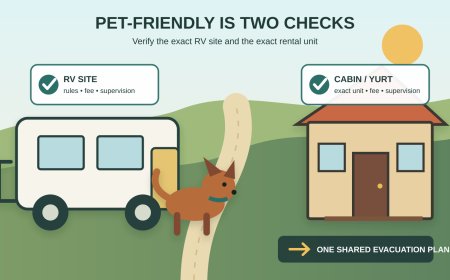
- Where may pets go if the property evacuates? Are there carrier, leash, vaccination-record or vehicle restrictions?
- Which events qualify for a refund, date change or credit: property closure, evacuation order, evacuation warning, access-road closure, utility loss or the guest’s decision not to travel?
- Are taxes, cleaning fees, reservation fees, add-ons and third-party booking fees returned on the same terms as lodging charges?
A phone conversation is useful for nuance. Follow it with: “Thanks for speaking with me. This is my understanding...” and list the answers. Ask the property to correct anything inaccurate.
Start with the road, not the tent
Ready.gov tells households to learn evacuation routes and decide where they will go before a wildfire forces a quick departure.[1] For a group booking, turn that broad advice into a property test.
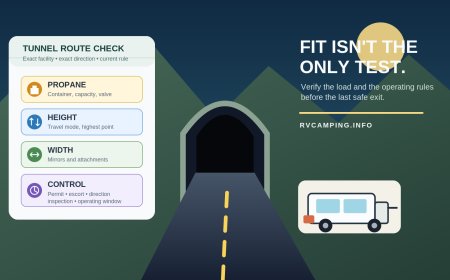
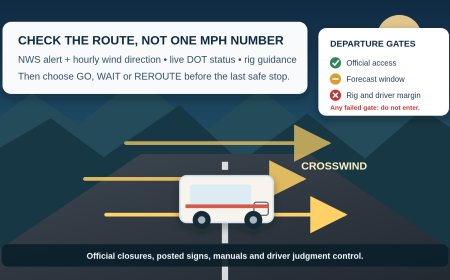
Open a map and trace the campground driveway until it meets two separate public roads. A loop inside the property is not a second exit if both ends feed the same bridge, canyon road or gate. Ask whether an RV can make every turn without backing, whether low branches or weight limits affect the route, and whether staff control a locked gate.
The National Interagency Fire Center’s home-preparation guidance calls for two different entrance and exit routes.[4] That is not a lodging guarantee or a rule that every campground must meet. It is a useful warning sign: a property with one way in and one way out deserves a clear early-departure plan, not a casual assurance that staff will handle it.
For the largest rig in the group, write down:
- overall length with tow vehicle or toad;
- height and width;
- whether the driver can depart without disconnecting utilities under pressure;
- where a second qualified driver will be; and
- whether the exit requires a U-turn, backing maneuver or gate code.
If the only safe plan depends on hooking up a trailer after an alert, build more margin. In elevated conditions, ask whether the campground permits the group to remain hitched and park facing the exit. A reservation is replaceable. A rushed hitching job in a crowded lane is a bad fallback.
Enroll visitors in the alerts that cover the property
Do not rely on one group member’s weather app. Ready.gov recommends several ways to receive warnings, including local community alerts, Wireless Emergency Alerts and the Emergency Alert System.[1]
Before the cancellation deadline:
- Get the property’s county, evacuation zone and exact street address.
- Find the county emergency management or sheriff alert-registration page from an official government site.
- Ask whether visitors can register the campground address without local residency.
- Have at least two adults in different vehicles enroll.
- Enable Wireless Emergency Alerts on every phone that supports them.
- Save the county emergency page and non-emergency number for offline reference.
- Ask the host which source staff monitor overnight and how they relay an alert when cell service fails.
Alert terms vary by state. In California, for example, an Evacuation Warning means a potential threat and specifically says people needing more time, along with people who have pets or livestock, should leave then. An Evacuation Order means an immediate threat and a lawful direction to leave now.[5] Learn the terms used where you are staying instead of importing California’s labels into another state.
Use two meeting points
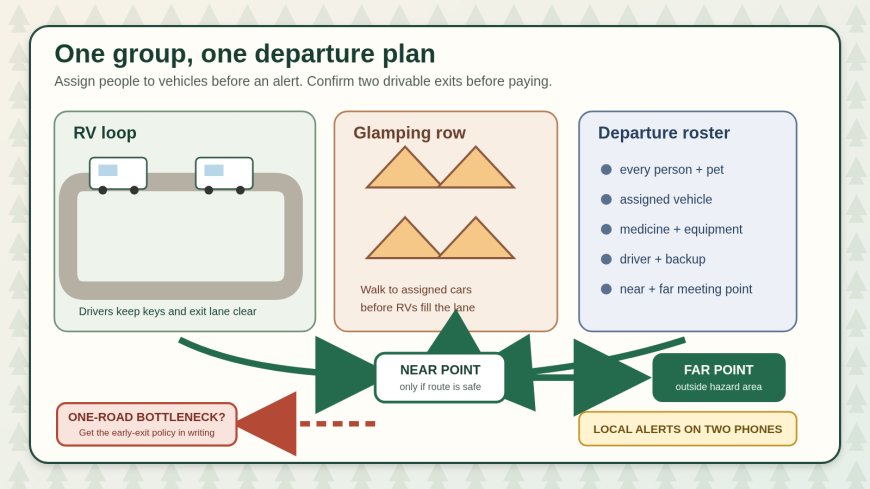
A mixed group can separate within minutes. One RV may leave from its pad, a family may be returning from a trail and glamping guests may be at a remote parking lot. Ready.gov advises choosing a familiar meeting place and planning how people will reconnect.[2]
Choose both of these before arrival:
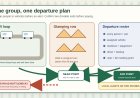
- Near point: a location outside the campground entrance where the group can gather only if officials say the route is open and the location is safe.
- Far point: a town or landmark well outside the hazard area, reachable by more than one road.
The trip leader should also name one contact outside the region. Each vehicle texts that person after leaving: vehicle name, occupants, pets, route and destination. The contact maintains the roster so drivers are not trying to coordinate a group chat while moving.
Never make the near point a reason to wait in danger. If officials direct traffic elsewhere, follow their instructions and proceed to the far point when safe.
Build the departure roster around people, not reservations
A campsite list tells you where people sleep. It does not tell you how they leave.
Create a one-page roster with a row for every person and pet. Record the assigned vehicle, driver, backup driver, mobility or communication help, medication cooler, pet carrier and far meeting point. Keep a printed copy in each lead vehicle and a digital copy available offline.
Then set departure roles:
- One adult checks the glamping tents and shared spaces.
- One adult accounts for people and pets from the roster.
- Each RV driver handles only that rig and its passengers.
- One person carries the group document folder and charging bank.
- The last vehicle is named in advance; nobody improvises a sweep.
The plan should work if the trip leader has no signal or is away from camp.
Plan for mobility, medication and animals before arrival
Ask privately what each traveler needs to move, communicate and stay medically stable. Do not wait for a warning to discover that a wheelchair will not fit in the assigned vehicle or refrigerated medicine is in a tent across the property.
Ready.gov recommends arranging accessible evacuation transportation in advance, planning how assistive devices will travel and discussing an emergency medicine supply with a doctor or pharmacist.[3] Apply that guidance to the booking:
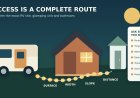
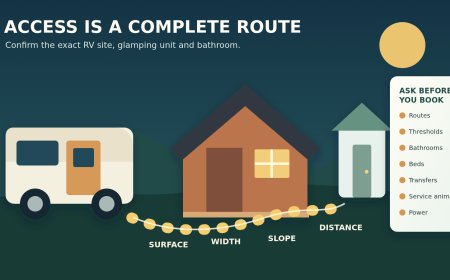
- Confirm the accessible route from each glamping unit to parking, including slope, surface, lighting, gates and distance.
- Assign a vehicle with enough door clearance, cargo space and passenger help for each mobility device.
- Carry chargers, spare batteries and written equipment instructions where practical.
- Keep prescriptions, dosage information, allergy details and refrigeration supplies with the traveler, not in a different rig.
- Decide which adult helps a child or traveler who may struggle with a noisy, unfamiliar departure.
Pets need seats too. Record which vehicle takes each animal and keep leashes or carriers where they can be reached without unpacking. Ask whether the far meeting point and backup lodging accept pets. Ready.gov notes that some shelters admit service or support animals but not pets, so “we will go to a shelter” is incomplete planning.[3]
If anyone needs extra boarding time, that person’s vehicle should generally leave at the earlier local warning stage rather than wait for the last possible instruction. Follow local officials, since terminology and conditions differ.
Put cancellation terms into a trigger table
“Wildfire policy” is too vague. Ask the property to complete a trigger table before you submit a large deposit.
| Event | Cancelled by | Refund, credit or no relief? | Deadline or proof required? |
|---|
|---|---|---|---|
| Property closes | Host | ||
|---|---|---|---|
| Official evacuation order covers property | Guest or host | ||
| Official evacuation warning covers property | Guest | ||
| Sole public access road closes | Guest or host | ||
| Utility outage makes lodging unusable | Host | ||
| Air is smoky but property remains open | Guest | ||
| One household cancels but others travel | Guest | ||
| Stay is cut short after check-in | Guest or host |
For each row, ask whether the remedy is cash returned to the original payment method, a credit with an expiration date or a date change subject to a rate difference. Clarify whether relief applies to the whole mixed booking or only the affected RV sites and glamping units.
Also ask who controls the money. A campground may approve a refund while an online travel agency controls processing or keeps its own fee. If different households are paying separately, request separate confirmations and receipts.
No checklist can promise a refund. The controlling terms are the booking agreement, the rate selected, the property’s written policy, any platform terms and applicable law. If the answer is “case by case,” ask who decides, what evidence they review and when the decision is made. Decide whether that uncertainty is acceptable before paying.
Preserve the record while everything is calm
Web pages and booking screens can change. Save the evidence that shows what everyone agreed to on the date of purchase:
- PDF or screenshots of the listing, cancellation policy and checkout terms;
- the property’s written answers to the 12 questions;
- reservation confirmation, itemized receipt and payment record;
- the names and dates of phone conversations, followed by email confirmation;
- notices from the property, booking platform and local authority;
- official maps or alert pages showing the property’s zone;
- road-closure notices and the time they were retrieved; and
- photos or video if access is physically blocked or the property is closed.
Keep originals. Do not crop away the URL, date, sender or reservation number. Store copies offline because a roadside dispute is exactly when a login or signal may fail. Evidence does not create a refund right, but it makes the timeline and the promises easier to evaluate.
Run a ten-minute drill after check-in
Before chairs, awnings and camp kitchens spread out, every driver should walk or drive the exit route. Locate glamping parking, gate controls and the property assembly point. Confirm that the rig keys are with a driver and that nobody has blocked a lane with a tow vehicle.
Then test the roster: every person says their vehicle, near point and far point. Put shoes, glasses, medication, identification, phone and pet gear where they can move with the traveler. Keep awnings and exterior gear ready to stow quickly when local fire conditions worsen.
If officials order evacuation, leave immediately.[1] Do not wait to regroup at the campsite, retrieve replaceable gear or argue about the cancellation policy. Money questions belong in the evidence folder. The road belongs to people leaving and responders coming in.
When to walk away from the booking
Decline the property if it will not identify its jurisdiction or alert process, cannot explain how glamping guests reach transportation, or dismisses a single access road without an early-departure procedure. The same goes for a large nonrefundable group deposit paired with cancellation language nobody will put in writing.
A workable plan does not require a perfect forecast. It requires honest property answers, enough vehicles for the people who need them, an exit the rigs can use and written terms the group can afford to accept.
Sources
- Wildfires | Ready.gov (accessed September 15, 2026; archived with this article)
- Make A Plan | Ready.gov (accessed September 15, 2026; archived with this article)
- People with Disabilities | Ready.gov (accessed September 15, 2026; archived with this article)
- Prepare and Protect Your Home | National Interagency Fire Center (accessed September 15, 2026; archived with this article)
- Evacuation Terminology | California OES Wireless Emergency Alerts (accessed September 15, 2026; archived with this article)
What's Your Reaction?