









GasStop GSUSA2 review: strong backup for a broken propane line, with fit limits
Research-based GasStop GSUSA2 review covering ACME fit, 75,000 BTU/h capacity, slow-leak limits and a practical RV load check.

The GasStop GSUSA2 adds a useful layer to a travel trailer or fifth-wheel propane system. It sits directly on a removable cylinder's Type 1 QCC/ACME connection and closes completely when flow suddenly rises far enough to resemble a major line failure.[1] That is a narrow job, but a worthwhile one.
It does not watch for every leak.[2] A seeping fitting, an extinguished burner or another slow release may stay below the trip point.[1][2] The pressure dial can help with a pre-use pressure-decay check, but it is not an automatic slow-leak detector and it does not replace the RV's LP alarm.[1][2]
This is a research-based review. RVCamping.info did not buy, install or physically test the product. As an Amazon Associate, RVCamping.info may earn from qualifying purchases. The reviewed listing is the two-pack GSUSA2 for RV ACME connections, ASIN B0B73WNBVF. Check the exact model and package on Amazon; the listing must say GSUSA2, two-pack and ACME/Type 1 rather than the POL version.[5]
The right buyer has removable cylinders and room under the cover
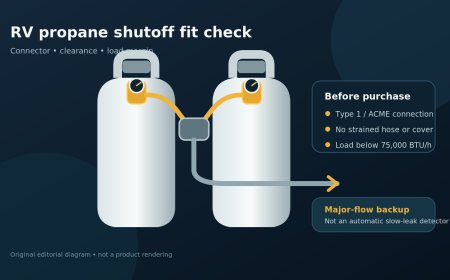
The GSUSA2 is aimed at towables with removable DOT cylinders and the familiar large hand-tightened Type 1 connector.[1] It is not the GSUSA1 POL model used for a different connection arrangement.[1] The manual requires the valve to mount directly on the cylinder, remain within 45 degrees of vertical, feed a regulator no higher than 20 inches water column and use a supply hose rated above 70 SCFH.[1] It specifically warns that lower-flow hose limiters or another excess-flow valve can interfere with shutoff behavior.[1]
That makes a five-minute inspection more valuable than a long feature list. Read the labels on the cylinder connector, regulator and pigtail. Check that the added valve will not force the hose into a hard bend or foul the cylinder cover. StressLess Camping's installation report found that the valve protruded enough to make an angled replacement hose useful on its trailer.[4] A fit problem here is not cosmetic; a strained high-pressure pigtail is a reason to stop and change the layout.
Buyers with a permanently mounted motorhome tank, a marine installation, a regulator above the manual's limit, an unidentified pigtail or a cover that presses on the valve should skip this exact model until a qualified propane technician identifies a compatible arrangement.
Count the appliance load before adding the valves
GasStop rates the GSUSA2 for 70 SCFH, stated as 75,000 BTU per hour at 61°F.[1] The valve is calibrated to close at 125% or more of that guaranteed flow.[1] High simultaneous demand can therefore look like an emergency, especially in cold weather or on a long system.[1] The manual says the unit may shut off more readily near freezing and can also trip when consumption exceeds its recommended capacity.[1]
Use the appliance nameplates rather than typical internet figures. Add the input ratings for every propane appliance that could run together, then compare the sum with 75,000 BTU/h.
| Example load check | Nameplate input |
|---|---|
| Furnace | 30,000 BTU/h |
| Water heater | 20,000 BTU/h |
| Range burners in use | 12,000 BTU/h |
| Total simultaneous load | 62,000 BTU/h |
| Remaining below the published capacity | 13,000 BTU/h (17.3%) |
This example is a worksheet, not a claim about your RV. Replace every number with the rating from the installed appliance. A 62,000 BTU/h total falls below the published capacity, but 17.3% is not much margin for a generator, outdoor appliance, colder conditions or an inaccurate assumption. A propane generator deserves particular attention because its fuel demand may push the system toward the valve's limit. If the labels are missing or the total approaches 75,000 BTU/h, have the system reviewed instead of treating the arithmetic as an approval.
The gauge is better for a leak check than for tank level
The dial measures pressure, not liquid propane quantity.[2] Temperature, vaporization rate and current demand all affect that reading.[2] GasStop says the low zone may warn that usable liquid is nearly gone, but the gauge cannot tell you that a cylinder is, for example, 42% full.[2]
Its more useful second job is a static pressure-decay screen.[2] The current FAQ says to switch off every appliance, pressurize the system by pumping the gauge four to six times, close the cylinder valve, record the needle position and wait 10 minutes.[2] A drop means there may be a leak; the system stays out of service until an approved propane technician finds or repairs it.[2] GasStop also recommends checking joints with soapy water.[2]
That procedure has independent practical support. An RV Travel reviewer installed the device, pressurized the system, closed the tank and reported that the gauge still showed pressure three days later.[3] The observation shows that the dial can make pressure loss visible. It does not turn the gauge into a calibrated manometer or certify the system.
Do not create a leak to test the shutoff. The safe, useful test is the documented no-flow pressure check. If you smell propane, hear gas, find a damaged seal or see the needle fall, close the supply if it is safe to do so, avoid ignition sources, leave the area and get qualified help.
What the automatic shutoff covers
The valve's best case is abrupt damage downstream: a pigtail or line fails and flow rises sharply enough to pass the trip calibration.[1][2] Once closed, it stays closed until the user fixes the problem and resets it.[1] The manual gives a maximum major-leak protection distance of 19 feet under its stated test conditions; GasStop's FAQ adds that actual distance can shrink with fittings, regulator pressure droop and heavier simultaneous demand.[1][2]
The boundary matters just as much as the benefit. GasStop says a leak that develops over more than about a second, or another minor or progressive leak, will not trigger the automatic closure.[2] Its FAQ also says the unit is not a crash sensor.[2] Keep the RV's functioning LP alarm, routine professional service and ordinary cylinder shutoff habits. The GSUSA2 adds catastrophic-flow protection; it does not replace those layers.[1][2]
Verdict
The GSUSA2 two-pack makes sense for a towable whose two removable cylinders, regulator, pigtails, cover clearance and appliance load all fit the manual.[1] The complete mechanical closure addresses a failure that an interior alarm can only report after gas reaches the sensor.[1][2] The pressure dial also gives owners a simple pre-use screening check.[2]
The tradeoff is specificity. This valve must match the connector and high-pressure hardware, it has a 75,000 BTU/h published capacity, and its automatic function ignores slow leaks by design.[1][2] Measure the space, read the labels and total the real appliance inputs before buying. If those checks produce a clean fit with sensible load margin, the GSUSA2 is a constructive extra layer rather than a substitute for the rest of the propane-safety system.
Sources
- GasStop GSUSA2 ACME user instructions (accessed October 30, 2026)
- GasStop frequently asked questions (accessed October 30, 2026)
- RV Travel hands-on GasStop test (accessed October 30, 2026)
- StressLess Camping GasStop installation review (accessed October 30, 2026)
- Amazon US GSUSA2 two-pack listing, ASIN B0B73WNBVF (accessed October 30, 2026)
What's Your Reaction?