








Bringing e-bikes to an RV-and-glamping stay? Book the charging plan first
Verify where each e-bike may be ridden, stored and charged before booking linked RV and glamping reservations, then plan charger compatibility, battery safety and emergency response.

Bringing e-bikes to an RV-and-glamping stay? Book the charging plan first
By Romana | Category: Glamping
A powered glamping cabin may have lights, heat and a coffee maker, yet still forbid an e-bike battery in the unit. An RV pedestal may have plenty of capacity for the rig, but that does not make it a group charging station. And a trail map that welcomes bicycles does not necessarily welcome every class of e-bike.
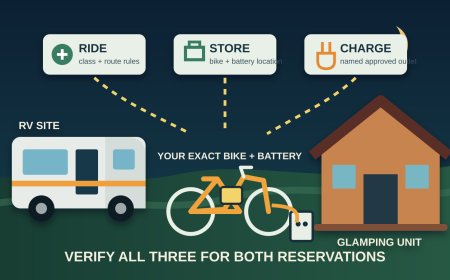
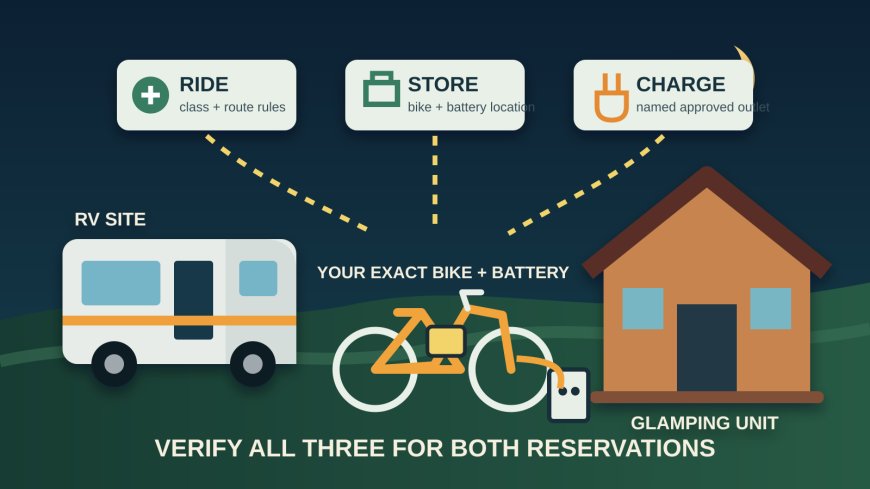
Mixed RV and glamping groups need three separate answers before booking: where the bikes may be ridden, where they may be stored, and where each battery may be charged. Do not let one answer stand in for the other two.
Start with the exact bike and battery
Write down the brand, model, e-bike class, charger model, battery voltage and watt-hours for every bike. Note whether the battery is removable. Photograph the battery label and charger label. If a bike has been modified, record that too rather than assuming it still falls within the class printed on the frame.
The class matters because land managers can treat Class 1, Class 2 and Class 3 bikes differently. Oregon State Parks, for example, describes Class 1 and Class 3 as pedal-assist categories with different assisted-speed cutoffs, while Class 2 can use a throttle. It also says a modified machine that no longer meets the state definition may be treated as a motor vehicle.[3] National Park Service superintendents may permit different classes on different roads or trails, and NPS tells visitors to check the rules for the individual park.[6]
The charger matters for another reason. CPSC tells micromobility users to charge only with the supplied charger, remain present, never charge while sleeping, follow the manufacturer's instructions and unplug the device when charging is complete.[1] A loose charger that happens to fit the port is not a harmless substitute.
Treat riding, storage and charging as different permissions
A campground can allow an e-bike on its roads without offering a legal place to charge it. Washington State Parks permits all e-bike classes on park roads and allows certain pedal-assist classes on bicycle trails, subject to posted restrictions, but its information sheet does not promise charging at a campsite or roofed accommodation.[4] Oregon likewise names campgrounds and park roads as places where e-bikes may be allowed, then directs visitors to posted and park-specific guidance.[3]
That distinction is easy to miss in a booking engine. A bicycle icon may describe recreation, not electrical service. An outlet icon may describe ordinary room power, not permission to bring a large lithium-ion battery indoors.
The reverse can also happen. WinMan Trails' BaseCamp listing specifically describes an outdoor e-bike charging outlet at its tiny cabins, while listing 50-amp RV sites separately.[7] That wording is useful because it identifies the charging location instead of leaving guests to infer permission from the word "electric." It is still worth confirming the outlet type, opening date, weather protection and whether the outlet is assigned to the exact cabin.
Check the RV reservation and rental reservation separately
Put the two accommodations in separate columns. The RV column should cover the reserved site and pedestal. The rental column should cover the exact cabin, yurt, pod or furnished tent.
For the RV site, ask:
- May a guest charge this specific e-bike battery at the site?
- Must charging occur outdoors, in a bike locker or at a designated station?
- Is a pedestal receptacle available for anything besides the connected RV?
- May a charger run while the group is away or asleep?
- Are extension cords, splitters or power strips prohibited?
- Where may the bike be parked without blocking the road, neighboring site or emergency access?
For the glamping rental, ask:
- May the complete bike enter the unit or porch?
- May a removable battery enter the unit?
- May the battery be charged from an accommodation outlet?
- Is there a designated bike room, rack, locker or outdoor charging point?
- Does that space close overnight or require a key, code, reservation or fee?
- What should the guest do with a battery that becomes hot, swollen, wet, damaged or gives off an unusual odor?
Do not soften the question to "Is there power?" A property may prohibit all guest e-bike charging. Lady Heyes Holiday Park, a UK glamping property, states that e-bikes and removable batteries may not be charged inside guest accommodations, from accommodation outlets, from communal outlets or from any other electrical supply on the property. It also bars visibly defective batteries from accommodations and communal buildings.[5] That is one property's rule, not a general glamping standard. It shows how specific the answer can be.
Do not improvise around an electrical rule
If the approved charging point is unavailable, do not move the charger to a porch outlet, bathhouse receptacle, laundry room or RV pedestal unless staff explicitly approves that location. "We only need it for an hour" does not change the equipment, circuit or property rule.
The U.S. Fire Administration advises using the charger supplied by the manufacturer, plugging a charging device directly into an outlet, and avoiding extension cords, multiplug adapters and overloaded outlets.[2] Those points matter in a mixed group because the obvious workaround is often a long cord from the RV or a power strip in the cabin. That workaround may violate both safety guidance and the rental agreement.
Bring the correct charger for each battery and label it. Similar plugs are not proof of electrical compatibility. Leave damaged chargers, cracked packs and improvised adapters at home. If the manufacturer's instructions set temperature or ventilation limits, those limits still apply at camp.
A weatherproof outlet also does not make every charger weatherproof. Ask whether the charging location stays dry and whether the charger may sit there unattended. If rain, smoke or a power outage interrupts the plan, the safe response may be to stop charging rather than relocate it into the rental.
Build the itinerary around battery range
Once the rules are clear, work out whether the trip still functions. Record the distance and elevation of the planned rides, the range estimate from the bike maker, the expected recharge time, and the hours when the approved charging location is available. Treat the range display as an estimate, not a promise.
A group with two bikes and one permitted outlet may need a charging roster. A cabin guest may have to carry a removable battery to a locked charging room. An RV guest may discover that the nearest approved charger is at a trailhead or in town. Those details affect dinner plans, vehicle use and who can ride the next morning.
Do not assume trail access from a statewide summary. NPS says e-bikes are not allowed in wilderness and that superintendents may restrict classes or locations.[6] Oregon tells riders to follow park-specific signs and lists places with added restrictions.[3] Save the official route page and current closure page for the exact destination, then check again on arrival.
Plan storage before the bikes arrive
Storage questions are usually harder than they sound. "Bike rack available" may mean an uncovered rack near the office. "Secure storage" may mean a locked room that closes before a late return. A porch may be part of the rental's exit path and unsuitable for a heavy bike.
Ask for a photo or description of the storage location. Confirm its distance from both accommodations, dimensions, roof coverage, lock arrangement and overnight access. Check whether staff permits the frame and battery to be separated, and whether carrying a battery through a shared building is allowed.
Keep bikes, trailers and charging cords out of paths between the glamping unit, bathhouse, road and RV. Never trade an easy charge for a blocked exit. If the approved space cannot hold the group's equipment, reduce the number of bikes or choose a property that can.
Know when to stop charging
CPSC says not to use packs modified or reworked by unqualified people and directs owners to use approved replacement packs.[1] Lady Heyes' property policy gives practical warning signs by naming batteries that are swollen, leaking, excessively hot, damaged or otherwise defective.[5]
Before each charge, look at the pack, case, connector and cable. Stop if something has changed. Do not carry a suspect battery into the RV or rental to keep it out of the weather. Move people away, follow the manufacturer's emergency instructions, notify property staff and call emergency services if there is smoke, fire, hissing, popping or an immediate hazard.
Do not put a discarded battery in campground trash or ordinary recycling. Both CPSC and USFA direct users away from those waste streams and toward appropriate battery or hazardous-waste collection.[1][2] Ask the property for local instructions, but do not leave a failed pack behind without an authorized handoff.
Give both halves of the group one emergency plan
An e-bike incident does not respect reservation boundaries. The bike may be stored near the cabin while its rider sleeps in the RV, or the battery may be in an approved charging room far from both.
At check-in, locate the nearest manual alarm, emergency number and assembly point. Ask how staff wants guests to report a hot or smoking battery. Decide who alerts the rental group and who alerts the RV group. Everyone should know two rules: do not re-enter for a bike or battery, and do not move a battery that is already smoking or burning.
Keep the glamping exit, RV door and vehicle lane clear. Store keys, phones and shoes where they can be grabbed without passing the charging area. If the property has no written battery response plan, that does not grant permission to invent one. Follow staff and fire-department instructions.
Send this booking message
We are booking RV site ___ and glamping unit ___ for dates ___. We will bring ___ e-bikes: brand/model/class ___, with removable/nonremovable batteries and the manufacturer's chargers. Please confirm where each bike may be ridden, stored and charged; whether batteries may enter either accommodation; whether charging must be attended; the outlet type and hours at any designated charging point; and the procedure for a damaged or overheating battery. Please tie the answer to both reservation numbers.
Save the reply, the property rule, the route rule and the charger instructions offline. Recheck them before the cancellation deadline and shortly before departure.
A workable mixed stay has an approved riding map, a storage space that does not block anyone, and a charging location named by the property. If one of those is missing, the group does not yet have an e-bike plan.
Sources
What's Your Reaction?