












Keep your RV drinking-water hose and campground spigot sanitary
A sanitary RV water-hookup routine for choosing a potable hose, inspecting the campground spigot, preserving backflow protection, storing hose ends, and responding to contamination.

Keep your RV drinking-water hose and campground spigot sanitary
By Romana
Category: Tips and Trends

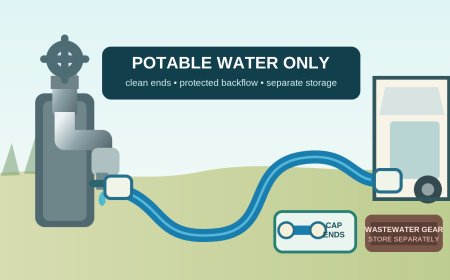
Treat the campground hookup as part of your drinking-water system, not as utility gear. Use a hose made and labeled for potable water, keep it dedicated to that job, protect both ends from the ground and sewer equipment, respect the spigot's backflow device, drain the hose after use, and store it capped in a clean compartment.
If the outlet is marked nonpotable, is under an advisory, or is visibly fouled, do not connect and hope a filter will fix it. Ask the campground for another confirmed drinking-water outlet. If the hose or RV plumbing has suffered known contamination, stop using it for drinking water until it has been cleaned, disinfected, and flushed under instructions that apply to the exact equipment and contaminant.
Start with a potable-only hose
Los Angeles County Public Health says a standard garden hose is unsuitable for carrying an RV's potable supply and advises using a food-safe hose.[4] Buy a hose whose packaging and permanent markings identify it for drinking-water service. Keep the product sheet so you know its temperature limits, cleaning instructions, and applicable certifications.
NSF/ANSI/CAN 61 is relevant when it appears on a hose or listing: the standard covers the health effects of substances that products, including hoses and fittings, may impart to drinking water. It does not certify taste, performance, or resistance to microbial growth.[5] In plain terms, an NSF 61 claim can help answer "is this material evaluated for drinking-water contact?" It does not make dirty hose ends sanitary or turn stagnant water into safe water. Verify the exact model in the certifier's current listing rather than relying on a color, a marketplace title, or an NSF-like logo.
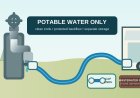
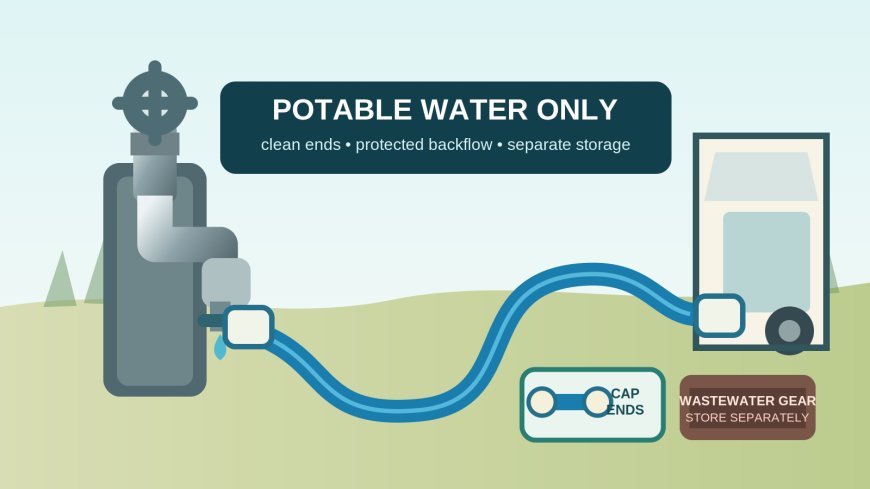
Mark the hose "DRINKING WATER ONLY" at both ends. Do not loan it for rinsing a sewer hose, flushing a black tank, washing a muddy mat, or drawing from an unapproved source. Keep wastewater gear physically separate so a tired arrival does not end with the wrong hose on the spigot.
Replace a hose that is cracked, sticky, badly abraded, permanently kinked, missing sound washers, or impossible to drain and inspect. A new washer can fix a clean fitting that drips; it cannot rehabilitate deteriorated hose material.
Inspect the campground spigot before connecting
CDC directs RV users to verify with campground management, before connection, that the supplied water is drinkable.[1] A faucet-shaped object is not enough. Dump-station rinse taps, irrigation outlets, winterized pedestals, and outlets covered by a boil-water or do-not-use notice may sit near potable fixtures.
Use this arrival check:
- Read every sign on the pedestal and nearby fixtures. Confirm that this exact outlet is potable and ask about current advisories.
- Look at the outlet, handle, backflow hardware, and ground below. Do not connect if you see sewage residue, a submerged outlet, broken plumbing, insects or debris inside the threads, or an active leak that has left the fitting in pooled water.
- Report a questionable fixture and request another potable outlet. Do not dismantle, scrape, or chemically spray campground plumbing.
- With the hose still off, open the faucet only as the campground directs and let the initial water run to an approved drain or onto a surface where runoff is permitted. Stand clear of splash. Stop if the water remains discolored, carries debris, or has an unusual odor, and contact staff.
- Close the faucet and attach the clean supply end without setting it on the soil, pedestal base, or sewer cap.
This is an inspection and contamination-avoidance routine, not a universal spigot-disinfection recipe. Sanitizer chemistry, contact time, surface compatibility, and flushing requirements vary. Spraying an arbitrary product into a public outlet can damage a device or introduce chemical residue into the water path. Campground staff or the water-system operator should handle a fouled public fixture.
Backflow protection is not an optional hose fitting
A cross-connection links potable plumbing with nonpotable plumbing. Backflow is a reversal through that connection, which can pull or push contaminants toward the drinking-water system when pressures change.[3]
The small device attached to some campground hose bibbs may be part of the park's backflow protection. Do not remove it because it drips during shutoff, makes noise, or complicates the fit. Do not defeat its vent or tape over openings. Report a missing, damaged, continuously leaking, or obviously altered device to campground staff.
There is no single add-on valve that is correct for every campsite, RV, and hazard. EPA notes that approved assemblies and testing requirements vary by state and municipality.[3] The campground controls its riser and public-water obligations; the RV owner controls the RV connection and onboard equipment. Ask the park which protection belongs at its outlet, and follow the RV maker's plumbing instructions. A plumber or the local water authority should resolve uncertain configurations.
Keep the categories straight:
- A pressure regulator controls pressure. It is not automatically a backflow preventer.
- A sediment or carbon filter performs only the functions on its label. CDC notes that many filters sold to improve taste do not remove germs.[1]
- A check valve may be one component of a system. Its presence does not prove that the connection meets the local hazard and testing rules.
Connect components in the order specified by their manufacturers and support heavy filters or regulators so they do not torque the campground spigot. Check for leaks after pressurizing. If a connection fails or the backflow device discharges unexpectedly, shut off the water and ask staff for help rather than improvising around it.
Keep the hose ends clean during use
The two couplings deserve more attention than the middle of the coil. One touches the campground outlet; the other joins the RV inlet or tank-fill fitting. A clean hose can be contaminated in seconds when either end drags through soil, rests on a sewer cap, or drops into a puddle.
CDC's 2025 sanitation standards for vessels are not RV regulations, but their hose-handling controls are useful here: potable hoses are dedicated to potable service, kept from dragging on contaminated surfaces, flushed with potable water before use, drained after use, and stored with protected ends.[2] Those controls transfer well to an RV because they address the same simple pathway: contamination entering an open coupling.
During setup:
- Wash or sanitize your hands before handling the clean couplings.
- Set the coiled hose on a clean tray or inside its storage bin, not on the campsite utility pad.
- Keep caps in the clean bin. Do not put them in a pocket with sewer gloves or set them on the pedestal.
- If an end touches clean-looking ground, treat it as contaminated. The ground is not a sanitary work surface.
- Route the hose away from the sewer connection and where tires, pets, mowers, or standing water can reach it.
- Do not leave a tank-fill hose inserted and unattended. Hold it so the fitting and hose end stay out of contact with the fill-port exterior and surrounding surfaces, following the RV maker's filling instructions.
Before attaching the RV end, flush the hose with confirmed potable water as its manufacturer directs. Discharge that water away from the sewer connection and where campsite rules permit. Flushing removes loose debris and standing water; it is not a substitute for disinfecting a hose after known contamination.
Drain, protect, and separate after every hookup
Turn off the spigot, relieve pressure safely, and disconnect without letting either end fall. Drain the hose completely according to its design. Wipe dirt from the exterior without pushing a used cloth into the couplings. Let wet exterior surfaces dry before closing the storage container.
Once drained, install clean protective caps or couple the ends together if the hose maker allows it. CDC's vessel standard calls for drained potable hoses to be stored rolled with ends capped or coupled in a dedicated locker.[2] For an RV, a clean, lidded, ventilated bin or a dedicated fresh-water compartment is the practical equivalent. The container should drain or dry between trips rather than hold a damp coil in a sealed puddle.
Do not store the potable hose loose in the wet bay beside sewer fittings, black-tank rinse adapters, gloves, or chemicals. A second bin costs little and removes ambiguity. Label the fresh-water bin and keep spare washers, caps, and the hose's instructions inside it. Clean the bin when grit or moisture accumulates.
When flushing is enough, and when to disinfect
Routine flushing and disinfection solve different problems.
Flush a hose before a normal hookup when it has remained dedicated to potable water, was drained and protected after its last use, has no damage, and has no known contamination. Use confirmed potable water and follow the hose maker's directions.
Take the hose out of drinking-water service when:
- either end touched a sewer fitting, wastewater, animal waste, floodwater, or another credible source of pathogens;
- nonpotable water or an unknown liquid entered the hose;
- a backflow or cross-connection incident may have affected the hookup;
- the hose was used for another purpose;
- repair or modification exposed its interior; or
- odor, slime, unexplained debris, or persistent discoloration suggests an internal problem.
The CDC vessel standard requires affected potable-water parts to be cleaned, disinfected, and flushed after contamination, repair, or replacement.[2] CDC's RV guidance separately tells owners to follow the RV manufacturer's instructions for when and how to drain, disinfect, and flush the onboard system.[1] Together, those sources support the decision to disinfect after a real contamination event, but they do not create one universal home recipe for every RV hose.
Do not borrow the chlorine concentration from a swimming-pool post, a marine manual, or an old RV forum. Hose materials, disinfectant strengths, contact times, temperatures, required rinsing, and disposal rules differ. Use a written procedure from the hose or RV manufacturer that covers the item involved, or obtain instructions from the campground water operator or local health department. Follow the disinfectant label exactly and never mix chemicals.
If sewage, fuel, pesticides, or an unknown chemical contacted the interior, replacement may be the safer and more practical choice. Disinfection does not remove every chemical, and a consumer hose offers no easy way to verify the result. Keep the suspect hose out of service while you get advice. If a campground advisory or backflow incident could have sent contaminated water beyond the hose, ask the water operator and RV manufacturer how to address the entire affected path, including filters and onboard plumbing. Replacing only the hose may not be enough.
A clean hookup sequence
Keep this short version inside the fresh-water bin:
- Confirm that the exact outlet is potable and not under an advisory.
- Inspect the spigot and backflow hardware; report contamination or damage.
- Keep the potable hose and its caps off the ground and away from wastewater gear.
- Flush the outlet and hose only as applicable instructions and campground rules direct.
- Connect without removing or defeating the park's backflow protection.
- Pressurize, inspect for leaks, and support heavy inline equipment.
- At departure, shut off, relieve pressure, disconnect, and drain completely.
- Cap or couple clean ends and store the hose in its separate clean container.
- After known contamination, stop. Use an equipment-specific cleaning, disinfection, and flushing procedure or replace the hose.
A sanitary hookup is mostly separation and handling. Keep drinking-water equipment dedicated, keep open ends protected, and let campground staff handle questionable public plumbing. Chemical disinfection is the exception for a defined contamination event, not a ritual to improvise at every pedestal.
Source credit: This original RVCamping.info guide draws on current CDC RV and potable-hose guidance, EPA backflow guidance, Los Angeles County public-health advice, and NSF's explanation of Standard 61. The arrival inspection, storage layout, and decision framework are RVCamping.info editorial analysis.
Sources
- Safe RV Water from Tank to Tap, CDC (PDF retrieved September 15, 2026)
- 2025 Vessel Sanitation Program Environmental Public Health Standards, CDC (PDF retrieved September 15, 2026; vessel standard cited as contamination-control guidance, not as an RV regulation)
- Protecting Water Quality through Cross-Connection Control and Backflow Prevention, U.S. EPA (October 2021 PDF, retrieved September 15, 2026)
- Public Health Requirements for Temporary Use of Recreational Vehicles, Los Angeles County Department of Public Health (September 29, 2021 PDF, retrieved September 15, 2026)
- NSF/ANSI 61: Drinking Water System Components - Health Effects, NSF (live page blocked; archived March 27, 2026 snapshot retrieved September 15, 2026)
What's Your Reaction?