














Shoulder-season RV freeze plan: protect the whole water path
A campsite decision framework for forecast bands, heated-hose limits, exposed tanks and valves, water shutoffs, onboard fallback and early departure.


Shoulder-season RV freeze plan: protect the whole water path
By Romana
Category: RV Camping
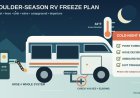
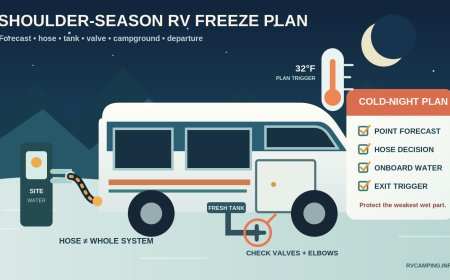
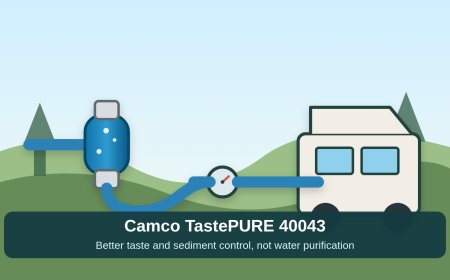
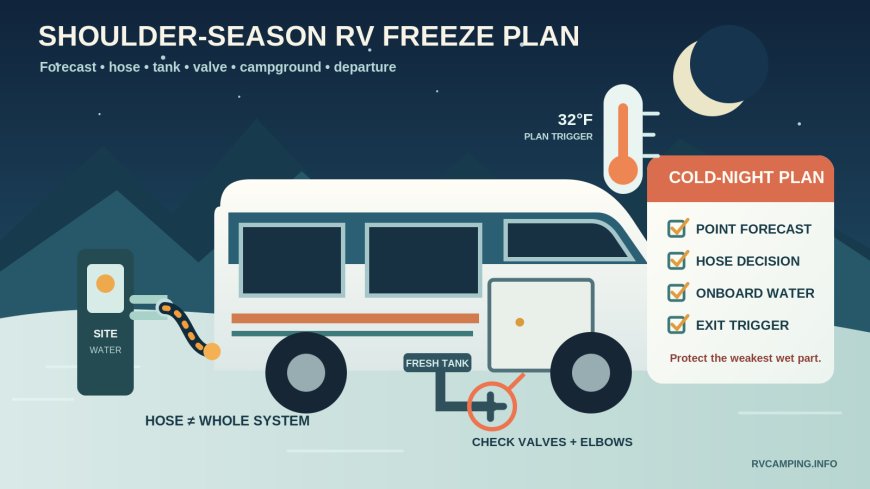
A heated hose can stay liquid while the campground hydrant, pressure regulator, RV inlet or waste valve freezes. That is the trap. A useful cold-night plan follows the water from the pedestal to every exposed fitting, through the tanks and drains, then gives you a clean switch to onboard water or an early departure.
There is no universal number of minutes below 32°F that makes every RV safe or damaged. Hose length, wind, enclosure, tank volume, plumbing layout, furnace operation and the exact equipment installed all change the result. Use 32°F as the point where liquid water can freeze and manufacturer instructions begin calling for freeze precautions, not as a promise that a brief dip is harmless or that damage is immediate.
Build the plan around the weakest wet component
Before the trip, trace the active water path on your actual rig. Start outside and work inward:
- campground hydrant or spigot;
- Y-valve, backflow device, pressure regulator and filter;
- drinking-water hose and every coupling;
- city-water inlet and check valve;
- interior lines, low-point drains, outside shower and water heater;
- fresh, gray and black tanks;
- drain pipes, elbows, termination valves and sewer hose.
Mark each item as exposed, enclosed but unheated, actively heated, or unknown. "Enclosed underbelly" and "tank heaters" are not complete answers. UltraHeat, a tank-heater manufacturer, calls for a separate review of the downstream waste plumbing; in its system, piping that extends more than six inches from the tank outlet toward the gate valve needs full heat coverage.[6] Its operating instructions also distinguish thermostatically controlled tank pads from pipe and elbow heaters that the operator must switch.[5]
Read the RV owner's manual and the manuals for the exact water heater, tank pads, furnace and water-management panel. A general Jayco towable manual, for example, says freezing-weather use requires preparations for both fresh-water and drainage systems. It also warns that more furnace use increases battery draw and propane consumption.[3] That wording matters: protection that depends on furnace heat also depends on fuel, 12-volt power and airflow.
Do not borrow a "four-season" claim from a different floorplan or model year. If the paperwork does not identify what is heated and under what conditions, treat that section as unprotected until the manufacturer or a qualified RV technician confirms otherwise.
Use forecast bands as decision points, not guarantees
Open the National Weather Service point forecast for the campground, not the nearest city, then open its hourly graph. The NWS hourly tool shows hour-by-hour conditions for the next seven days.[2] Recheck after arrival because a reservation-week forecast is not a campsite-night forecast.
The NWS uses a Freeze Warning when the forecast calls for a long spell below 32°F. Freeze Watches concern the potential for significant, widespread freezing temperatures within 24 to 36 hours.[1] Those products are valuable alerts, but their public definitions focus on vegetation. They do not certify RV plumbing.
Use these planning bands:
- Above 36°F in the hourly forecast: keep watching. This band is not a guarantee; exposed fittings can respond differently from the forecast point.
- 33°F to 36°F: begin the freeze check. The four-degree margin is an RVCamping.info planning buffer for forecast and campsite variation, not a physical damage threshold.
- 32°F or lower for any forecast hour: activate the rig-specific freeze plan. Decide before dark whether the hose stays connected, the RV switches to its tank, or the water system is drained and winterized.
- Several hours below freezing, a sharper forecast drop, wind exposure, or a low below the documented range of any component: move to the more conservative option. If you cannot verify protection for the whole wet path, disconnect and drain it or leave while roads are still safe.
Also compare the campground's elevation and terrain with the forecast point. A low site beside a creek, an open windy pad and a protected site near the office do not have identical exposure. A small outdoor thermometer at the wet bay can reveal a problem, but it does not extend a product rating or replace the manual.
Write the triggers down. A decision made at 3 p.m. is usually better than improvising beside a stiff hose at midnight.
Heated hose, ordinary hose or no hose overnight?
Keep a non-heated hose connected only when the freeze plan is inactive
An ordinary potable-water hose is the simple choice when the site forecast and the rig's documented limits leave a comfortable margin. If the freeze-review band is reached, disconnect while the hose is still flexible. Shut off the campground spigot, relieve pressure inside the RV, disconnect both ends, drain the hose completely and store the regulator and filter where they will not freeze.
Never assume that leaving a faucet dripping is allowed or protective. It can waste campground water, fill the gray tank, freeze at the sewer end and leave the campground's equipment exposed. Ask the campground before using any continuous-flow tactic.
Use a heated hose only when every condition is met
A heated hose solves one defined problem: keeping water inside that hose from freezing within the exact model's documented conditions. Camco's current 25-foot model 22911, for example, is listed as drinking-water certified and rated to prevent freezing down to -20°F.[4] That claim belongs to that product. It does not automatically apply to another length, an older generation, a repair coupling or the hardware attached at either end.
Keep the connection only if all of these are true:
- the hose is certified for drinking water and its intact label/manual covers the expected temperature;
- its cord, thermostat and plug pass the manufacturer's inspection steps;
- the pedestal connection provides the required, protected electrical supply and the campground permits its use;
- the hydrant, regulator, filter, couplings and RV inlet are protected by an approved method or are documented as protected by the campground or RV maker;
- the hose runs without tight coils, standing water traps, traffic exposure or stress on the inlet; and
- you have a tested onboard-water fallback if the pedestal is shut off.
Do not attach improvised heat tape, insulation or a heated enclosure to campground property without written permission. The hydrant is not yours to modify. If the campground cannot confirm that the pedestal remains operable in the forecast conditions, use the tank.
Switch to onboard water when the hose is the weak link
For a short cold spell, the cleanest option is often to fill the fresh tank during staffed hours, disconnect and drain the exterior hose, then use the 12-volt pump. That removes the long exposed connection. It does not protect an exposed fresh tank, suction line, pump, low-point drain or city-water check valve, so finish the component map before relying on this method.
Verify tanks, pipes and valves separately
Look underneath with the RV safely parked. Do not crawl under a rig supported only by leveling or stabilizer jacks. Locate each tank, the fresh-tank outlet, low-point drains, elbows, dump valves and the final termination cap. Photograph the layout and label the switches inside.
For each heating device, record:
- what it heats: tank, pipe, elbow, valve or compartment;
- whether it uses 12-volt DC or shore power;
- whether control is automatic or manual;
- the required tank fill level;
- its published operating range; and
- what happens after a fuse, shore-power, converter, battery or furnace failure.
Do not turn on an unknown tank pad just because the switch says "heater." UltraHeat instructs users to power its holding-tank heaters when the temperature is approaching or below freezing and liquid is present. It says the liquid must cover the area where the pad is mounted; its pipe and elbow heaters also require fluid and are not thermostatically controlled.[5] Other products may work differently, so use the manual for the hardware on your RV.
Keep waste gate valves closed during the stay unless the RV and campground specifically require another procedure. Drain the sewer hose after dumping and store it rather than leaving a sag full of liquid. A warm holding tank does not help if the exposed pipe, elbow or knife valve downstream is frozen.
The water heater needs its own check. The Suburban manual for its listed steel-tank RV water heaters says to drain or use RV-approved antifreeze when the appliance is subject to freezing during winter storage. It also directs owners to drain the heater if it will be turned off while exposed to freezing temperature.[8] Follow the exact heater manual in your rig; bypass and drain procedures vary, and an electric element must not be energized in an empty tank.
Ask the campground six questions before arrival
Call or email close enough to the stay that the weather is visible. Ask:
- Will water remain on at individual sites overnight on my dates?
- Are the hydrants designed for freezing weather, and must the hose be disconnected after filling?
- Are heated hoses allowed? May guests insulate or heat any campground fitting?
- If site water is shut off, where is the nearest staffed potable fill and during what hours?
- Will the dump station and rinse water remain available?
- How will an overnight shutoff, early closure or evacuation be communicated?
Save the answer with the employee's name and date, but recheck at arrival. Shoulder-season service changes can follow weather rather than the reservation calendar. El Morro National Monument, for instance, says campground spigots are available in warmer months and water is turned off for the season when overnight temperatures begin dropping below freezing.[7] A booking confirmation that lists water does not prove that a spigot will be operating on a cold night.
If the answer is vague, arrive with the fresh tank partly or fully filled within the RV's weight limits, or plan a confirmed potable fill before the campground. Do not count on an unverified gas station spigot.
Make the onboard-water fallback usable
Test the pump and tank before leaving home. Sanitize the system on the RV manufacturer's schedule. Confirm that the fresh-tank drain closes, the monitor gives a useful reading, the pump reaches pressure and no fitting leaks. Carry separate drinking water so one plumbing fault does not become an immediate health problem.
At the campground:
- fill only from a confirmed potable source with your own drinking-water hose;
- stop at the fill level allowed by the RV manual and cargo calculation;
- disconnect, drain and store the fill hose before the cold window;
- place the pump switch where everyone can find it;
- keep enough battery and propane reserve for the protection systems that require them; and
- know how to isolate or drain a leaking section without searching for a manual after dark.
Set a water budget from your own measured use rather than a generic gallons-per-person claim. Run a normal evening at home from the tank, note the monitor change and learn how the rig behaves when the pump loses prime. The test is more useful than a tidy estimate that ignores showers, toilets, pets and tank-gauge error.
Set departure triggers before the cold arrives
A departure trigger should leave enough daylight and road margin to pack, disconnect and reach a safer location. "We will see how it goes" is not a trigger.
Leave or fully winterize the water system before the cold window if any of these applies:
- the forecast falls below the documented operating limit of a hose, heater or RV system;
- the entire water path cannot be mapped and protected;
- the campground plans to shut off the only potable supply and the onboard fallback is not working;
- shore power is unreliable and the battery, converter, propane or furnace cannot support the documented protection method;
- a tank-pad, wet-bay heater, furnace, pump or freeze-protection control faults;
- water flow drops unexpectedly, the pump cycles with all faucets closed, a fitting leaks, or a valve begins to bind;
- the owner-manual procedure calls for draining or winterizing under the expected conditions; or
- snow, ice, wind or campground access could trap the rig after the plumbing decision is made.
If a departure requires crossing a pass or driving on ice, the road-weather trigger may need to come earlier than the plumbing trigger. Moving the RV after the road deteriorates trades a preventable plumbing risk for a driving risk. Choose the alternate campground, serviced storage location or lower-elevation stop while travel is still routine.
The evening freeze card
Keep this short card near the water panel:
- NWS point and hourly forecasts checked for the campsite
- Freeze Watch/Warning and campground messages checked
- Lowest forecast hour and duration written down
- Hose choice made: ordinary, exact-model heated, or disconnected
- Hydrant, regulator, filter, couplings and inlet accounted for
- Fresh tank filled to the planned level; pump tested
- Tank, pipe, elbow and valve protection identified and powered correctly
- Furnace, propane, shore power and battery reserve confirmed
- Dump valves closed; sewer hose empty
- Water-heater operating or winterizing procedure confirmed
- Fault, winterize and departure triggers agreed on
- Departure completed before road conditions worsen
The decision is not "Can this RV handle 30°F?" It is narrower: which wet component is least protected tonight, what keeps it safe, and what will you do if that protection fails? Once those answers are specific, a shoulder-season cold snap becomes a controlled campsite change instead of a frozen-plumbing surprise.
Sources
- [1] National Weather Service: Understanding Cold Weather Alerts (accessed September 17, 2026).
- [2] National Weather Service: Get Your Hourly Weather Forecast (accessed September 17, 2026).
- [3] Jayco: 2024 Towable Owner's Manual (manufacturer PDF archived September 17, 2026).
- [4] Camco: 25-foot Heated Drinking Water Hose (-20°F model) (SKU 22911; accessed September 17, 2026).
- [5] UltraHeat: Tank, Pipe and Elbow Heater Operating Instructions (accessed September 17, 2026).
- [6] UltraHeat: Selecting a Tank Heater (accessed September 17, 2026).
- [7] National Park Service: El Morro Campground (campground water-shutoff policy; accessed September 17, 2026).
- [8] Suburban: RV Water Heaters Installation, Operation and Maintenance Manual (manufacturer PDF archived September 17, 2026).
What's Your Reaction?