




How to use an RV dump station safely, cleanly and legally
Plan an RV dump-station stop, keep potable and sewer gear separate, prevent cross-contamination, contain spills and confirm local disposal rules.
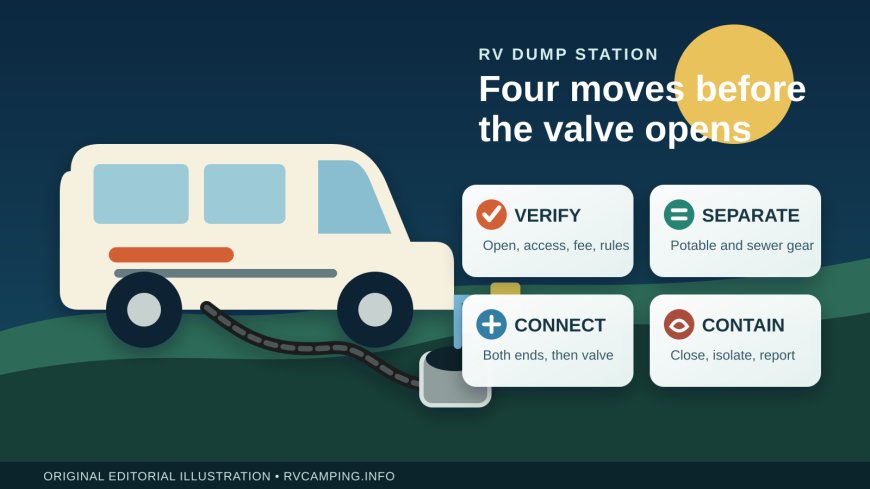
Treat a dump station as a scheduled service stop, not a hole in the ground that happens to accept a sewer hose. Confirm that the station will be open to your rig, read its posted rules, keep drinking-water gear away from rinse equipment, make every connection before opening a valve, and send all wastewater into the designated inlet. If something spills, close the valve first, keep people away, notify the operator and follow that site's cleanup and reporting instructions.
The exact fee, access policy, accepted waste and spill procedure are local. Hygiene is less negotiable: avoid contact with sewage, cover cuts, use waterproof gloves, protect against splashes, and wash with soap and water after the job.[3]
Verify the stop before you need it
A map pin does not prove that a dump station is operating today. Freeze closures, maintenance, limited hours, locked gates, campground-only access and cashless fees can all break a plan. Bryce Canyon's National Park Service listing is a useful example: its station operates spring through fall, closes when overnight temperatures fall below freezing, charges non-campers a fee, and lists nearby alternatives.[1] Those details describe that one station, not a national NPS policy.
Check the facility's official page on the day of travel and call when the consequences of a miss are high. Ask:
- Is the dump station open on my arrival date and during my arrival window?
- May non-guests use it, and does the driver need a reservation, pass, code or receipt?
- What is the fee, and how is it paid?
- Are RV black water and gray water both accepted? Are portable waste totes allowed?
- Are tank-rinse or macerator systems allowed, and is rinse water available?
- Is there a separate potable-water fill? If so, where is it?
- Can the lane handle the rig's height, length, turning radius and sewer-outlet side?
- What number should a user call for an overflow, damaged inlet or spill?
Save one backup before leaving. A tank that is already near full turns a closure into a sanitation problem. It is better to redirect while the waste is still sealed inside the RV.
Build a two-zone kit
Store sewer gear and fresh-water gear in different bins or compartments. Color coding helps, but physical separation does more. The sewer kit should have a serviceable hose, compatible inlet adapter, disposable or washable waterproof gloves, eye protection, absorbent material, a dustpan or scoop, heavy bags, a small receptacle for contaminated cleanup material, and soap plus safe handwashing water.
The drinking-water kit should have a potable-rated hose, its own fittings and caps, and nothing that has touched a dump-station rinse hose, sewer inlet, waste valve or sewer equipment. Do not use a hose at the dump pad to fill the fresh tank unless the outlet is explicitly marked potable and the facility permits filling there.
Minnesota's official dump-station construction drawing shows why labels and separation matter. It requires a warning on a water riser that is not for drinking or domestic use, prohibits direct connections between water piping and RV holding tanks even with backflow protection, and specifies separation from contamination sources.[4] Those are Minnesota construction requirements. The travel habit is universal and simple: a rinse outlet is nonpotable unless the operator clearly identifies a separate potable source.
Queue without turning the lane into a workshop
Do the slow work before joining the line. Put on closed shoes, locate the waste outlet, check the hose and fittings for cracks, confirm both tank valves are closed, move stored gear within reach, and read the RV manual if the valve arrangement is unfamiliar. Keep children and pets inside the vehicle or with another adult away from the pad.
In line, leave enough space for the rig ahead to pull out without backing toward you. Do not block traffic while filling fresh water at a separate outlet. If the station has two inlets or a bypass lane, follow signs rather than inventing a new traffic pattern.
Once at the inlet:
- Set the parking brake and position the RV so the hose reaches without being stretched tight or routed where a tire can cross it.
- Put on gloves. Add eye protection when a splash is possible. Cover any cut with a clean, dry waterproof bandage.[3]
- Check that the station drain is open, not visibly backed up, and compatible with the adapter. Stop and contact the operator if sewage is standing on the pad.
- Connect the hose to the RV first, seat the station end securely, and support the run so it does not kink or pull loose.
- Open only the intended valve. Stay beside the hose and both connections while waste is moving.
The City of Carpinteria's RV dumping guide says to secure both hose ends before opening a valve, watch the hose while dumping, keep unused valves shut, and empty black water before gray water.[2] Dumping gray second can move some black-tank residue through the hose, but it does not sanitize the hose or make the equipment safe for potable-water work.
Skip a prolonged tank flush when posted rules forbid it or a queue is building. A dump lane is shared infrastructure. Routine deep cleaning belongs at a full-hookup site or service location that allows it, not wherever the hose happens to fit.
Close out without cross-contamination
After flow stops, close the black valve fully, then dump gray if permitted. Close the gray valve. Follow the RV and equipment manuals when disconnecting; keep the hose aimed into the inlet and control both ends instead of letting them fall onto the pad.
Use only the station's permitted rinse method. Carpinteria's guide recommends leaving the station end in the inlet, disconnecting at the RV and rinsing through the hose before final removal.[2] That is one municipality's published method. A sign at the station may require something else, so the sign wins.
Cap the RV outlet. Seal and store the sewer hose and adapter in the sewer zone. Remove gloves without touching their contaminated outer surfaces. CDC guidance for people who handle human waste says to clean hands thoroughly with soap and water after taking off protective equipment; it also recommends waterproof gloves and goggles or a splash barrier where exposure is possible.[3] Hand sanitizer is useful when soap is not yet available, but it should not replace the planned soap-and-water wash after sewage handling.
Move the rig clear before reorganizing bins, recording tank treatment, or filling potable water at a separately designated point.
If a hose disconnects or the inlet backs up
The first move is mechanical: close the RV valve. Do not reach into moving sewage to rescue a hose. Warn nearby users, keep shoes and tires out of the spill, and prevent people or pets from walking through it. If the station is overflowing, do not add water or open another tank.
Contact the campground, park, fuel station or municipal operator immediately. The operator knows where the facility drains and which local health or environmental rules apply. A release that reaches soil, a storm drain or water may trigger reporting duties that an ordinary pad cleanup does not. Do not hose waste toward a gutter.
For a small residue that the operator authorizes you to handle, follow the posted spill plan and product labels. Carpinteria tells users to carry absorbent, gloves, safety glasses and a receptacle, and to use dry cleanup methods for dumping spills and residue.[2] CDC recommends keeping sewage away from the face and open wounds, using waterproof gloves, and protecting eyes from splashes.[3] Bag or containerize recovered material, then ask the operator where it must go. Do not put liquid sewage or contaminated absorbent into a trash can unless the facility specifically directs that disposal.
If sewage splashes into the eyes, mouth, an open wound or broken skin, rinse promptly with clean water and seek medical advice based on the exposure. Wash contaminated clothing separately before reuse. Leave a closed or damaged station closed for the next person; report it rather than improvising.
Legal disposal means an authorized receiving point
Use a dump station, campsite sewer connection, municipal receiving facility or service provider that explicitly accepts RV holding-tank waste. A convenient storm drain, roadside grate, vault toilet, pit toilet, street cleanout or private sewer cleanout is not permission. Even a cleanout on private property may be restricted by the owner, sewer utility, plumbing code or treatment-system limits. Get approval first.
State and local rules vary, and gray water is not automatically exempt. California illustrates the stakes: Health and Safety Code section 117555 makes dumping or allowing sewage, septic effluent, human excreta or solid waste to overflow on roads, public parks and other public property a misdemeanor unless the property is designated for that purpose; dumping on private property without the owner's consent is also covered.[5] That is a California example, not a substitute for checking the law where the RV is parked.
The safest nationwide planning rule is narrower than any legal claim: keep both black and gray water contained until an authorized facility confirms it accepts that waste. Follow the most specific current instruction from the station operator, land manager, sewer utility and local authority. When instructions conflict, keep the valves closed until the responsible operator resolves it.
A 60-second departure check
Before pulling away, confirm that:
- both holding-tank valves are shut;
- the sewer outlet cap is installed;
- no hose, adapter, support or glove remains on the pad;
- the inlet cover is returned as directed;
- no visible residue or spill has been left unreported;
- sewer gear is sealed away from potable-water gear;
- everyone who handled the equipment washed with soap and water;
- the next legal dump option is saved if a tank was not fully emptied.
A clean stop starts before the valve opens. Verification prevents the desperate detour, separation protects the water system, a secure setup prevents most spills, and a closed valve buys time whenever the station or equipment does something unexpected.
Sources
- RV Dump Station — Station-specific operating season, fee, potable-water note and alternatives; accessed September 10, 2026.
- RV Dumping Guide — Official connection order and spill-kit guidance; accessed September 10, 2026.
- Protecting Workers Handling Human Waste — Hygiene and protective-equipment guidance applied conservatively to RV sewage handling; accessed September 10, 2026.
- RV Sanitary Disposal Station Construction — Official construction drawing and potable/nonpotable separation example; accessed September 10, 2026.
- California Health and Safety Code, Section 117555 — Location-specific prohibited-disposal example; accessed September 10, 2026.
Source credit: National Park Service, City of Carpinteria, Centers for Disease Control and Prevention, Minnesota Department of Labor and Industry, and California Legislature. This article provides general planning and hygiene information, not legal advice. Verify current rules with the station operator and authorities where you are traveling.
What's Your Reaction?