








Raw meat in the campsite cooler: build a leak path that stops at the bin
A two-barrier campsite cooler system that keeps raw meat below ready-to-eat food, controls meltwater drainage, and contains leaks before they spread.

Raw meat in the campsite cooler: build a leak path that stops at the bin
By Romana | October 11, 2026 | Cooking
Raw meat does not become a cooler-wide problem merely because ice melts. The failure begins when juice escapes its package, crosses into shared meltwater, reaches a ready-to-eat food or coats the hands that open everything else. A safe packing plan interrupts that path more than once.
Quick answer: Use a separate raw-food cooler when practical. In a shared food cooler, securely wrap or bag each raw package, place all raw packages inside a rigid leakproof lidded bin, and load that bin at the bottom below ready-to-eat food. Keep food at 40°F or below, use watertight containers, keep the drain closed during transport, and drain only as a controlled waste-handling step. If raw juice enters the meltwater, treat the wet compartment and exposed food as contaminated—not as something a fresh bag of ice can repair.[1][3][4]

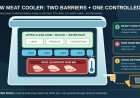
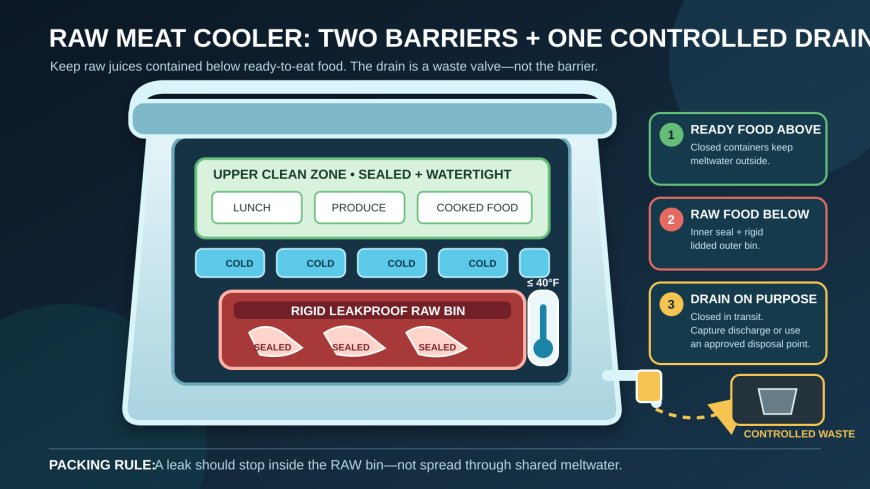
The raw zone has two containment layers and stays below the food that will not receive a cooking step. The drain remains closed until controlled disposal. Original RVCamping.info diagram.
Start with two barriers, not one grocery tray
When space permits, USDA's preferred arrangement gives raw meat and poultry their own cooler. If one cooler must hold both raw and ready-to-eat food, raw items belong below ready-to-eat items. The agency also says to double-wrap raw packages or place them in plastic bags so juices cannot drip onto other food.[1] CDC gives the same underlying rule for storage: raw meat, poultry and seafood should be in sealed containers or securely wrapped so their juices do not leak.[4]
Turn that guidance into a two-barrier system:
- Inner barrier: Keep the original package intact, then place it in a sound leakproof bag or sealed food-safe container. Do not trust a thin store tray and loose plastic overwrap as the only wall.
- Outer barrier: Put those individually contained packages inside one rigid, washable, leakproof bin with a fitted lid. This is the red RAW zone.
The outer bin is an RVCamping.info packing control, not a special federal product requirement. Its job is practical: contain a failed inner package, protect soft bags from puncture, and give hands one clearly marked surface to avoid during snack service.
A separate raw cooler is still the cleaner choice because it removes the raw-to-ready pathway altogether. A dedicated raw cooler should still use sealed packages and a lidded bin; separation does not make a leak desirable.
Build the shared cooler from the floor upward
Load only cold or frozen food. Place an appliance thermometer where it reflects the food-storage area rather than touching a frozen pack. FDA says cold perishable food should stay at 40°F or below until service.[3]
For one shared cooler, use this bottom-to-top order:
- a cold source across the floor;
- the closed, rigid RAW bin;
- cold packs or sealed ice around the raw bin, without blocking its lid or forcing it open;
- a stable divider or upper basket, if the cooler provides one;
- sealed dairy, cooked food and meal ingredients in watertight containers;
- ready-to-eat food—sandwiches, washed produce, cheese and condiments—in closed upper bins; and
- another cold source near the top, with the thermometer visible during a quick opening.
USDA says meltwater should not touch food and directs campers to use watertight storage.[1] That instruction applies to the upper zone too. A paper sandwich wrap, folded produce bag or cracked snap lid is not dependable protection in a cooler that can tip or fill with water.
Do not invert the stack simply because dinner will be used last. Raw-below-ready separation outranks reverse-use convenience. If dinner meat needs to come out before lunch, give the raw bin its own accessible side or use a separate raw cooler rather than lifting ready-to-eat containers onto the ground.
Treat the drain as a waste valve
The drain is not a cross-contamination control by itself. Containment does that work. A plug left open can drip into an RV storage bay, onto a campsite pad or across a hand that later touches the lid. A plug pulled casually can also invite someone to reach through wet packages while the cooler is still loaded.
Use three operating states:
1. Travel: plug closed
Close and check the drain before loading the cooler into the RV or tow vehicle. Keep the cooler upright and secured. The closed plug contains ordinary meltwater if the cooler tips, and it gives you a visible warning if liquid later appears outside the shell.
2. Normal camp use: inspect before draining
Meltwater is not proof that raw meat leaked, and draining water does not prove the food stayed cold. Read the thermometer, inspect the raw bin without opening raw packages, and check whether every upper container remains watertight. Keep hands used on the raw bin away from ready-to-eat food until they have been washed; CDC says hands should be washed after handling uncooked meat, poultry or seafood.[4]
FDA tells consumers to drain meltwater and replace ice frequently when cold serving dishes are set on ice.[3] That advice does not say every loaded cooler must run with its drain continuously open. In a campsite cooler, drain for a defined reason: to make room for replacement ice, prevent water from entering a vulnerable container, reduce weight before moving, or empty the unit for cleaning.
3. Controlled drain: food protected, outlet managed
Before opening the plug:
- close and move ready-to-eat containers away from the drain path;
- confirm the raw bin lid is shut;
- place the cooler where discharge can be captured or sent to an approved campground disposal point;
- keep potable-water gear, dishes, pet bowls and food-prep surfaces outside the splash area;
- open the drain without putting a hand into the cooler water;
- close the plug after the required water is removed; and
- wash hands before touching clean food or utensils.
Campground wastewater rules vary. The food-safety sources cited here do not authorize dumping on the ground, into a storm drain or beside a water source. When an approved disposal route is not available, keep the liquid contained until staff or posted rules identify one.
If the raw bin leaks, stop the normal routine
A failed inner bag caught by a clean, intact outer bin is exactly what the system is designed to handle. Keep that bin closed, remove it without setting its wet exterior on the picnic table, and move it directly to the raw-prep area. Replace the failed inner containment before returning unused raw food to cold storage.
If juice escapes the outer bin into shared meltwater, use a stricter response:
- Stop reaching into the cooler and keep diners away.
- Wash hands after any raw-water contact.
- Discard ready-to-eat food that was directly exposed, along with food in open, torn or non-watertight packaging. Cooking a hamburger later does not make contaminated grapes, bread or cheese safe.
- Move demonstrably sealed containers to a clean holding cooler or bin. Keep their wet exteriors away from serving surfaces and clean the exterior before opening.
- Keep the leaking raw food cold only if it remains securely contained and the cold-storage requirement is still met; otherwise follow the applicable time-and-temperature discard guidance rather than guessing.
- Capture and dispose of the contaminated liquid through an approved route.
- Wash, rinse and sanitize the cooler, drain, plug and raw bin as appropriate for their materials and manufacturer instructions before putting them back into food service.
Raw juice can spread bacteria through packages, hands and utensils, which USDA identifies as cross-contamination.[1] A new layer of ice changes temperature; it does not remove contamination. Do not use suspect meltwater for handwashing, dishwashing, produce rinsing, pet water or beverages.
Keep the unloading route one-way
The safest layout continues after the lid opens. Put the clean serving area at one end of the table and the raw-prep area near the grill at the other. Remove bread, produce, condiments, clean utensils and the cooked-food platter first. Close their containers and the cooler.
Remove the raw bin last. Carry the whole closed bin to the raw station rather than carrying loose packages across the table. After touching the bin or raw packages, wash hands before reopening the shared cooler. USDA says raw and cooked food should not share platters, boards or utensils because the raw juices can contaminate the cooked meal.[2]
Do not return the cooked meal to the raw bin, even after the bin looks empty. Original packaging and raw-zone containers remain on the raw side until they are cleaned. Give the cooked food a clean platter and utensils that never entered the raw route.[2]
Pack a small containment kit
A useful cooler kit fits in one labeled tote:
- spare leakproof bags or containers sized for the meat packages;
- one rigid lidded raw bin that fits the cooler without bowing;
- an appliance thermometer;
- disposable towels for containing a spill;
- soap and potable water for handwashing;
- clean raw-only and cooked-only utensils or clearly separated sets;
- a clean backup container for intact ready-to-eat food; and
- a closure or cap for the cooler drain if the original part is easy to lose.
Do not add an improvised sanitizer recipe unless it comes from current authoritative instructions and fits the cooler material. Product concentration, contact time and surface compatibility matter. At camp, prevention through containment is easier to verify than a rushed decontamination attempt beside dinner.
The 60-second cooler check
Run this check before departure and each time new ice is added:
- Cold: Is the food compartment at 40°F or below?[3]
- Inner seal: Is every raw package securely wrapped, bagged or containerized?[1][4]
- Outer bin: Is the RAW bin closed, intact and below ready-to-eat food?
- Upper zone: Is every ready-to-eat item in a watertight container?[1]
- Drain: Is the plug closed except during a controlled disposal step?
- Hands: Can the raw bin be handled without touching clean food next?
- Route: Is there an approved place to capture or dispose of drainage?
- Backup: Is there a clean container ready if one barrier fails?
The system is intentionally redundant. The inner package can fail without contaminating the cooler. The outer bin can get wet without putting raw food above lunch. The drain can stay closed until disposal is controlled. No single zipper, stack order or plug has to carry the entire safety plan.
Evidence note: USDA, FDA and CDC supply the separation, secure wrapping, cold-holding and watertight-container guidance. RVCamping.info developed the two-barrier raw bin, three-state drain protocol, one-way unloading route and 60-second check as campsite operating tools. FDA’s drain-water instruction applies to cold serving dishes set on ice; this article does not present it as a universal instruction to leave a cooler drain open.
Sources
What's Your Reaction?