











One cold campground night: disconnect the RV water hookup or leave it on?
A cold-night decision guide for disconnecting an RV fresh-water hookup, switching to the onboard tank, respecting heated-hose limits and rejecting improvised heat tape.

By Romana | RV Camping | October 10, 2026
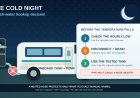
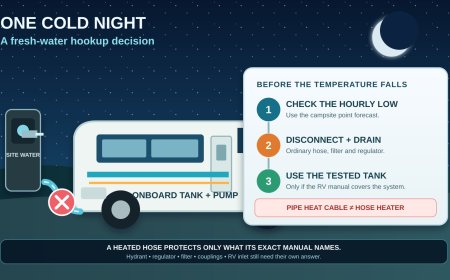
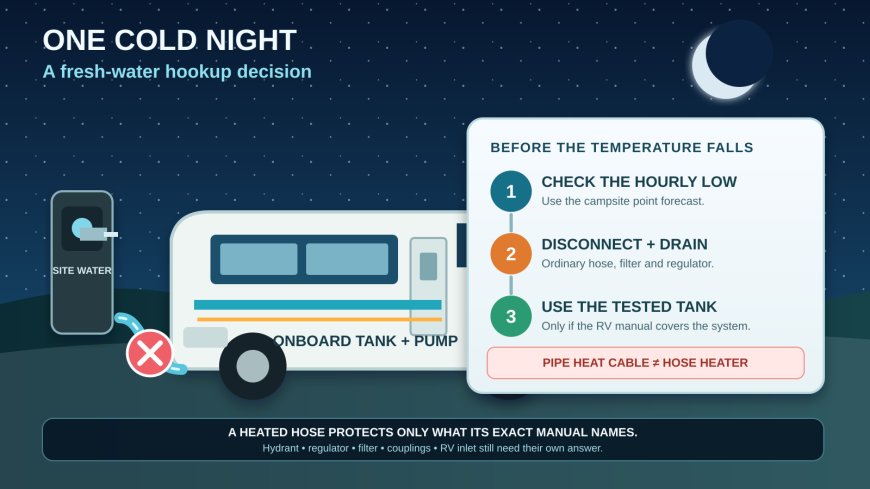
A forecast that slips below freezing for one night creates a smaller decision than full winterization: should the campsite water hose stay connected, or should you fill the fresh tank and run the pump until morning? For most RVers with an ordinary potable-water hose, the conservative answer is to disconnect before the cold window, drain every removable hookup part, and use the onboard tank—but only if the tank, pump and active plumbing are protected under the instructions for that exact RV.
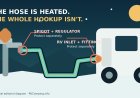
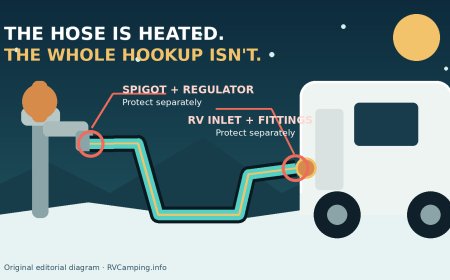
This guide is deliberately limited to the fresh-water hookup. It does not repeat our prior frozen sewer-hose and dump-valve response. It also does not promise that a heated hose makes the whole connection freeze-proof. The hydrant, filter, regulator, couplings and city-water inlet remain separate weak points.
Make the call before dark
Open the National Weather Service forecast at the campsite’s actual location rather than relying on a city-wide app reading. Its Hourly Weather Graph lets you inspect each forecast hour across the coming week, so you can see when the temperature is expected to cross freezing and how long the cold window may last.[3]
Treat any hourly forecast of 32°F or lower as a decision trigger, not a guaranteed damage point. Forecast error, elevation, wind exposure and the location of the actual campsite can all change what exposed hardware experiences. If the RV or hose manual calls for action at a warmer temperature, follow that instruction instead.
Choose among three paths by late afternoon:
- Ordinary hose: disconnect, drain and stow it before it becomes stiff.
- Purpose-built heated drinking-water hose: keep it connected only when its exact instructions, power requirements and temperature rating cover the night—and when every fitting at both ends is also protected.
- No verified cold-weather setup: stop using the water system, drain or winterize it exactly as the RV manual requires, or move before roads deteriorate.
Do not wait for flow to slow at midnight. Reduced flow may mean ice is already forming in the hose, filter, regulator, hydrant or inlet.
The ordinary-hose cutoff
An unheated hose should come off before the forecast cold window when any of these is true:
- the hourly forecast reaches freezing;
- the campground requires disconnection;
- the hydrant or exposed fittings have no documented protection;
- the hose, regulator or filter manual excludes freezing exposure;
- wind or a shaded site adds uncertainty; or
- nobody will be awake and able to respond to a loss of water or power.
Winnebago’s cold-weather guidance offers the same basic fallback: fill the freshwater tank, disconnect the fresh-water hose and put it away so the hose and inlet are not exposed to freeze damage.[1] That is practical advice, not proof that every Winnebago—or any other RV—has a protected onboard tank. The same Winnebago page tells readers to check the RV manual and notes that not all RVs are intended for all-season use.[1]
Disconnect in a controlled sequence:
- Fill the fresh tank only to the level allowed by the RV manual and the rig’s weight limits.
- Confirm the pump works, then switch it off while changing water sources.
- Shut the campground spigot completely.
- Open a cold-water faucet briefly to relieve trapped pressure, then close it.
- Disconnect the hose without twisting the RV inlet. Catch the small amount of water that drains.
- Remove the regulator and filter if their instructions do not allow freezing exposure.
- Walk the hose downhill, drain it fully, loosely coil it and store all removable parts where their manuals permit.
- Cap the RV inlet, select the correct tank/pump valve position for the exact water panel, and test the pump for normal flow and shutoff.
If the campground uses a frost-free hydrant, follow its posted instructions. Some designs need the hose removed so the standpipe can drain. Do not wrap, insulate or heat campground property without permission.
Tank fallback is a system check, not just a full tank
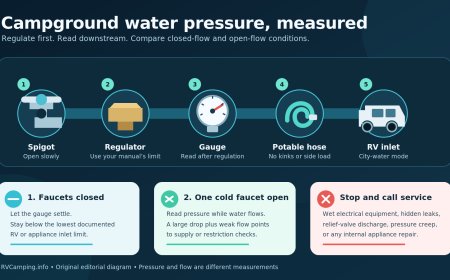
Switching to the fresh tank removes the long exposed hose, filter and regulator from service. It does not protect an underfloor tank, tank outlet, pump strainer, suction line, low-point drain, outside shower, city-water check valve or water heater.
Before relying on the tank, find those components on the actual floorplan. Keep the furnace or approved compartment-heating system operating exactly as the RV manual requires. In its 2026 Class C manual, Jayco calls for fresh-water and drainage preparation in freezing conditions. It also warns that protection can require adequate propane and electrical power because heavier furnace use consumes more of both.[4] That language is model-family guidance, not a temperature rating for another coach.
The tank fallback is not ready if:
- the fresh tank or pump sits in an exposed or unheated bay;
- the manual requires winterization in the expected conditions;
- shore power, battery state or propane cannot support the furnace and controls overnight;
- a wet-bay heater or tank pad cannot be positively identified;
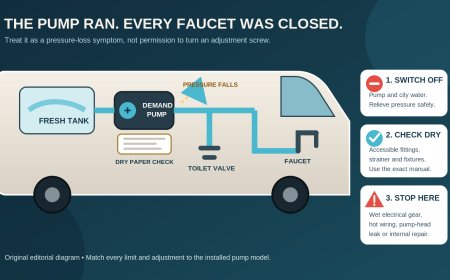
- the pump will not prime, cycles with every faucet closed or leaks; or
- the city-water inlet remains full and exposed with no documented protection.
Carry separate drinking water even after a successful pump test. It gives you a safe fallback if the pump fails or a fitting begins to leak. Use the tank conservatively overnight, and verify gray-tank capacity before showers or dishwashing.
What a heated hose does—and does not—cover
A purpose-built heated drinking-water hose can be appropriate when the manufacturer’s instructions cover the expected temperature and installation. For its current 25-foot model 22911, Camco claims drinking-water certification and assigns a -20°F freeze-protection limit.[2] That rating belongs to that identified model and length. It is not a general rating for every heated hose, and it says nothing by itself about the campground hydrant, regulator, filter or RV inlet.
Before leaving one connected, verify all of the following:
- the model number and intact label match the manual you read;
- the hose is listed for potable water;
- the expected low stays inside the published operating limit;
- the hose, cord, plug and controller show no damage;
- the required grounded, weather-protected electrical supply is available and campground-approved;
- the hose lies as instructed without a tight coil, pinch, traffic hazard or pull on the inlet;
- the hydrant, regulator, filter, couplings and inlet each have documented protection; and
- the fresh-tank fallback is filled and tested in case power or site water fails.
A powered hose is not a reason to skip an overnight check. Confirm water flow, dry connections and power before bed, then inspect again in the morning. If a breaker or ground-fault device trips, leave it tripped until the cause is identified; do not bypass protection.
Heat tape stops at its listed application
“Heat tape” is not a universal hose accessory. EasyHeat’s AHB pipe-heating cable manual limits that product to accessible, water-filled metal or plastic supply pipes and explicitly says not to use it on hoses. It also requires a properly grounded, GFCI-protected 120-volt receptacle and a model selected for the pipe dimensions.[5]
That creates a clear campground boundary:
- Do not wrap ordinary pipe-heating cable around a flexible drinking-water hose unless the exact cable instructions expressly list that hose application.
- Do not add heat cable over a purpose-built heated hose.
- Do not cross, splice, shorten, overlap, bury or cover a cable unless its exact manual authorizes that configuration.
- Do not use indoor-only cords, damaged plugs or connections lying in water or snowmelt.
- Do not install cable on the campground hydrant or pedestal without campground authorization.
- Do not assume insulation creates heat; it can conceal a frozen fitting or cause an incompatible cable to overheat.
If a permanent rigid pipe in an owner-controlled wet bay needs heat tracing, that is an installation job governed by the cable manual, the pipe material, electrical protection, RV-maker limits and applicable code. A qualified RV technician or electrician should handle it when any of those requirements are unclear.
If the hookup is already stiff or flow has stopped
Stop adding pressure. Shut off the campground source if the valve moves normally, switch to bottled water, and keep people away from wet electrical connections. Do not sharply bend a rigid hose, force a frozen coupling, pull against the city-water inlet, or use a torch, open flame, heat gun or unattended portable heater.
Call campground staff when its hydrant or site equipment is involved. Contact an RV technician when the inlet, check valve, filter housing or concealed line may be frozen; when water appears inside a wall or bay; or when safe recovery is not described in the exact manuals. A controlled thaw by authorized staff is cheaper than a cracked fitting hidden behind cabinetry.
The five-minute evening card
Before the temperature falls:
- ☐ Check the NWS point and hourly forecast for the campsite.
- ☐ Read campground water and heated-hose rules.
- ☐ Identify the hose, filter, regulator and RV manual limits.
- ☐ Fill and test the onboard tank and pump.
- ☐ Disconnect an ordinary hose; drain and stow every removable part.
- ☐ If using a heated hose, verify the exact model, rating, power and both endpoint fittings.
- ☐ Reject improvised heat tape on a hose.
- ☐ Confirm furnace fuel, battery and shore-power reserve.
- ☐ Keep bottled drinking water available.
- ☐ Set a stop point for leaks, low flow, lost power or an unknown component.
For a single cold campground night, the best setup is usually the one with fewer exposed, water-filled parts. Disconnecting early turns a long outdoor water path into a short onboard one. The final decision still belongs to the manuals for the exact RV and components—not to a generic “four-season” label or a heated-hose temperature printed on someone else’s model.
Source credit: This fresh-water hookup decision guide was developed from National Weather Service forecast guidance, RV-manufacturer cold-weather advice, and the identified hose and pipe-heating product instructions. It is not a substitute for the manuals supplied with a specific RV, hose, pump, filter, regulator, heater or campground hydrant.
Sources
- Winnebago, *10 Tips for Staying Warm in Your RV this Winter* (manufacturer-hosted cold-weather article; tank fallback, hose disconnection and manual caution; archived October 10, 2026).
- Camco, *Heated Drinking Water Hose -20, 25-foot, model 22911* (official product page; model-specific potable-water and freeze-protection claims; archived October 10, 2026).
- National Weather Service, *Get Your Hourly Weather Forecast* (official instructions for the seven-day Hourly Weather Graph; archived October 10, 2026).
- Jayco, *2026 Class C Owner’s Manual* (model-family cold-weather, fresh-water and power cautions; archived October 10, 2026).
- EasyHeat, *AHB Automatic Electric Water Pipe Heating Cable Owner’s Manual* (Rev. 12; listed applications, hose exclusion, cable selection and electrical-protection requirements; archived October 10, 2026).
What's Your Reaction?