







Assateague RV Camping: Oceanside vs. Bayside
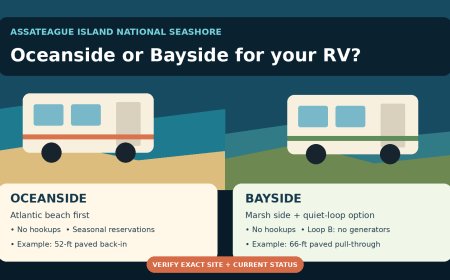
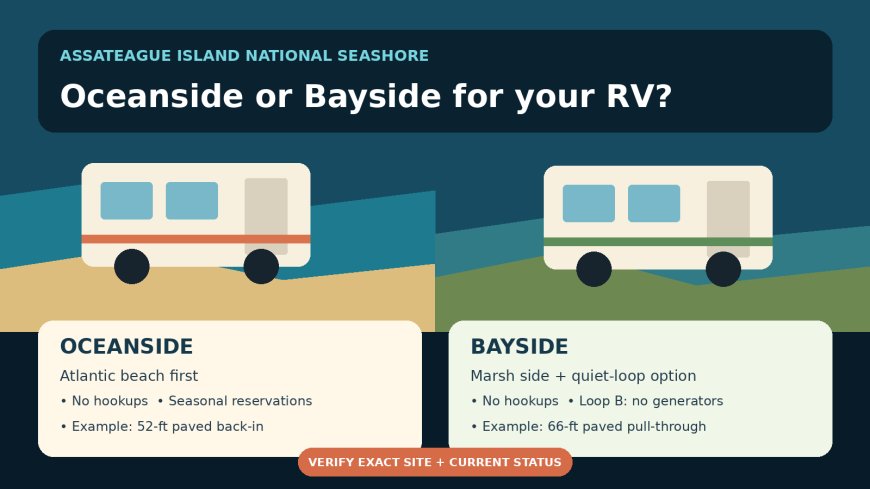
Oceanside is the Atlantic-beach choice; Bayside offers the usual year-round reservation path, a generator-free loop, and long site-specific RV pads.

Assateague RV Camping: Oceanside vs. Bayside
By Romana | Updated October 10, 2026
Assateague Island National Seashore’s two drive-in choices share the same barrier island, price structure, dry-camping reality, dump stations, and wild-horse rules. Their practical differences are sharper than the names suggest. Oceanside is the direct Atlantic-beach choice; Bayside gives RV travelers more reservable winter certainty, a designated generator-free loop, and some unusually long site records. Neither campground has electric, water, or sewer hookups.[1][4]
The original assignment called for another Big Bend comparison. A manifest check found that RVCamping.info already published that destination and substantially the same campground choice on September 18, 2026. This Assateague comparison replaces it rather than creating a competing page.
Status checked October 10, 2026: NPS listed both Oceanside and Bayside as open. Recreation.gov also carried a current construction notice saying Bayside sites would shift to first-come, first-served beginning November 16, with existing reservations honored but possible site reassignment. Verify that notice and current conditions again before departure.[4][5]
Quick comparison for RV travelers
| Decision factor | Oceanside Drive-in | Bayside Drive-in |
|---|---|---|
| Best reason to choose it | Fastest campground-to-Atlantic-beach access | Marsh-and-bay setting, year-round reservation pattern, and a generator-free loop |
| Hookups | None | None |
| RV-capable inventory | Drive-in sites in Loops 1 and 2; walk-in and group inventory is tent-only | Drive-in sites in Loops A, B, and C |
| Reservations and winter | Reservations March 15–November 15; Loop 1 closes in winter, while Loop 2 becomes first-come, first-served | Ordinarily reservable year-round, up to six months ahead; check the current construction notice |
| Generator tradeoff | Permitted outside quiet hours at drive-in sites, subject to the park noise rule | Prohibited around the clock in Loop B; permitted outside quiet hours in A and C |
| Services | Vault/chemical toilets, seasonal unheated rinse showers, seasonal drinking water, year-round dump-station water | Same shared campground service pattern |
| Rig-fit lesson | Exact site record controls; official example Site 004 is a 52-foot paved back-in | Exact site record controls; official example B33 is a 66-foot paved pull-through |
| Exposure | More immediate surf, wind, salt, and sand experience | More sheltered feel, but still a low barrier-island environment with insects and weather exposure |
Oceanside is the beach-first option
Oceanside Drive-in is the better answer when the Atlantic is the reason for the trip. It accepts tents, trailers, and RVs in designated drive-in sites, but it remains dry camping. The NPS page lists no hookups and describes picnic tables and fire rings at the sites.[1] Do not confuse Oceanside Drive-in with the campground’s large Oceanside Walk-in inventory: Recreation.gov labels those as walk-to sites, and the official notice prohibits sleeping in vehicles there.[4]
Season is the biggest planning distinction. NPS places Oceanside arrivals from March 15 to November 15 in the reservation period.[2] From November 16 through March 14, Loop 1 closes and Loop 2 operates first-come, first-served.[1] That can work for a flexible winter traveler, but it is not the same certainty as holding a conventional reservation. Arrive with a legal fallback rather than assuming an open winter pad will wait for you.
Oceanside also makes the island’s exposure part of camp. NPS calls the barrier-island habitat harsh and specifically tells campers to prepare for sun, insects, sand, and wind.[1] An RV reduces tent exposure, but it does not remove salt spray, blowing sand, awning risk, or the need to secure outdoor equipment. Retract an awning before leaving the site, keep loose gear inside when wind rises, and expect unheated rinse showers rather than a full bathhouse experience.
Bayside is the reservation-and-quiet-loop option
Bayside Drive-in also accepts RVs and trailers without hookups. Its strongest planning advantage is that NPS ordinarily describes it as reservable year-round, up to six months ahead.[1] That gives a winter RV trip a clearer booking path than Oceanside Loop 2’s first-come, first-served period. The live Recreation.gov notice currently complicates that advantage: Bayside is scheduled to operate first-come, first-served beginning November 16 during water-system construction, although existing reservations are to be honored and site assignments may change.[4]
Bayside Loop B is the specific choice for campers who want a generator-free setting. The rule is not a campground-wide Bayside ban: generators are prohibited 24 hours a day in Loop B, while the general quiet-hours rule applies elsewhere.[3] Recreation.gov repeats the Loop B prohibition.[4] If silence matters, filter for B. If battery capacity requires generator charging, do not reserve B and hope for an exception; compare A or C instead.
The bay side may feel less surf-exposed, but it is not an inland RV park. Recreation.gov warns that extreme mosquitoes and biting insects are normal.[4] Screens, repellent, and a plan for entering the RV without holding the door open can matter as much as the view.
Rig fit is site-specific, not campground-wide
Assateague’s inventory proves why a single “maximum RV length” is misleading. Recreation.gov lists Oceanside Site 004 as a 52-foot paved back-in, 14 feet wide, accepting an RV or trailer up to 52 feet.[6] Bayside Loop B Site B33 is a 66-foot paved pull-through, 13 feet wide, accepting an RV or trailer up to 66 feet.[7] Those are examples of two individual records, not blanket limits for their loops.
The larger number also does not automatically make B33 the easier choice. Its 66-foot field must hold the equipment arrangement Recreation.gov permits, and Loop B forbids generators. A 52-foot back-in may suit a shorter motorhome with a workable power plan better than a longer pull-through in the wrong service environment.
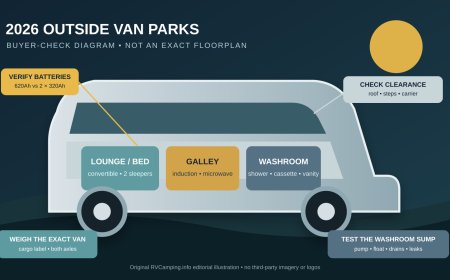
Measure the complete traveling setup before filtering sites:
- For a motorhome, include racks, cargo boxes, and any fixed rear carrier.
- Add a towed car and tow hardware if they must occupy the campsite pavement.
- For a trailer, measure the coupled tow vehicle and trailer rather than quoting only the trailer body.
- Record width with slides and awning stowed and deployed; a 13- or 14-foot site-width field is not a promise that every slide configuration works.
- Check entry type, paved length, vehicle count, and the site photo for turning room.
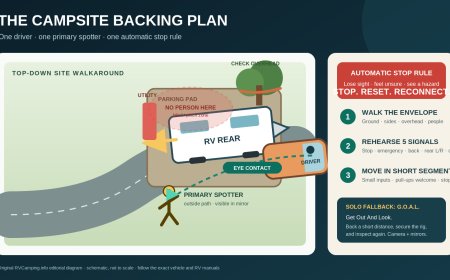
A drive-in booking can cover either two registered motor vehicles or a vehicle-and-trailer pair. Every vehicle and trailer wheel must remain on pavement, and equipment may not protrude into the roadway.[3] North Beach overflow exists, but it should not be used to justify booking a pad that is too short for the intended combination.
Service planning: both choices are dry camping
There is no utility winner. Recreation.gov lists vault toilets, drinking water, and unheated showers from March 15 through November 15. Campground water is available when temperatures remain above freezing, while water at the dump stations is available year-round.[4] NPS describes the showers as seasonal cold-water facilities and confirms both RV areas have no hookups.[1]
That means the correct service plan is date-specific. Fill the fresh tank before settling into the site if needed, but verify current potable-water status first. Budget battery capacity around the loop’s generator rule. Use the dump station for black and gray water: NPS prohibits dumping either at the campsite.[3] In freezing weather, “campground open” does not mean every seasonal tap or shower operates.
The park’s quiet hours run from 10 p.m. to 6 a.m. Generator use and idling a vehicle to charge batteries are prohibited during that window. Where generators are otherwise allowed, the limit is 60 decibels at 50 feet.[3] Solar and battery systems still need a realistic energy budget because shade, clouds, short winter days, and high loads can defeat an optimistic charging plan.
Access, horses, and arrival details
Camping is only in Assateague’s Maryland district. The Maryland and Virginia entrances are reached separately by bridge, and there is no road running through the island from one district to the other.[4] Enter the Maryland side via the route in the reservation directions; do not set a Virginia visitor-center destination and expect to drive north to camp.
Both campgrounds share the wild-horse operating rules. Food and beverages must be secured in a vehicle, locked cooler, or another latchable hard-sided container when not being used. Visitors must remain at least 40 feet from horses and may not touch, feed, or entice them.[3][4] A screen room, outdoor kitchen, pet bowl, or open cooler is not secure storage merely because someone plans to return soon.
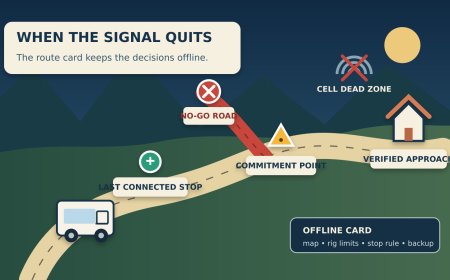
Check-in is at noon and checkout is at 11 a.m. Campers arriving after the ranger station closes must register by 10 a.m. the next morning; a reservation holder who has not checked in by noon on the following day can be treated as a no-show.[3][4] Download the confirmation and site number before crossing the bridge.
Which Assateague campground should you book?
Choose Oceanside Drive-in when beach access is the priority, your exact site accommodates the complete rig, and your dates fit its reservation or winter first-come pattern. It is the more direct Atlantic experience and the less predictable winter booking choice.
Choose Bayside Drive-in when the marsh side fits the trip, you want the usual year-round reservation path, or a generator-free loop is a feature rather than a limitation. Recheck the water-system construction notice before relying on a specific winter assignment.
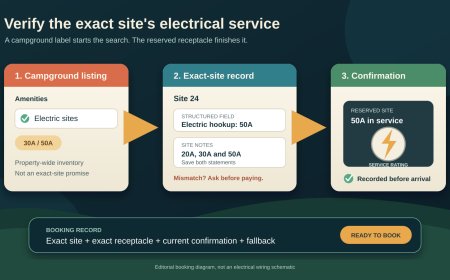
For either one, book from the individual campsite record, not from a campground-wide length claim. Confirm the live status, services for the exact dates, complete-rig pavement fit, and generator rule. Assateague’s campgrounds are geographically close, but season and power strategy can make one clearly better for a particular RV.
Source credit: RVCamping.info compared current National Park Service and Recreation.gov campground, regulation, condition, and individual-site records retrieved October 10, 2026. The decision framework and rig-fit analysis are original editorial work.
Sources
- Camping at Assateague — National Park Service — Campground types, hookups, reservation seasons, seasonal facilities, and Maryland-only camping. Accessed October 10, 2026.
- Campgrounds and Reservations — National Park Service — Reservation requirement and six-month booking window. Accessed October 10, 2026.
- Campground Regulations — National Park Service — Pavement, generator, quiet-hours, wastewater, horse, arrival, and stay rules; updated August 20, 2026. Accessed October 10, 2026.
- Assateague Island National Seashore Campground — Recreation.gov — Facility seasons, amenities, access, notices, wildlife rules, and inventory. Accessed October 10, 2026.
- Current Conditions — National Park Service — Current campground status and Maryland-district access notes; updated October 9, 2026. Accessed October 10, 2026.
- Oceanside Site 004 — Recreation.gov — Official 52-foot paved back-in example and site rules. Accessed October 10, 2026.
- Bayside Site B33 — Recreation.gov — Official 66-foot paved pull-through example and Loop B generator prohibition. Accessed October 10, 2026.
What's Your Reaction?