












Safe ice at an RV campsite: drink ice, cooler ice and meltwater
Separate drinking ice from cooling ice, keep raw-food leaks contained, and handle RV cooler meltwater without sending contamination into cups or ready-to-eat food.

Safe ice at an RV campsite: drink ice, cooler ice and meltwater
By Romana
Category: Cooking
A bag of ice can arrive at camp with three possible jobs. Some cubes may go into cups. Some may sit around cans and sealed food. The rest may melt into water that has touched packaging, hands and the cooler floor. Those jobs are not interchangeable.
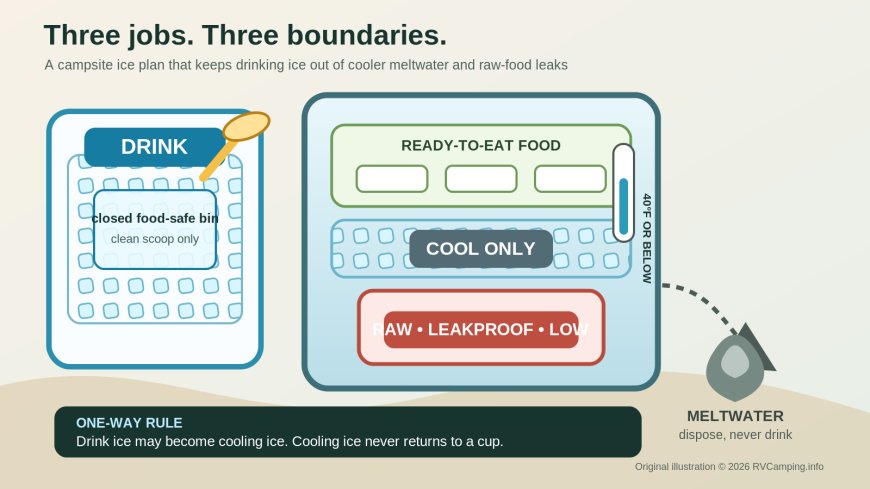
The short answer: Treat ice for drinks as food. Keep it in a clean, closed container and serve it with a clean scoop. Use separate ice or sealed cold packs to cool food and cans. Once loose ice has cooled packages, do not put it in a drink. Keep raw meat in a leakproof lower bin so raw juices cannot enter the general meltwater, and never drink or cook with cooler meltwater.[1][2][3]

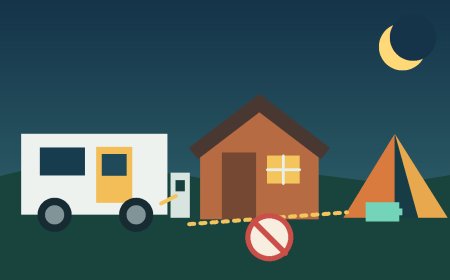
Three labels prevent the most tempting shortcut: DRINK ice never enters the food cooler, COOL ice never returns to cups, and RAW stays inside a lower leakproof tub. Original diagram by RVCamping.info.
Give the ice a job before you leave
FDA considers packaged ice a food and says it must be made, held and transported under sanitary conditions. The agency's consumer advice is equally plain: use clean tongs or a scoop, keep ice in a food-safe container, and do not touch it with dirty hands or glasses.[1]
That makes "ice" too vague for an RV packing list. Write one of these labels on each container:
- DRINK: Factory-bagged ice or ice made from known safe water, protected from hands, cans and raw food.
- COOL: Loose ice, blocks, frozen bottles or gel packs assigned to cold holding. Nothing in this group goes into a cup.
- RAW: Not ice at all, but the leakproof tub that keeps meat, poultry or seafood and its juices out of the cooler's shared water.
The distinction matters even if every cube started in the same FDA-regulated bag. FDA's Food Code says ice used to cool the outside of food packages, cans or equipment may not later be used as food.[2] A clean origin does not survive a dirty assignment.
Build a practical RV cooler layout
The cleanest arrangement uses two insulated boxes plus one raw-food tub:
- Small drink-ice cooler: A lidded food-safe bin of drink ice sits inside. The scoop stays in a separate clean sleeve or protected holder, not buried by its handle. Cups and clean hands never enter the ice.
- Main food cooler: Sealed ready-to-eat food occupies the upper basket. Cooling ice or frozen packs surround the containers. A visible appliance thermometer tracks whether perishable food remains at 40°F or below.
- Raw-food tub: A rigid, leakproof, lidded tub sits at the bottom of the food cooler. Individually wrapped raw packages stay inside it.
USDA advises a separate cooler for raw meat or poultry when possible. In one cooler, raw food belongs below ready-to-eat food, with packages double-wrapped or bagged to stop juices from dripping.[3] The lower tub is RVCamping.info's practical RV adaptation: it adds a wall against punctures and tips when the cooler rides on a rough road.
If the rig can carry only one cooler, keep the same boundaries in miniature. Put drink ice inside a sealed, food-safe container at the top. Place ready-to-eat food in another sealed upper bin. Put cooling ice around those containers, then place the lidded raw tub at the bottom. Do not let convenience erase the labels.
This guide does not repeat the full travel-day loading routine. For pre-chilling, thermometer placement and lid-opening strategy, see Pack the Cooler Like a Route Plan. The focus here is what can enter a cup and what must stay outside it.
Protect the drink ice like any ready-to-eat food
Drink ice receives no later cooking step. Set up its serving routine before anyone wants a refill:
- Wash hands before handling the bag, bin lid or scoop.
- Wipe visible dirt from the outside of a purchased bag before it enters a clean compartment.
- Pour ice from the bag into the clean bin without setting the opened bag on the ground or raw-food lid.
- Use a clean, non-breakable scoop or tongs. Do not use a drinking glass as a scoop.
- Keep the scoop in a clean, protected spot between uses. If it falls on the picnic table, ground or raw-food area, replace it with a clean one.
- Close the bin after each serving.
FDA specifically warns against touching ice with dirty hands or glasses.[1] The glass shortcut is risky for another reason: a breakable rim can chip in the ice, and the outside of a used cup is not a clean food-contact surface.
A party bag floating among cans is cooling ice, not drink ice. Can tops and hands move in and out of that water all day. Even if the bag began sealed, a puncture or an opened seam ends the boundary. Keep drinking cubes in their own closed bin.
Start with water you would drink
Safe ice requires safe source water. CDC says untreated water can make people sick when it is used to drink, cook, wash produce, or make ice and drinks. Clear-looking stream or campground water can still contain bacteria, viruses or parasites.[4]
Use factory-sealed packaged ice, or make ice only from water you have reason to regard as safe for drinking. If a campground posts a boil-water notice or identifies a spigot as non-potable, do not freeze that water and assume the freezer fixes it. Freezing is not one of CDC's recommended water-treatment methods.
When source safety is uncertain, follow the current advisory. CDC identifies boiling as the best way to kill germs in water and gives treatment alternatives for hiking, camping and travel.[4] Water that may contain harmful chemicals, toxins or radioactive material cannot be made safe by boiling or disinfecting; CDC says to use bottled water or another source instead.[4]
If questionable water has already entered the RV plumbing, deal with that system separately. Keep your RV drinking-water hose and campground spigot sanitary covers the hookup boundary. Do not transfer uncertainty from the faucet into an ice tray.
Keep cooling ice out of food and cups
The food cooler is a wet environment unless every cold source stays sealed. USDA tells campers to store food in watertight containers so melting ice water cannot contact it.[3] FDA's Food Code likewise bars direct ice or water contact when a package can admit water because of its wrapping, container or position.[2]
A zipper bag holding cheese or cut fruit may be fine only if its closure is intact and it remains watertight under load. Paper-wrapped sandwiches, torn produce bags, cardboard cartons and loosely folded deli wrap are not meltwater barriers. Put ready-to-eat food in rigid lidded containers or a sound sealed bin above the raw tub.
Cooling ice is allowed to do its job. Leave it around sealed containers if the cooler is cold and the water is contained. Meltwater is not automatically proof that the cooler failed. It is proof that the water now belongs to the cooling system, not to the drinking supply.
A sealed frozen drinking-water bottle is different. Its contents have not touched the cooler. When it thaws, wipe or wash the exterior before opening so contamination on the outside does not reach the bottle mouth.
If raw juice reaches the meltwater
A leaking raw package changes the whole compartment. USDA explains that raw-meat and poultry bacteria can spread through dripping juices, hands and utensils.[3] Treat water in that cooler as contaminated rather than trying to rescue it as wash water.
- Keep hands, cups, the drink-ice scoop and ready-to-eat food away from the water.
- Discard ready-to-eat food that had direct contact with the water, plus anything in packaging that was open, torn or not reliably watertight.
- Move intact sealed containers to a clean holding area without placing dripping exteriors on a food-prep surface.
- Wash your hands, then clean container exteriors before opening them.
- Drain the cooler only at an approved location. Do not dump raw-food water at the campsite, beside a water source or into a storm drain.
- Wash, rinse and sanitize the cooler and raw tub according to their manufacturers' instructions before reuse.
Do not use contaminated meltwater to wash dishes, rinse produce, fill a pet bowl or extinguish a cooking fire where the splash could reach food. It is waste water.
The leak also triggers a temperature check. Ice presence alone is a rough clue, not a complete cold-holding record. Verify the cooler with an appliance thermometer and use the established time-and-temperature rules for any food that warmed. This article's narrow decision is simpler: raw-juice contact makes exposed ready-to-eat food a discard, even if the cooler stayed cold.
A campsite ice station that works
Put the drink-ice cooler at the clean end of the picnic table, away from the grill and raw prep area. Tape the scoop sleeve to the lid so it cannot wander. Set cups beside it, with a marker for names if cups will be reused. The food cooler stays in shade on a stable surface, with its drain closed unless you have a specific reason and approved place to drain it.
Assign one adult to reset the station after meals:
- close the drink-ice bin and check that the scoop is clean;
- return perishables in sealed containers to the food cooler;
- inspect the raw tub for leaks;
- read the cooler thermometer;
- note whether more cooling ice is needed;
- wash hands before the next drink service.
Colored tape helps when people arrive after setup: blue for DRINK, gray for COOL and red for RAW. Color is a cue, not the control. The lids, watertight containers and clean serving utensil do the actual work.
The no-transfer rule
Use one sentence when explaining the system to the campsite group: ice only moves forward in cleanliness, never backward. Drink ice can be reassigned to cooling if necessary, but cooling ice never returns to drinks. Ice or water that entered the raw zone is waste.
That rule also answers the morning-after question. Loose cubes left in the drink bin may remain drink ice only if the bin stayed closed, the scoop stayed clean and nobody introduced a cup, hand, can or food package. When that history is uncertain, move the cubes to cooling duty or discard them. Do not let a clear appearance stand in for a clean history.
Evidence note: FDA, USDA FSIS and CDC supply the food status of ice, safe-source-water guidance, cooler separation principles and meltwater-contact limits. RVCamping.info created the three-label system, nested RV layout and station-reset routine as planning tools. They are not a substitute for a campground water advisory, local waste rule or product manual.
Sources
What's Your Reaction?