

























Cooked rice safety at an RV campsite: cool it, store it, reheat it
Cool cooked rice in shallow containers, make room in a small RV refrigerator, reheat it to 165°F, and know when campsite leftovers must be discarded.

Cooked rice safety at an RV campsite: cool it, store it, reheat it
By Romana
Category: Cooking
Cooked rice is useful campsite fuel: inexpensive, compact before cooking and easy to fold into breakfast, bowls or skillet meals. Its weak point is the handoff after dinner. A deep pot left beside the stove, a crowded RV refrigerator and an unlabeled container can turn “we’ll use it tomorrow” into a guess.
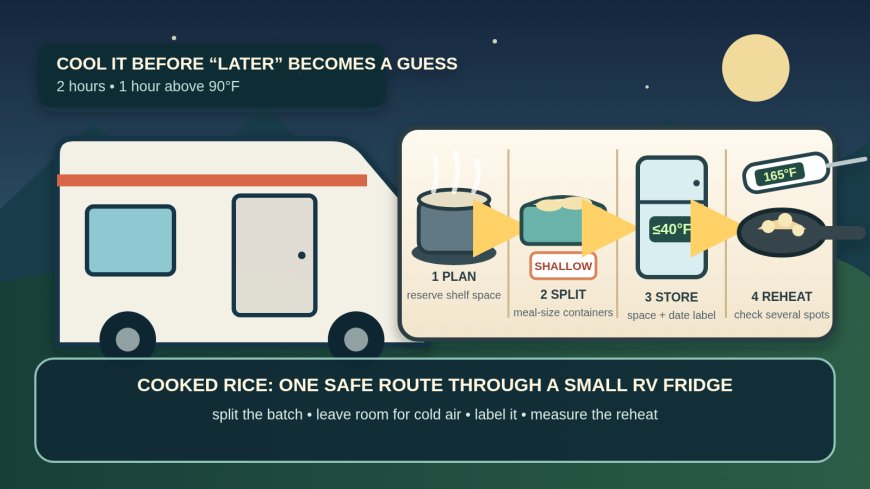
The short answer: If rice will not be eaten promptly, divide it into shallow containers and refrigerate it within two hours of cooking—or within one hour when the outdoor temperature is above 90°F.[1][2]
Hold the RV refrigerator at 40°F or below, set a use-or-freeze deadline no later than day four, and bring each reheated serving to 165°F.[1][3]
Discard rice when it missed the time limit, its cold-storage history is unknown, or an RV power interruption kept it above 40°F for four hours or longer.[1][4]

Cook less, split the leftovers, leave room for cold air and label the deadline. Original illustration by RVCamping.info.
The rice problem is what happens after cooking
Rice safety advice sometimes arrives online as a blanket warning against reheating. That misses the real decision. Properly cooled and stored rice can be reheated; rice that sat warm too long does not get a new history because it goes into a hot skillet.
University of Maine Cooperative Extension identifies Bacillus cereus as the organism behind the concern and says it occurs in soil and plants, including starchy foods such as rice and pasta. The extension warns that improper cooling and storage can allow growth and heat-stable toxin formation, which later heating may not undo.[3] This article does not extend that claim beyond the source: its practical controls are time, temperature, container depth and refrigerator capacity.
The campsite version of the problem is mostly logistics. Dinner may end after dark. The fridge may already hold drinks and groceries. A warm pot may be too large for the shelf. If you decide where the rice will cool only after the meal, the easiest option becomes leaving it on the stove.
Decide before you cook: eat now, hold hot or chill
Choose one route before adding water to the pot:
- Eat it now. Make the amount the group is likely to finish.
- Keep it hot. Hold cooked rice at 140°F or warmer until service.[1]
- Chill it on time. Start portioning as soon as dinner service ends, not after dishes and the campfire.
USDA gives leftovers two hours to reach refrigeration once cooking ends or verified hot holding stops. At an outdoor temperature above 90°F, the limit shortens to one hour.[1] FDA gives the same two-hour and one-hour limits for perishables.[2]
That clock is cumulative. Ten minutes beside the stove, an hour on the picnic table and more time during cleanup all belong to the same window. Moving the pot into the shade may slow warming, but shade is not refrigeration.
A useful RV habit is to set a phone timer when the rice leaves active hot holding. Better still, reserve the leftover portion before taking the serving bowl outside. The reserved rice can begin its cold-storage route while everyone eats.
Build a small-fridge cooling lane
The goal is not to make rice cold on the counter before it enters the refrigerator. USDA permits prompt refrigerator placement; alternatively, it allows fast pre-chilling with clean ice water or cold water before refrigeration.[1] FDA directs cooks to divide large quantities of leftovers among shallow containers so they cool faster.[2]
For a compact RV refrigerator, use this workflow:
- Check the thermometer. The compartment must be holding 40°F or below.[2][4]
- Clear one shelf. Move drinks and shelf-stable items elsewhere before the hot rice needs space.
- Split the batch. Transfer rice from the deep cooker pot into several clean, shallow containers. A thin layer releases heat faster than one dense mound.[1][2]
- Stage, do not stack. Place the containers in a single layer with gaps around them. FDA says an overpacked refrigerator can prevent the chilled air from circulating.[4]
- Label immediately. Write “rice,” the cooking date and a use-or-freeze date no later than day four.[1][3]
- Recheck the appliance. Look at the refrigerator thermometer after the door has stayed closed long enough for the system to recover.
If the RV refrigerator is already warm or cannot accommodate the containers without blocking airflow, do not force the batch inside and assume the dial will catch up. Use a properly iced food cooler that is verified at 40°F or below, or discard the surplus before its time limit expires. A cooler is cold storage only when a thermometer confirms it.
For a very hot or large batch, set the shallow containers in clean ice water and stir the rice with a clean utensil to speed heat transfer, then refrigerate promptly. Keep meltwater out of the food, and do not let this staging step consume the two-hour—or hot-weather one-hour—allowance.[1]
Do not make the refrigerator fight your whole dinner
An RV refrigerator has less air volume and less shelf area than a residential model. One large, hot vessel can obstruct circulation while the door stays open during rearranging. The most reliable fix begins with batch size.
Cook tomorrow’s rice tomorrow when propane, water and time permit. If planned leftovers are useful, portion them into meal-size containers before the trip and make sure the refrigerator has an empty landing zone. Keep frequently opened drinks in a separate cooler so the food compartment stays closed.
Place the appliance thermometer where it can be read without unloading the shelf. FDA says 40°F or below is the refrigerator target and recommends checking with an appliance thermometer rather than relying on a control setting.[2][4]
Cover or seal the rice for storage. USDA advises airtight packaging or covered storage containers, followed by prompt refrigeration or freezing.[1] Use a clean scoop each time instead of eating from the container or mixing a fresh batch into an older one.
Give every container a deadline
USDA’s refrigerator window for leftovers is three to four days; University of Maine Extension gives the same range for cooked rice.[1][3] Count the day of cooking as the starting point, not the first day somebody remembers seeing the container.
A simple label removes arguments:
- Cooked: Wednesday dinner
- Use or freeze by: Sunday dinner
- Contents: plain rice or named mixed dish
If a meat, egg, seafood or dairy ingredient in a rice dish has a shorter safe window, use the shorter deadline. Freezing is the practical choice when the trip plan changes, though quality may decline over time. Freeze in meal-size, tightly closed portions so one breakfast does not require thawing the whole batch.[1]
Do not use smell, taste or appearance to approve an unknown container. FDA notes that food can cause illness without looking, smelling or tasting spoiled.[4] A sour odor, mold or other obvious spoilage is reason to discard, but a normal smell is not proof that the time and temperature history was safe.
Reheat only the portion you will serve
Reheat refrigerated rice to 165°F, measured with a food thermometer.[1][2][3] In a skillet, add a small amount of water, break up cold clumps and stir so the center heats with the edges. In a microwave, use a microwave-safe covered dish, vent the cover and rotate or stir because cold spots can remain. USDA advises checking microwave-reheated food in several places.[1]
For an RV galley:
- Scoop one meal’s portion into the pan or microwave-safe dish.
- Add enough water to create steam without turning the rice soupy.
- Cover and heat, stirring and turning the rice through the center.
- Check several spots with a clean food thermometer.
- Continue heating until all checked areas reach 165°F.
- Serve immediately on clean plates.
The 165°F target applies to properly handled leftovers. It is not a rescue step for rice that stayed on the picnic table past the limit. University of Maine Extension specifically warns that toxins associated with improperly cooled rice may be heat-stable.[3]
Avoid cycling the main container in and out of cold storage. Removing one serving preserves a clearer temperature history for the remainder and reduces repeated handling. If you reheat more than the group eats, do not leave that pan beside the stove for later.
When to throw cooked rice away
Discard the rice when any of these is true:
- It spent more than two hours outside refrigeration or verified hot holding, or more than one hour when the outdoor temperature was above 90°F.[1][2]
- Nobody can establish how long it sat out.
- The refrigerator did not hold 40°F or below and the rice’s exposure cannot be reconstructed.[4]
- A power outage left refrigerated leftovers above 40°F for four hours or longer.[4]
- The container is beyond the three-to-four-day refrigerated window.[1][3]
- It shows mold, an off odor or another sign of spoilage.[4]
During a power failure, keep the refrigerator closed. FDA says an unopened refrigerator keeps food cold for about four hours. Once power returns, discard refrigerated perishable food that remained above 40°F for four hours or more.[4] Do not repeatedly open the door to check one rice container; read the appliance thermometer if possible and protect the entire cold compartment.
When the evidence is missing, the discard decision is not wasteful caution after the fact—it is the result of a failed storage record. The next batch can be smaller and labeled before dinner begins.
The cabinet-card version
- Plan: Leave room in the refrigerator before cooking.
- Clock: Refrigerate within two hours; use one hour above 90°F.[1][2]
- Split: Move rice from the deep pot into shallow meal-size containers.[1][2]
- Space: Keep containers in one layer with room for cold air.[4]
- Measure: Verify the refrigerator or food cooler is 40°F or below.[2][4]
- Label: Use or freeze refrigerated rice within three to four days.[1][3]
- Reheat: Heat only what you need to 165°F throughout.[1][2][3]
- Discard: Throw it out when time, temperature or storage history is uncertain.
The best RV rice routine is designed backward from the refrigerator shelf. Make a batch that the cold-storage system can actually cool, package and track. Then reheating is a simple measured step—not an attempt to repair yesterday’s uncertainty.
Evidence note: Federal time, temperature, storage and reheating guidance is cited to USDA FSIS and FDA. The rice-specific Bacillus cereus explanation is limited to the cited University of Maine Cooperative Extension source.[3] RVCamping.info created the small-fridge cooling lane, labeling format and cabinet card as practical planning tools; they are not government protocols or product-test findings.
Sources
- Leftovers and Food Safety | USDA FSIS — USDA FSIS consumer guidance; archived snapshot dated September 12, 2026.
- Safe Food Handling | FDA — FDA consumer guidance; live page archived September 16, 2026.
- Is Your Leftover Rice Safe? | University of Maine Cooperative Extension — University of Maine Cooperative Extension; published March 5, 2026 and archived September 16, 2026.
- Are You Storing Food Safely? | FDA — FDA Consumer Update; live page archived September 16, 2026.
What's Your Reaction?