

The campground water is off: how many gallons can your motorhome carry?
Use the motorhome’s OCCC label, 8.34 pounds per gallon and an axle-scale check to decide whether a full, partial or destination fill works.
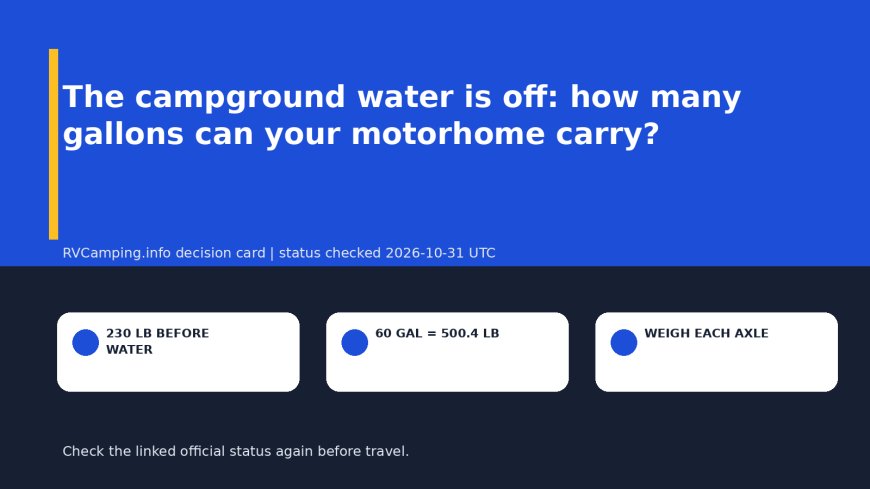
A water shutoff can turn a routine tank fill into a payload problem; the answer comes from the motorhome label, gallon arithmetic and an axle scale, not the tank gauge alone.
The water shutoff creates a second problem
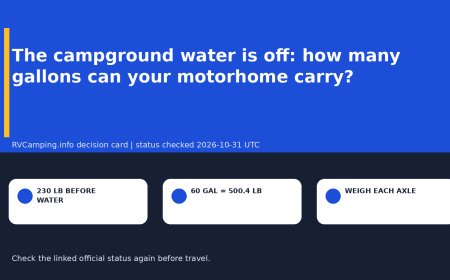
A shoulder-season campground says its potable water is off, so filling the motorhome at home seems like the obvious fix. Water weighs 8.34 pounds per gallon.[1] A 60-gallon fill therefore adds 500.4 pounds before the first chair, grocery bag or passenger is reconsidered.
NHTSA has warned that a filled water tank can consume a significant share of an RV's cargo capacity.[2] The useful question is not whether the tank holds 60 gallons. It is whether the loaded motorhome has room for that weight while staying within its total and axle ratings.
One label changes the plan
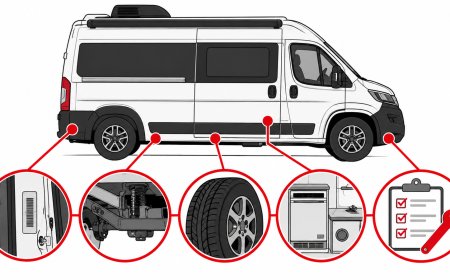
Start with the Occupant and Cargo Carrying Capacity, or OCCC, label for the exact motorhome. Subtract occupants, gear, food, pets, installed accessories not already included in the labeled weight, and trailer tongue weight when applicable. The remainder is the label allowance left before adding water. Manufacturer guidance counts a full water load and tongue weight as cargo.[3]
Consider a motorhome with 1,450 pounds of OCCC. Two occupants total 530 pounds, gear and food add 410, pets and other cargo add 60, and a towed trailer places 220 pounds on the hitch. That leaves 230 pounds before water.
The gallon ceiling is not a fill recommendation
Dividing 230 by 8.34 gives a mathematical ceiling of 27.58 gallons. The full 60-gallon tank would put the plan 270.4 pounds over the label allowance. Even 25 gallons weighs 208.5 pounds and leaves just 21.5 pounds on paper.
That thin remainder is why the calculation is a gate rather than a target. It does not account for a forgotten tool bag, an inaccurate estimate or an axle that reaches its rating before the vehicle reaches GVWR. A 10-gallon transit load weighs 83.4 pounds and leaves 146.6 pounds in this example, but the scale still decides whether the actual loading works.
Compare three trip plans, not one tank level
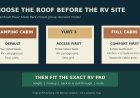
A full tank from home is convenient only when the label budget and axle weights support it. A measured partial fill trades convenience for payload. A small transit reserve plus a verified potable source near camp preserves capacity on the road but creates a dependency on that fill point.
Choose among those routes with the real itinerary. A fill station that closes before arrival or does not allow RV tank filling is not a plan. Neither is carrying water beyond a rating because the destination supply is uncertain. Sometimes the correct adjustment is fewer gallons; sometimes it is less gear or a different campground.
Finish at a scale, not the monitor panel
The manufacturer manual says the loaded vehicle must remain within GVWR and each axle's GAWR.[3] Weigh the motorhome in the condition planned for travel, including people, cargo, fuel, water and tongue weight. A passing total does not excuse an overloaded axle.
Do not use the tank monitor as a measuring instrument. The same manual notes that a tank can hold more fluid than its panel indicates.[3] Meter the fill when possible, record the amount, and weigh the actual load. The label and arithmetic eliminate impossible plans; the scale checks the one you intend to drive.
Worked load comparison
| Water plan | Water weight | Label headroom left | Initial result |
|---|---|---|---|
| 10 gallons | 83.4 lb | 146.6 lb | Passes arithmetic; weigh axles |
| 25 gallons | 208.5 lb | 21.5 lb | Passes narrowly; weigh axles |
| 60 gallons | 500.4 lb | -270.4 lb | Fails label budget |
Source note: RVCamping.info checked the linked primary records on 2026-10-31. The decision model, timeline comparison and calculations are original editorial work.
Sources
- USGS water conversion factors — Accessed 2026-10-31.
- NHTSA cargo carrying capacity rulemaking — Accessed 2026-10-31.
- 2025 Winnebago Journey operator manual — Accessed 2026-10-31.
What's Your Reaction?