








Quiet Hours Are Only the Start: A Booking Worksheet for Mixed RV and Glamping Groups
Use this worksheet to compare quiet hours, generator limits, vehicle parking and shared amenities before booking RV sites with glamping units.

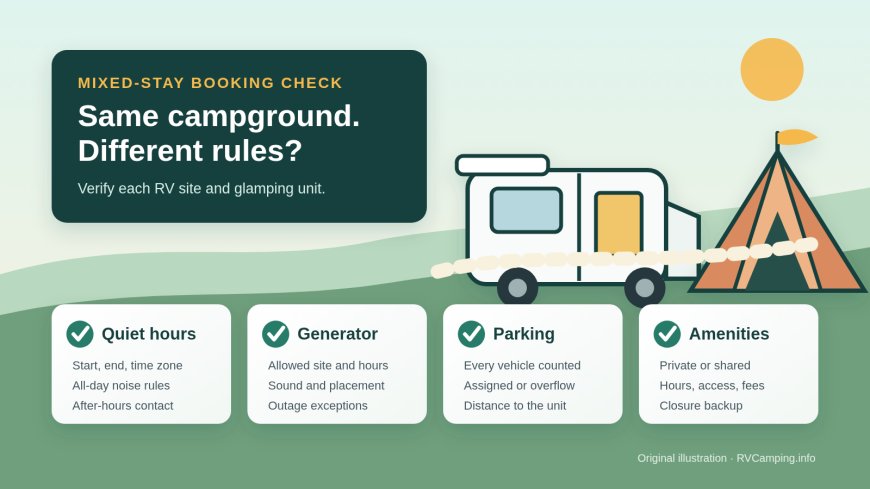

Verify each accommodation's noise, generator, parking and amenity rules before the group pays.
Quiet hours are only the start: a booking worksheet for mixed RV and glamping groups
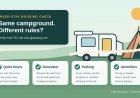
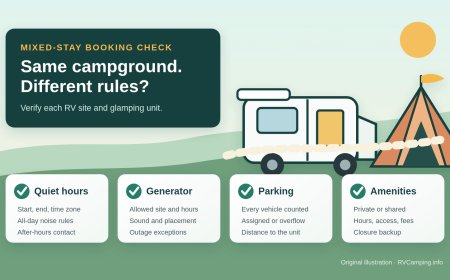
An RV site and a glamping tent can share a campground address while operating under different practical rules. Before anyone pays, verify when noise stops, whether a generator can run, where every vehicle goes and which amenities each reservation actually includes.
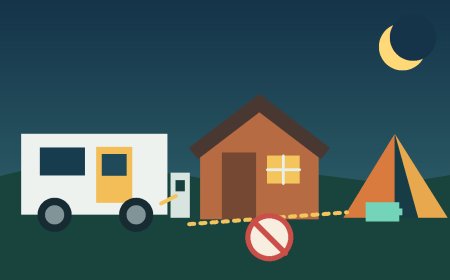
A mixed booking often looks simple on the map: reserve two RV pads, add a furnished tent and meet at the pool. The trouble starts in the details. The RV household may have climate control, a private bathroom and a vehicle beside the rig. The glamping household may sleep behind canvas, walk to a bathhouse and park somewhere else. A late generator start, an extra SUV or a closed shower can affect the two sides of the group very differently.
Do not solve this by asking whether the campground is “quiet” or “has bathrooms.” Those are labels. Build one written record for the exact RV site types and exact glamping units under consideration.
Copy this worksheet before you book
Complete one row for every accommodation, even when several reservations are at the same property. Put the policy URL or a staff reply in the last column. Blank cells are unresolved booking questions, not permission.
| Check | RV site A | RV site B | Glamping unit A | Written source |
|---|---|---|---|---|
| Quiet hours, including time zone | ||||
| Noise rule outside quiet hours | ||||
| Generator allowed? | ||||
| Generator hours, location and decibel limit | ||||
| Power supplied and outage procedure | ||||
| Vehicle count included | ||||
| Tow car, trailer and visitor-car treatment | ||||
| Assigned or overflow parking location | ||||
| Walking distance from parking to unit | ||||
| Toilet and shower: private or shared | ||||
| Bathhouse hours and cleaning closure | ||||
| Pool, kitchen, laundry and lounge access | ||||
| Amenity hours, fees and age rules | ||||
| After-hours contact | ||||
| Remedy if a promised service is unavailable |
Send the property this note with the worksheet attached:
We are booking a mixed group with [number] RV sites and [number] glamping units for [dates]. Please confirm the answers below for each exact site or unit type. We need the quiet-hour and generator rules, included vehicle count, parking location, and the private or shared amenities included with each reservation. Please identify any rule that differs by accommodation, loop, rate or event date. If a web page controls, please send the current link. If anything changes before arrival, how will guests be notified?
A phone call may clear up a confusing page. Follow the call with an email that lists your understanding and asks the property to correct it. Save the reply with the reservation confirmations.
Quiet hours do not answer every noise question
Record the start time, end time and time zone. Then ask what “quiet” means. Some properties ban amplified music at all times. Others permit conversation or a small speaker as long as it cannot be heard at the next site. Arrival, vehicle movement, pets, children, outdoor televisions and campground events may each have separate rules.
Real policies show why a group should not assume a standard window. Askew’s Landing lists quiet hours from 10 p.m. to 7 a.m., while Rustic Acres states a 9 p.m. to 8 a.m. window.[1][2] Bethel Woods publishes midnight to 7 a.m. for its campground.[3] These are examples, not a range to use when a property has not answered.
Canvas changes the practical calculation. A conversation that seems modest inside an RV may carry into a nearby furnished tent. Ask whether the glamping area has a separate expectation, whether vehicles may enter that area after the cutoff and whether an evening program, bar or concert is audible from the booked unit. If the group plans a birthday dinner, card game or outdoor movie, name it instead of asking whether “normal gathering” is allowed.
Put these details in the record:
- the rule that applies all day, not only during the posted window;
- the cutoff for outdoor cooking, fire rings, speakers and vehicle movement;
- whether campground events are exempt;
- the number to call about a disturbance after the office closes; and
- the consequence for a warning, repeated complaint or early removal.
Do not promise the group that 9:59 p.m. is party time just because quiet hours begin at 10. A nuisance rule can be broader than a clock.
Treat the generator rule as its own line item
Quiet hours and generator hours are separate questions. “No generators overnight” does not tell you whether they are allowed at breakfast, restricted to a specific loop or prohibited whenever shore power is available.
The current Askew’s Landing rules prohibit generator use rather than merely switching generators off during its quiet window.[1] Bethel Woods takes a different approach for its event campground: its FAQ permits small silenced portable units below 60 dB only in daylight and with other campers’ consent.[3] One property says no; another adds equipment, timing and neighbor-consent conditions. Neither policy should be borrowed for a third campground.
For each RV, record why a generator might be needed. The answer could involve battery charging, air conditioning, medical equipment or a planned dry site. Then ask:
- Is generator use permitted on this exact site type?
- What clock hours apply, and are there midday blackout periods?
- Does the campground impose a sound rating, fuel rule or required placement?
- Are generators allowed during a utility outage?
- Does management make a separate accommodation for powered medical equipment, and how is it arranged before arrival?
- Is the glamping unit supplied with electricity, heat, a fan or air conditioning?
- What happens if the supplied power fails overnight?
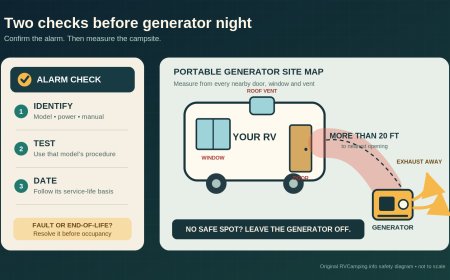
Do not position a generator, exhaust or extension cord near a tent based on a booking answer alone. Follow the equipment instructions and onsite direction. A “yes” on the worksheet establishes permission; it is not a setup plan.
If quiet sleep or temperature control is nonnegotiable, decide what answer is acceptable before contacting properties. A traveler who needs powered equipment may need a full-hookup site, a verified battery plan or different lodging rather than a hoped-for generator exception.
Count parking by vehicle, not by household
Mixed groups arrive with more rolling stock than the reservation count suggests. One “RV reservation” might bring a motorhome and towed car. A trailer booking has both the trailer and tow vehicle. Glamping guests may arrive in two cars. Friends may stop by for dinner. A boat or utility trailer can fall under another rule entirely.
Make an inventory before choosing sites:
| Item | Quantity | Length if relevant | Must stay near sleeping unit? |
|---|---|---|---|
| Motorhomes | |||
| Travel trailers or fifth wheels | |||
| Tow vehicles | |||
| Towed cars | |||
| Glamping guests’ cars | |||
| Visitor cars | |||
| Boat or utility trailers |
Askew’s Landing permits one or two vehicles at a paid site when they fit fully off the road, directs guests to coordinate overflow space and requires prior written approval for certain trailers.[1] Rustic Acres says its glamping occupancy includes two cars, but its broader rule warns that not every site can hold two vehicles and that overflow space is limited.[2] At Bethel Woods, RV and car-camping vehicles stay within the campsite, while glamping parking is described as being in the general area of the sites.[3]
Those examples point to four different questions: how many vehicles the rate includes, how many physically fit, whether overflow space is guaranteed and how far glamping guests must carry their belongings. “Two cars allowed” does not necessarily mean two cars beside the tent.
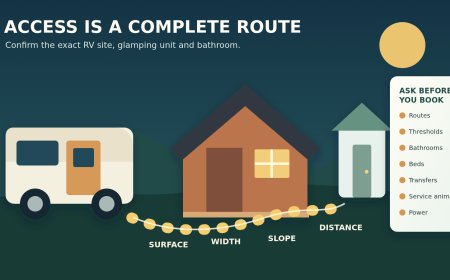
Ask for a marked map or site-specific description. Confirm the walking surface, lighting, grade, gates and after-hours access between glamping parking and the unit. If someone needs close parking, do not translate “general area” or “short walk” into a distance. Request a measured or site-specific answer.
Also settle the social plan. If everyone gathers at one RV pad, confirm whether glamping guests’ cars may move there, whether visitor registration or fees apply, and when those cars must return to their assigned area. Never use an empty campsite as unofficial overflow parking.
Verify the amenity attached to each rate
“Bathhouse on property” can mean a modern shower a few steps away, a facility in another loop or a building that closes for cleaning. “Private bathroom” might describe only the premium glamping tier. The reservation name matters.
Bethel Woods illustrates the tier problem clearly. Its Basic Glamping description points guests to nearby restrooms and shared showers, while Luxury Glamping lists a bathroom with a shower.[3] The same FAQ also contains a broad statement that glamping tents have private bathrooms, so the unit-level descriptions are the safer prompt for clarification.[3] This is not a criticism of the property. It is a useful example of why a group should quote the exact product name in its question.
For every shared facility, verify:
- which reservations may use it;
- whether access is included or carries a fee;
- location and actual walking distance from each unit;
- operating hours and routine cleaning closures;
- toilet, sink and shower counts;
- whether showers are private rooms or stalls;
- accessible route and fixture details needed by anyone in the group;
- whether towels, toiletries, locks or access codes are supplied; and
- the outage or closure procedure.
Repeat the exercise for the pool, hot tub, camp kitchen, laundry, lounge, Wi-Fi, shuttle and dump service. Ask whether wristbands, reservations, adult supervision or capacity limits apply. Ask when privileges end on checkout day. If the group expects to cook or meet in a shared pavilion, confirm that the space can be used without a separate booking.
Avoid turning one amenity into the group’s only plan. An RV bathroom can be a personal backup, but its owner did not necessarily volunteer it as a bathhouse for several households. A pool shower may not be available after the pool closes. A glamping porch may have a low occupancy limit even when the campground accepts the larger group.
Run the mismatch check before deposits become nonrefundable
Place the completed rows side by side and circle every difference. Then test the group’s actual schedule against those differences.
- Late arrival: Can a glamping guest reach parking and carry gear to the tent without driving through a restricted area?
- Early departure: Can an RV start, retract equipment and leave without violating the noise rule?
- Morning power: If generator use starts later than the group wakes, can the RV batteries and equipment cover the gap?
- Evening gathering: Which site can legally and physically hold the people and parked cars?
- Bathroom closure: Which facility is the documented alternative, and is it open to glamping guests?
- Rain: Is the route from glamping parking to the unit and bathhouse usable with luggage?
- Separated reservations: If one household cancels, do the remaining bookings still provide the gathering space or amenity everyone expected?
Assign one group member to keep the final policy packet. It should contain the dated web pages or screenshots, staff emails, completed worksheet, map, reservation names, unit types, fees and after-hours contact. Recheck the links shortly before the free-cancellation deadline and again before departure. Policies, hours and site assignments can change.
Booking red flags
Pause before paying when the answer changes depending on whom you ask, a premium-unit feature is being used to describe every glamping tent, overflow parking is “probably fine,” or generator permission is offered verbally despite a written prohibition. Another warning is a shared amenity central to the trip with no stated hours or closure backup.
Ask the property to resolve the conflict in writing. If it will not, decide from the more restrictive reading. The goal is not to catch a campground in a mistake. It is to keep one household’s equipment, vehicle or bedtime from becoming another household’s problem.
A mixed group does not need identical accommodations. It needs compatible rules. When each unit has a confirmed noise window, power plan, parking place and amenity list, the RV and glamping sides can share the trip without assuming they bought the same experience.
Sources
What's Your Reaction?