















Flow-Rite RV2000 review: easier battery watering, with one inspection catch
Research-based Flow-Rite RV2000 review with a three-gate fit check, separate pump warning and a two-loop flooded-battery maintenance plan.
The Flow-Rite RV2000 solves a specific problem well: two hard-to-reach 6V flooded house batteries that still need distilled water. Six replacement valves connect to one remote fill point, so the owner can water both batteries without reaching every cell opening.[1][2]
That convenience is the reason to buy it. It is also the reason to keep a separate inspection routine. A firm pump bulb means the valves have stopped accepting water; it does not show whether a valve has stuck, a terminal has corroded or a cable has loosened. Owner reports include years of quick, trouble-free filling, but one owner found cells that had not been receiving water after some caps malfunctioned.[5][6]
This is a research-based review. RVCamping.info did not buy, install or physically test the system.
As an Amazon Associate, RVCamping.info may earn from qualifying purchases. The reviewed listing is ASIN B001FCAXT0, model RV2000, UPC 784176120006. Check the exact model on Amazon.[7] The separate RV-2020 hand pump is needed to fill the installed system and is not listed among the RV-2000 kit components.[1][4]
The fit decision takes three gates
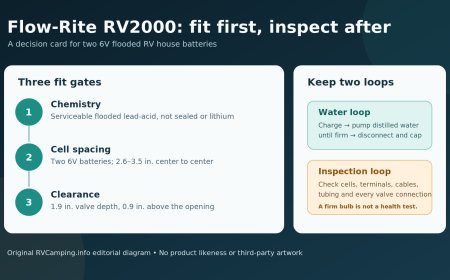
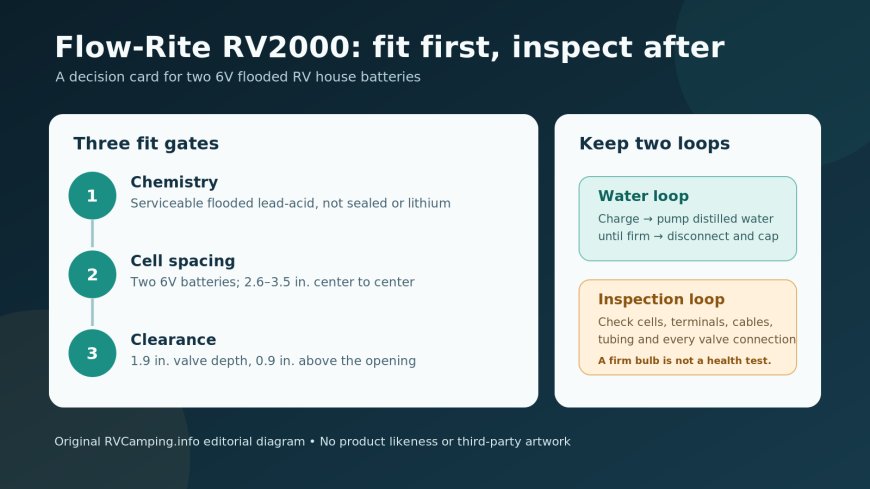
RV-2000 is not a generic battery accessory. It is the two-battery Pro-Fill RV kit built around six valves and two BA-127-FLEX manifolds.[1] Use three gates before ordering.
| Gate | Pass condition | Stop condition |
|---|---|---|
| Battery type | Two serviceable 6V flooded lead-acid batteries, three cells each | AGM, gel, sealed maintenance-free, lithium or 12V batteries |
| Cell layout | Cell centers measure 2.6 to 3.5 inches apart | Spacing or valve layout falls outside the Flow-Rite cross-reference |
| Compartment clearance | At least 1.9 inches of valve depth and 0.9 inch above each opening, with room for cables and tubing | A hold-down, cable, lid or bus bar blocks the valve/manifold path |
Flow-Rite publishes the 2.6-to-3.5-inch spacing for the flexible manifold, along with 1.9 inches of valve depth and 0.9 inch of installed height above the opening.[1][3] Its catalog cross-references familiar batteries such as Interstate GC2 models and Trojan T105, T125, T145 and T605, but it also assigns other layouts to different hardware.[3] Measure the exact batteries. A familiar brand name is not a fit measurement.
The distinction between 6V and 12V matters too.[3] Two 6V batteries wired in series may form a 12V house bank, but RV-2000 still fits the three-cell layout of each individual 6V battery. Flow-Rite's MP-2000 Qwik-Fill is a different system for common 12V marine deep-cycle batteries.[3]
Buyers also need to check the route above the caps. One iRV2 owner chose a watering system because four batteries fit the compartment but lacked enough vertical room for normal water checks.[5] That is the RV2000's strongest use case. If both battery tops already sit in the open at waist height, the kit saves less work and adds valves and tubing that still require inspection.
It turns an awkward job into a short one
The owner evidence consistently favors the system where access is poor. One iRV2 contributor reported that a job that had taken about 20 minutes dropped to roughly three after installation. Another said adding water to a difficult four-battery compartment took about 30 seconds.[5] Those are individual reports, not timed tests of every RV2000 installation, but they explain the product's practical value better than a feature list.
The fill routine is simple. Fully charge the batteries, place the RV-2020 pump pickup in distilled water, keep the jug below the battery tops, connect the quick coupler and squeeze until the bulb becomes firm. Disconnect the pump immediately and replace the dust cap.[2][4] Flow-Rite says not to store the pump in the battery compartment or leave it connected after filling.[2]
The charge-first sequence prevents a common mistake. Electrolyte expands while a battery charges. If the plates are exposed, the manual says to add only enough water to cover them, charge the batteries, then complete the fill with Pro-Fill.[2] Filling a discharged battery to its final level first can push electrolyte out during charging.
The installed hardware may stay on the batteries in winter storage, but Flow-Rite says it will not operate below freezing.[2] Wait for it to thaw before trying to pump water. The manual also limits one connected system to six batteries and recommends locating the fill line toward the middle when more than two are linked.[2]
Keep the water loop and inspection loop separate
A single-point filler changes how water reaches the cells. It does not eliminate flooded-battery maintenance. The safest way to use it is to run two loops.
The water loop is the short one: charge, look for signs of an abnormally dry battery, put the distilled-water jug below the battery tops, pump until the bulb firms, disconnect and cap the line.[2]
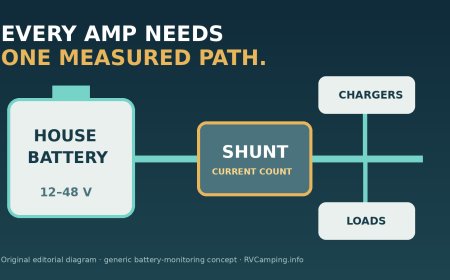
The inspection loop takes longer. Look over the battery tops, terminals, interconnects, hold-downs, tubing, quick coupler and every visible valve connection. Watch for wetness, staining, cracked parts, displaced tubing or a cell that seems to consume water differently from its neighbors. Keep following the battery manufacturer's service and safety instructions.
That second loop answers the product's main tradeoff. The manifold makes direct viewing harder.[6] In the iRV2 discussion, one owner said removing each three-cap assembly was manageable with enough hose slack.[5] Another reported that some caps had stopped filling their cells and the problem was not discovered until the array was removed for a specific-gravity check.[6] These reports conflict in outcome, but not in the lesson: convenience should make scheduled maintenance easier, not make the battery bank invisible.
A sensible baseline is to verify the levels directly after the first few fill cycles and whenever water use changes unexpectedly. The exact interval belongs to the battery maker and the owner's observed consumption, not to a universal calendar invented for this accessory. A firm bulb is a fill signal, not a battery-health test.
Verdict
The Flow-Rite RV2000 is a good buy for an RV that will keep two compatible 6V flooded house batteries and makes their caps difficult to reach. The product turns six cell openings into one accessible fill point, and owner reports show why that can change a postponed chore into a quick routine.[2][5]
Skip it if the batteries are sealed, 12V, due for a near-term lithium replacement, outside the published spacing range or already easy to inspect. Also skip this exact kit if cables or the compartment lid cannot clear the added valve and manifold height.
For the right bank, the purchase decision is not complicated: pass the chemistry, spacing and clearance gates; add the separate RV-2020 pump; then keep the water loop and inspection loop on the calendar. That preserves the RV2000's best feature without pretending its automatic valves can inspect the battery for you.
Sources
- Flow-Rite Pro-Fill RV two-battery system specifications and components (accessed November 1, 2026)
- Flow-Rite Pro-Fill RV installation and operation manual, BL-189-031921 (accessed November 1, 2026)
- Flow-Rite battery watering catalog and battery cross-reference, ninth edition (accessed November 1, 2026)
- Flow-Rite RV-2020 hand pump product page (accessed November 1, 2026)
- iRV2 owner discussion about installation, access and maintenance time (accessed November 1, 2026)
- iRV2 owner discussion about direct inspection and reported valve failures (accessed November 1, 2026)
- Amazon US listing for Flow-Rite RV2000, ASIN B001FCAXT0 (accessed November 1, 2026)
What's Your Reaction?