












Brown outside, pink inside: the campsite burger test that actually works
A thermometer-first campsite burger workflow covering color myths, side-entry probing, cold transport, clean serving, and leftovers.

Brown outside, pink inside: the campsite burger test that actually works
By Romana | October 10, 2026 | Cooking
A burger can look finished and still miss its safety temperature. Another can remain pink after it reaches that temperature. Camp cooks who judge the center by color are asking meat pigments to do a thermometer's job.
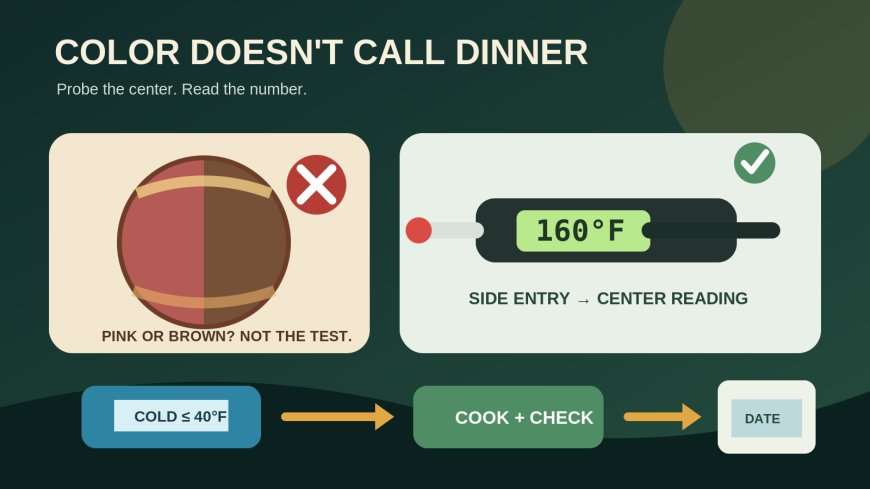
Quick answer: Cook ground-beef patties to 160°F and verify the center of each patty with a food thermometer. For a thin burger, insert the probe through the side so its sensing area reaches the middle. Brown color, pink color, grill marks, firmness and clear-looking juices do not release a burger for service.[1][2]

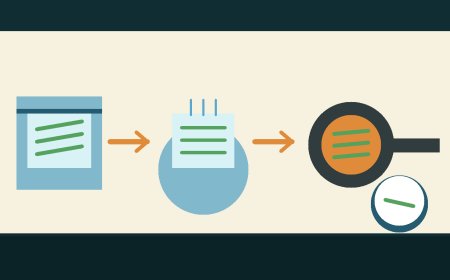
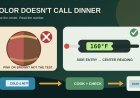
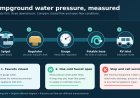
Color gets a red X; the measured center gets the decision. Original RVCamping.info illustration.
A browned center can arrive too early
Ground beef does not change color on a dependable safety schedule. USDA reports that some patties brown before reaching 160°F, a result called premature browning. The same agency explains that safely cooked beef can also retain pink because meat pigment, acidity, fat and other ingredients affect appearance.[1]
That creates two opposite mistakes. A cook may pull an under-temperature brown burger because it “looks done.” Or the cook may dry out a verified 160°F burger while waiting for every trace of pink to disappear. The thermometer avoids both guesses.
Ground meat needs this treatment because grinding can move bacteria from the meat's surface throughout the batch. The safety endpoint for ground beef is therefore different from the familiar whole-cut beef rule. A hamburger does not use the 145°F-and-rest target for a steak. Its consumer endpoint is 160°F.[1][2]
This is a measurement rule, not a preference about whether a burger should be juicy or firm. A diner can request more cooking after 160°F. The campsite cook should not serve it below the endpoint based on color.
Make the thermometer part of setup
A thermometer buried in an RV drawer tends to appear after everyone is hungry. Put it beside the clean serving plate before the package of beef opens. Check its instructions, including where the sensing area is located and how long the display needs to settle. A thick dial stem may sense along a larger section than a thin-tip digital probe.
Also stage two places for the utensil: a raw-side tray and a clean-side rest. The probe must be washed with hot, soapy water before and after use. A probe that has entered an undercooked patty should not move directly into a finished burger.[2]
Use this four-reading routine:
- Let the burger cook until it is near the expected finish, without using color as a pass signal.
- Lift or steady the patty with a clean method that keeps hands away from the grate.
- Insert the probe sideways into the thickest part and guide the sensing area to the center.
- Wait for a stable reading. Below 160°F means more heat; 160°F or above means the patty may move to a clean plate.[1][2]
Check every patty. A hot spot, flare-up, thickness difference or frozen center can make one burger finish before its neighbor. If a reading seems implausibly high or low, move to a second central location and check again rather than averaging a hot edge with a cool middle.[1][2]
Do not measure against the grill, skillet or spatula. Contact with hot metal can produce a reading for the cooking surface instead of the beef. A top-down stab through a thin patty can leave much of the sensing area outside the center. Side entry gives the probe more food to travel through.
Give raw beef a short, cold trip
The thermometer workflow begins before ignition. Carry ground beef at 40°F or colder with ice or frozen packs. USDA's camping guidance recommends separating raw meat from ready-to-eat food; when one cooler must do both jobs, raw meat belongs below food that will not receive cooking. A second bag or wrap helps contain leaking juices.[3]
Use a cooler thermometer. “Still cool” is not a temperature. Keep the food cooler in shade, limit openings, and place drinks elsewhere when possible. Take out only the patties that fit the current cooking batch, leaving the rest under cold control.
Do not partially cook burgers at home and finish them at camp. The first heating can let surviving bacteria multiply during the pause. Either transport the beef raw and cook it continuously at camp, or fully cook it in advance, chill it correctly and handle it as a refrigerated leftover.[1]
A forgotten package needs a time history, not optimism. Perishable food that has remained outside safe cold or hot holding for more than two hours must be discarded; the limit contracts to one hour when ambient temperature exceeds 90°F.[4] Cooking later does not erase every hazard created by bad handling.
Separate the reading from the serving
A 160°F reading solves only the cooking endpoint. It does not clean the raw plate, spatula or hands. Move a verified burger onto a plate that never held uncooked meat. Wash hands after raw handling and keep buns, cheese, lettuce and condiments beyond the raw-work area.
The simplest grill kit has two visibly different spatulas. One handles patties while they are below the endpoint. The second handles verified burgers. If only one is available, stop and wash it thoroughly with hot, soapy water before its first clean-side use. Do the same for tongs.
Do not stack a cooked burger on top of a burger that has not yet been measured. Do not assume the last patty is safe because the first one read 160°F. Each burger earns its own reading and clean landing.
Run one clock after cooking
Serve verified burgers promptly. If they sit at the picnic table, the outdoor clock includes time spent waiting for late arrivals, eating and cleaning up. USDA says leftovers should enter refrigeration within two hours after cooking or after removal from hot holding. Above 90°F, use one hour.[4]
Write the deadline on tape:
- FIRST BURGER LEFT HEAT: ______
- AIR ABOVE 90°F: YES / NO
- REFRIGERATE OR DISCARD BY: ______
Refrigerate only burgers with a known history: safely cooked, protected from raw contamination and chilled before the deadline. Use shallow covered containers so cooling is not slowed by a deep, tightly packed stack. The RV refrigerator or cooler must maintain 40°F or below.[3][4]
Eat refrigerated cooked burgers within three to four days. Reheat saved patties to 165°F, measured at the center.[4] A leftover with an unknown service clock, a warm refrigerator episode or raw-juice contact does not qualify for rescue by reheating.
The burger card for the grill lid
Keep the release rule compact enough to use while the campsite is busy:
- COLD: Beef stays at 40°F or colder and below ready-to-eat food.
- CLEAN: A clean plate, clean-side utensil and washed thermometer are ready.
- CENTER: Probe every thin patty from the side.
- 160°F: The number, not the color, releases the burger.
- CLOCK: Chill within two hours, or one hour above 90°F.
- LEFTOVERS: Refrigerate three to four days; reheat to 165°F.
A browned burger can be unsafe, and a pink burger can be safely cooked. Neither appearance settles the question. Pack one accurate food thermometer, put its sensing area in the center, and let the reading make the call.
Evidence note: USDA supplies the color findings, temperature endpoints, probe placement, camping cold-chain guidance and leftover limits. The four-reading routine, written clock and six-line grill card are original RVCamping.info workflow tools. This is consumer food-safety guidance, not a recipe or a substitute for product instructions.
Sources
- Color of Cooked Ground Beef as It Relates to Doneness — USDA Food Safety and Inspection Service
- Food Thermometers — USDA Food Safety and Inspection Service
- Food Safety While Hiking, Camping & Boating — USDA Food Safety and Inspection Service
- Leftovers and Food Safety — USDA Food Safety and Inspection Service
What's Your Reaction?