



Before the gatepost: measure your motorhome’s tail swing
Measure your motorhome’s outward rear-corner sweep in a controlled lot, then use C = S + B and M = A − C before a tight turn.
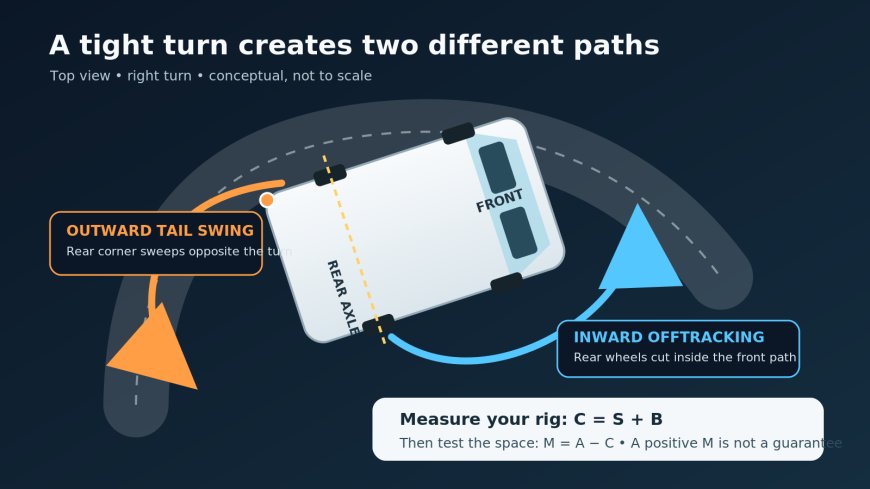
A motorhome can miss a post with its front corner and still clip it with the rear. A controlled-lot measurement gives you a rig-specific number to use before a tight turn, but only for the configuration and maneuver you tested.
Two paths move in opposite directions
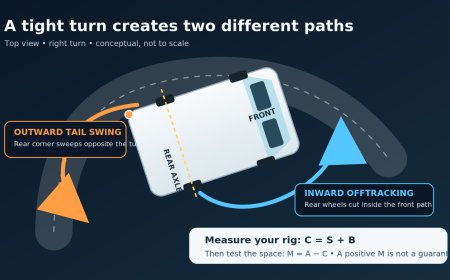
In a turn, the rear wheels generally track inside the path of the front wheels. FHWA calls this offtracking and notes that it grows with axle spacing and shrinks as turn radius increases.[1] This is the inside-of-the-turn problem: a rear tire can climb a curb or strike a low obstacle even though the front cleared it.
Tail swing is different. Bodywork and equipment behind the rear axle can sweep outward, on the side opposite the turn. Georgia’s CDL manual tells school-bus drivers to watch that outward movement in their mirrors, while limiting its three-foot figure to a school bus.[4] That figure is not a motorhome allowance.
Both paths matter at once. Turning right can move the right rear wheel inward while the left rear corner moves outward. Watching only the nose, or only the inside wheel, leaves half the problem unchecked.
Calibrate the rig you actually drive
Federal school-bus training requires trainees to use turn reference points and demonstrate control of tail swing.[2] Newmar likewise recommends a spotter while a new motorhome driver practices turns and parking.[3] Those sources support practice and observation; the following measurement card is RVCamping.info’s own protocol for a rigid motorhome.
Use a large, level, empty paved area in daylight. Keep people and hard objects out of the motorhome’s possible path. Mark with flexible cones or chalk. A competent spotter must stand well outside every possible vehicle path, remain visible to the driver, and stop the exercise if there is any doubt. The motorhome or chassis manual and qualified instruction take precedence over this editorial protocol.
- Record the exact setup: rear rack or carrier, bikes or mobility equipment, load, tag-axle state if applicable, tire condition, and the planned steering maneuver. Disconnect any towed vehicle. This protocol does not apply to trailers or fifth wheels.
- Park straight beside a chalk or cone line that represents the starting side plane of the rear body. Include the outer edge of attached equipment if it extends farther.
- At walking speed, make the relevant pull-away or 90-degree turn. The spotter marks the farthest outward position reached by the rearmost outside corner or equipment. The spotter does not chase the corner or enter the test area while the motorhome is moving.
- Stop, secure the motorhome, then measure perpendicular from the starting side plane to the mark. Repeat three times turning each direction. Record all six measurements.
- Call the largest observed sweep S. Keep the individual readings; a wide spread is a reason to repeat the test, not average away the larger result.
A rear-overhang measurement can be useful context, but it does not replace the test. Newmar offers a heuristic of one foot of potential tail swing for every three feet behind the rear axle.[3] Treat that ratio as a prompt to pay attention, not a prediction or clearance guarantee.
Turn one observation into a no-go check
Choose a contingency buffer B for the planned maneuver, then calculate:
C = S + B
Here, C is the operational clearance zone measured outward from the motorhome’s starting side plane. The buffer is deliberately user-selected. This article does not supply a universal buffer because slope, steering rate, body roll, pavement, loading, driver repeatability and measurement error vary. No value of B makes the result a guarantee.
Before a tight real-world turn, stop where it is safe and measure or conservatively estimate available lateral clearance A from that same starting side plane to the nearest obstacle on the outside of the turn. Then calculate:
M = A − C
A negative margin means the measured space is smaller than the chosen clearance zone. Reposition, change the path or decline the turn. A zero or positive margin only passes this arithmetic screen; it is not a guarantee. It does not prove the maneuver is safe, and it does not account for the inward rear-wheel path. Continue slowly only when the whole path is visible and the maneuver remains within the motorhome maker’s guidance.
Worked example: the gatepost fails the check
Consider a hypothetical rigid motorhome with 11 feet (132 inches) of rear overhang. Newmar’s 3:1 heuristic would suggest 44 inches of potential swing, but the owner does not use that estimate as the decision number. Six controlled-lot observations are 39, 42, 40, 37, 41 and 40 inches. The largest is S = 42 inches.
For this example, the owner selects B = 24 inches. That is an illustrative choice, not an engineering or legal standard.
- C = S + B = 42 + 24 = 66 inches
- Available clearance beside the gatepost: A = 60 inches
- M = A − C = 60 − 66 = −6 inches
The result is a stop: the proposed path has six inches less space than the owner’s chosen clearance zone. The driver needs to reposition, use another path or not make the turn.
The heuristic’s 44 inches happens to be close to the 42-inch observation. That coincidence does not validate either number. The observed sweep belongs only to the tested motorhome, setup, pavement, steering input and maneuver.
Keep the calibration card specific
Recalibrate after adding or moving rear equipment, changing the body envelope or testing a materially different turn. Use separate records for left and right if the configuration is asymmetric, even though S uses the largest observation for the clearance calculation.
The card has two jobs: remind the driver how far the rear corner moved during a repeatable exercise and reject a space that is already too small under the chosen assumptions. It cannot certify a turn. Mirrors, a safely positioned spotter and continuous attention to both the inward wheel path and outward rear-corner sweep remain part of every tight maneuver.
Source note: RVCamping.info checked the linked primary records on 2026-11-01. The controlled-lot calibration protocol, C = S + B decision model and worked example are original editorial work.
Sources
- FHWA, Western Uniformity Scenario Analysis, Chapter 6: Roadway Geometry — offtracking definition and geometry discussion; accessed and archived 2026-11-01.
- 49 CFR Part 380, Appendix D: School Bus Endorsement Training Curriculum — Unit D2.4 tail-swing reference-point requirement; accessed and archived 2026-11-01.
- Newmar, “7 Tips on Driving a Diesel Pusher Motorhome” — manufacturer heuristic and spotter advice; accessed and archived 2026-11-01.
- Georgia Department of Driver Services, CDL Manual, Section 10.7.4 — school-bus tail-swing warning; accessed and archived 2026-11-01.
What's Your Reaction?