






Which opened condiments need refrigeration in an RV?
A label-first, FoodKeeper-backed RV guide to opened-condiment refrigeration, cooler placement, set-out clocks and discard boundaries.

Which opened condiments need refrigeration in an RV?
By Romana Category: Cooking
The RV refrigerator door is small, the cooler gets opened all afternoon, and half the condiment bottles seem to say something different. The useful question is not “Does ketchup live in the pantry?” It is “What does this exact product require after opening, and has it stayed inside that boundary?”
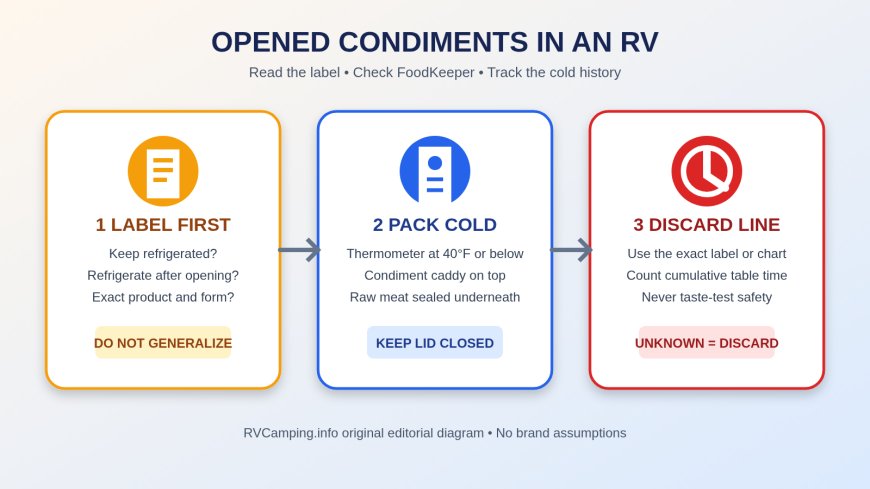
The short answer: Read the storage instruction on the exact package first. If it says “keep refrigerated” or “refrigerate after opening,” give it verified cold space at 40°F or below. When the package is silent, look up the exact food and form in USDA FoodKeeper rather than applying one rule to an entire condiment family. Separate cold condiments from raw-meat leak risk, use a cooler thermometer, and discard by time and temperature when refrigeration fails.

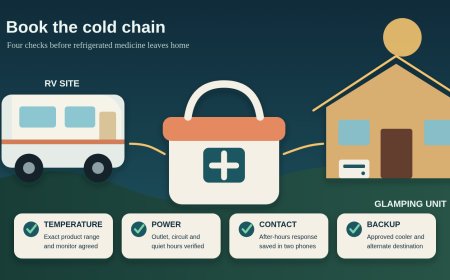
The bottle’s label starts the decision; the cooler history finishes it. Original RVCamping.info illustration.
The label outranks condiment folklore
FDA tells consumers to check storage directions on labels and says that if a food requiring refrigeration was not properly chilled, throwing it out is usually the safest choice.[3] That makes the first campsite step simple: read the unopened bottle before packing and read it again after opening.
Sort each item into one of three bins:
- Cold by instruction. The package says “keep refrigerated” or “refrigerate after opening,” or the product was sold from a refrigerated case. Plan cold space for it.
- Shelf-stable after opening by the exact product guidance. The label permits pantry storage, or the exact FoodKeeper record provides an after-opening pantry period. Keep it capped, clean, and away from RV heat.
- Unresolved. The label is missing, damaged, transferred to another container, or vague. Look up the exact product and form in FoodKeeper. Until resolved, treat it as cold rather than inventing a category rule.
FDA’s refrigeration-label guidance explains why the words alone can be confusing: some foods need refrigeration for safety, while others use similar instructions to preserve quality.[2] Campers cannot determine which purpose a manufacturer intended by tasting the product or by comparing it with another brand. Follow the instruction either way.
The USDA-developed FoodKeeper is designed to provide food and beverage storage guidance and includes a condiments, sauces, and canned-goods category.[1] Match details such as commercial versus homemade, shelf-stable versus sold cold, and unopened versus opened. “Salsa” is not a sufficiently precise lookup if one jar came from an unrefrigerated grocery shelf and another is a fresh deli product.
What the federal outage chart can and cannot tell you
FoodSafety.gov’s power-outage chart is useful for drawing discard boundaries, but it is not a permission slip to ignore a package label. Its “keep” group includes mustard and catsup; jelly and relish; taco sauce; olives and pickles; and Worcestershire, soy, barbecue, and hoisin sauces after exposure above 40°F for more than two hours. Opened vinegar-based dressings are also listed as keep.[4]
The same chart treats other condiments differently. Fish or oyster sauce, creamy dressing, opened spaghetti sauce, and commercial garlic in oil are in the discard group after that exposure. Opened mayonnaise, tartar sauce, and horseradish have a separate boundary: discard if they were above 50°F for more than eight hours.[4]
Use those distinctions only for the event the chart describes. They show why “all sauces are safe” and “all opened condiments must stay cold” are both bad shortcuts. For ordinary trip storage, the product label and exact FoodKeeper entry remain the working rules. Quality can also deteriorate before a federal emergency chart requires disposal.
Homemade condiments deserve their own label. A reused mustard squeeze bottle filled with homemade aioli is not mustard. Write the contents and preparation date on the container, identify its perishable ingredients, and keep it cold. If nobody can state what is inside or when it was made, do not pass it around the picnic table.
Give cold condiments a low-traffic zone
USDA’s camping guidance recommends taking the smallest quantity needed, even giving a small jar of mayonnaise as an example. It also says raw meat should ideally ride in a separate cooler; when only one cooler is available, raw meat belongs below ready-to-eat foods.[5]
Turn that into a practical RV layout:
- Put drinks in a separate cooler when possible. Frequent drink runs dump warm air into a food cooler.
- Place refrigerated condiments together in a watertight caddy near the top, above and physically isolated from raw meat packages.
- Double-bag raw meat and keep it at the bottom, or use a separate raw-food cooler.
- Put an appliance thermometer where it can be read without unpacking everything. Keep cold food no warmer than 40°F.[3][5]
- Use small trip-size containers so a family-size jar does not make repeated warm trips to the table.
- Keep the cooler shaded and closed. Return the condiment caddy as soon as serving ends.
A refrigerator-door shelf is convenient but often crowded and repeatedly warmed. If a bottle must stay cold, assign it a stable shelf or bin where it will not fall out, leak, block the door seal, or sit next to raw-meat drips. Do not pack so tightly that cold air cannot circulate; FDA specifically warns against crowding a refrigerator or freezer.[3]
Avoid community dipping. Squeeze bottles or clean serving spoons reduce crumbs and food residue entering the main container. Never return a spoon that touched raw meat to a sauce jar. Wipe the rim with a clean towel before closing it, and replace a cap that fell into dirt rather than screwing grit back onto the bottle.
Put a clock on the picnic table
A chilled condiment leaves temperature control when it comes out of the refrigerator or cooler. FDA’s general rule for foods requiring refrigeration is no more than two hours at room temperature, shortened to one hour when air temperature is above 90°F.[3] That is the conservative boundary for a cold-by-instruction condiment unless its authoritative product guidance gives a different, item-specific emergency rule.
Write the set-out time on tape attached to the caddy. Do not restart the clock each time the bottle briefly returns to a warming cooler. Time is cumulative. A bottle that spent 45 minutes at lunch and 90 minutes at dinner has exceeded a two-hour limit even though neither meal did.
Discard a cold-required condiment when:
- it exceeded its applicable time-and-temperature boundary;
- the cooler or refrigerator history is unknown after a failure;
- raw-meat juices leaked onto the cap, opening, or food and the contamination cannot be removed safely;
- the container is swollen, leaking, cracked, deeply rusted, or otherwise damaged;
- mold, an unusual odor, bubbling, or an unexpected texture change appears; or
- the identity, opening date, or storage instruction cannot be reconstructed well enough to make a decision.
Do not taste food to decide whether it is safe after a refrigeration failure. The federal outage chart explicitly says to evaluate each item rather than sampling it.[4] Smell and appearance can identify some spoilage, but FDA notes that foodborne pathogens may be present when food does not look, smell, or taste spoiled.[3]
An opening-date system that fits an RV
Use painter’s tape and record three things: `OPENED`, the date, and `COLD` when refrigeration is required. For a FoodKeeper lookup, add the resulting use-by date rather than making everyone repeat the search. Photograph the original label before decanting into a small travel container, and write the contents on both the lid and side.
Before departure, audit the condiment bin:
- Read every post-opening statement.
- Check the exact FoodKeeper listing for silent or uncertain labels.[1]
- Reserve 40°F-or-below space for every cold item.
- Pack only the amount the trip needs.[5]
- Write opening dates and set-out times.
- Carry a cooler thermometer and enough cold source for the full travel day.
After the trip, do not put a bottle back into the home refrigerator merely because it still feels cool. Check the thermometer history, the table clock, contamination, and the label. When any safety-critical fact is missing, replacement is cheaper than a foodborne illness gamble.
Evidence note: Brand formulations and labels vary. This guide intentionally avoids declaring every member of a condiment category shelf-stable or refrigerated. The exact package instruction comes first; USDA FoodKeeper supplies item-specific storage guidance when needed; the FoodSafety.gov outage chart is used only for defined discard decisions.
Sources
- FoodKeeper App — FoodSafety.gov (USDA-developed storage tool; condiment category)
- Guidance on Labeling of Foods That Need Refrigeration by Consumers — U.S. FDA
- Are You Storing Food Safely? — U.S. FDA
- Food Safety During Power Outage — FoodSafety.gov (condiment-specific keep/discard chart)
- Food Safety While Hiking, Camping & Boating — USDA FSIS
What's Your Reaction?