













Beat sunset to the campsite: an RV arrival-time worksheet for fall
Work backward from campground rules, local sunset, RV setup time, road conditions and weather to calculate a before-dark fall arrival.


Beat sunset to the campsite: an RV arrival-time worksheet for fall
By Romana
Category: RV Camping
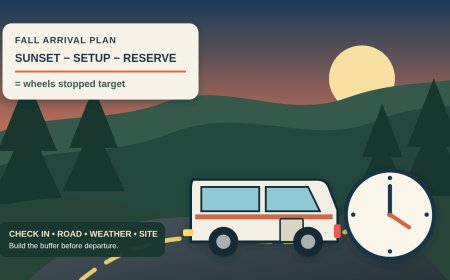
In fall, “we should get there around six” is not an arrival plan. The useful target is wheels stopped at the assigned site while enough usable light remains to inspect, position and secure the RV. Work backward from local sunset, the campground’s arrival rules and a setup time measured for your own rig. Then add separate allowances for stops, traffic and weather.
The result may move departure much earlier than a car-navigation estimate. That is the point. A late fuel stop should spend buffer time, not push the RV into an unfamiliar loop after dark.
Three clocks control the arrival
Write down three times before calculating anything:
- Campground clock: office closing, gate hours, check-in procedure, quiet hours and any deadline that could put the reservation at risk.
- Daylight clock: sunset at the campground on the arrival date, not sunset at home and not a monthly average.
- Travel clock: realistic driving time plus planned stops and a delay allowance based on the route and forecast.
Use the earliest binding deadline. If a staffed check-in closes at 5:00 p.m. and sunset is 6:35 p.m., arriving at 6:00 does not solve the check-in problem. If after-hours entry is permitted but a wooded back-in site needs 40 minutes of careful positioning and connections, a 6:20 arrival does not solve the daylight problem.
NOAA’s sunrise/sunset calculator accepts a location and date; it also explains that daylight-saving selection changes the displayed result by one hour.[1] Enter the campground location, verify the time zone shown, and copy the local sunset into the worksheet. Treat sunset as a planning boundary rather than a promise of good visibility. Hills, trees, clouds and heavy rain can take away usable light sooner.
Confirm the campground procedure, not just “check-in: 2 p.m.”
A listed check-in time usually tells you when a site becomes available. It may not tell you when the office closes, whether a gate is locked, how to find an assigned site after hours or when an unclaimed reservation is released. This worksheet uses the resulting deadline as one input; for a fuller policy audit, use RVCamping.info’s campground check-in and late-arrival guide.
Call or message the campground and ask:
- What is the latest time for staffed check-in?
- If we arrive after the office closes, where will the site assignment, map and gate code be available?
- Is the entrance gate closed or locked at a set time?
- Must we register the next morning?
- What is the no-show or first-night forfeiture deadline?
- Are there quiet-hour limits on backing assistance, generators or setup work?
- Is there an overflow or late-arrival area where the complete rig can fit?
- Does the final approach have a preferred direction for a long RV or trailer?
Save the answer with the reservation confirmation. Do not assume a procedure from another campground in the same park system. Yosemite, for example, tells after-hours arrivals to go to the reserved site and check in the next morning, but it also says travelers who will arrive later than the reserved date should call the campground office; an unreported absence through noon after the first night can forfeit the reservation.[4] That is one park’s published procedure, not a universal rule.
If the campground cannot confirm after-hours access, make staffed closing the hard arrival deadline. If it does confirm late arrival, record the exact gate, kiosk or envelope procedure and keep a screenshot offline.
Estimate setup by sequence
“Setup takes 20 minutes” often omits the slow parts: finding the site, walking the pad, deciding where the wheels belong and making another approach. Split the job into blocks and estimate each one.
| Setup block | Your minutes |
|---|---|
| Entrance to assigned site, including a wrong turn allowance | ____ |
| Walk the pad for branches, pedestal position, slope and obstacles | ____ |
| Back in or position, including spotter communication | ____ |
| Parking brake, chocks and leveling | ____ |
| Verify clearance before slides or awning | ____ |
| Essential connections and safety check | ____ |
| Total daylight setup time | ____ |
Use a timer during a calm daylight setup with the same travel configuration. Do not race the clock. Round the result up, then add 15 to 30 minutes for an unfamiliar site. A pull-through motorhome and a long travel trailer backing into a tree-lined pad should not share the same default.
Define a separate light reserve after setup. Thirty minutes is a practical starting input, not an official safety standard. Increase it when the loop is wooded, the site is unpaved, rain is forecast, the approach is narrow or the driver will be tired.
Check weather and roads twice
Run a planning check the evening before travel and an operational check shortly before departure. Review conditions along the route, the final campground road and the destination. Weather on the highway is only part of the picture; fog, wind, rain or an early wet snow can slow the drive and the setup.
The National Weather Service’s route tool displays forecast weather on road segments in six-hour intervals and labels itself a planning product. It directs travelers to a state transportation department’s 511 service for current road conditions.[2] FHWA describes 511 as a source of current travel-condition information that can help with choices about departure time and route, while noting that implementation rests with state and local agencies.[3]
Use those tools for different jobs:
- Forecast: Will wind, precipitation, visibility or temperature alter the route or setup?
- Road report: Are there closures, incidents, work zones, restrictions or pass conditions now?
- Campground check: Is the access road open, and has the office, gate or water service changed?
Do not turn a delay allowance into permission to drive through conditions that call for stopping. Set a hold or reroute point before departure, such as the last large fuel stop before a mountain road or the last town with a campground that can take the whole rig.
The before-dark arrival calculation
Use local clock times for the campground.
Step 1: Find the daylight deadline
Daylight arrival deadline = local sunset − setup minutes − light-reserve minutes
Step 2: Find the campground deadline
Use the latest arrival time that preserves access and the reservation. This could be office closing if staffed check-in is mandatory, gate closing if no code is available, or a campground-confirmed late-arrival time.
Step 3: Set the wheels-stopped target
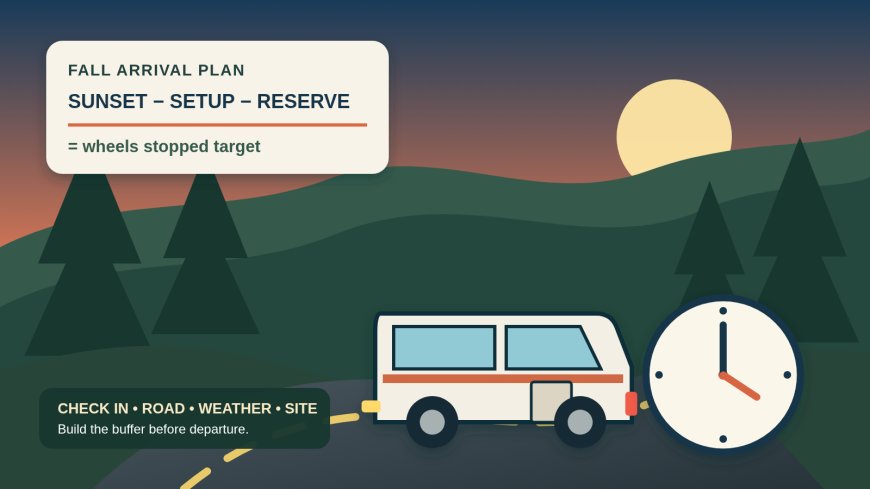
Wheels-stopped target = earlier of the daylight deadline and campground deadline
This target means stopped at the site, not turning off the highway or reaching the registration building.
Step 4: Build the travel budget
Travel budget = navigation drive time + planned-stop minutes + traffic/weather margin
List stops rather than hiding them inside one guess. Include fuel, meals, rest breaks, pet care, a driver change, border or ferry processing when relevant, and a final grocery stop only if it fits before the deadline.
Step 5: Calculate departure
Latest planned departure = wheels-stopped target − travel budget
Call it “latest planned,” not “must leave by.” Leaving earlier protects the margin.
Worked example
This example is illustrative; it is not a recommendation for every driver or route.
- Local sunset: 6:42 p.m.
- Setup estimate: 45 minutes
- Light reserve: 30 minutes
- Daylight arrival deadline: 5:27 p.m.
- Campground-confirmed staffed deadline: 6:00 p.m.
- Wheels-stopped target: 5:27 p.m. (the earlier time)
- Navigation drive time: 4 hours 20 minutes
- Planned stops: 55 minutes
- Traffic/weather margin: 40 minutes
- Total travel budget: 5 hours 55 minutes
- Latest planned departure: 11:32 a.m.
The calculation exposes a common planning error. A “four-hour-and-twenty-minute drive” becomes almost six hours once real stops and a modest delay allowance are visible.
Copy-and-use worksheet
ARRIVAL DATE: ____________________
CAMPGROUND / SITE: ______________
CAMPGROUND PHONE: _______________

CAMPGROUND CLOCK
Office closes: ___________________
Gate closes / code works: ________
Late-arrival steps: ______________
No-show deadline: ________________
Quiet hours: _____________________
Campground deadline: _____________

DAYLIGHT CLOCK
Local sunset: ____________________
Source and date checked: _________
Setup estimate: __________ minutes
Light reserve: ___________ minutes
Daylight arrival deadline: _______

TARGET
Earlier of campground and daylight deadlines:
WHEELS STOPPED AT SITE: __________

TRAVEL BUDGET
Navigation drive time: ___________
Fuel stops: _____________ minutes
Meal/rest stops: _________ minutes
Pet/driver-change stops: _ minutes
Other fixed stops: _______ minutes
Traffic/weather margin: __ minutes
TOTAL TRAVEL BUDGET: _____________

LATEST PLANNED DEPARTURE: _________
PERSONAL TURNAROUND / HOLD POINT: _
BACKUP OVERNIGHT LOCATION: ________
Recalculate after any material route or weather change. If a closure adds 50 minutes, do not quietly consume the setup window; move departure, use the alternate, or activate the backup stay.
If the buffer disappears en route
Call the campground while safely parked. Confirm that the reservation remains protected and that the gate, site assignment and late-arrival instructions have not changed. If after-hours entry is allowed, ask whether the campground prefers a late-arrival holding area.
At the site, use a park-safe minimum instead of attempting the full campsite build in darkness:
- keep headlights aimed away from occupied sites when practical;
- use a spotter with agreed hand signals and a flashlight aimed at hazards, not windows;
- stop if the driver loses sight of the spotter;
- set the parking brake and chock as the RV and equipment manuals require;
- inspect clearances before any slide movement;
- connect only what can be identified and inspected safely; and
- postpone the awning, outdoor furniture, sewer hose and other nonessential work until daylight.
If the pad, trees, drop-offs or utility layout cannot be assessed safely, use the confirmed overflow area or backup stop. A reservation is not a reason to force a blind setup.
The fall reset
Repeat the worksheet for every travel day. Sunset changes with date and location, and the campground deadline changes with each property. By late fall, a departure time that worked on the same route a month earlier can erase the whole setup window.
The useful number is not estimated arrival at the campground entrance. It is the latest departure that still leaves the RV stopped, inspected and secure before the light is gone.
Sources
- [1] NOAA Global Monitoring Laboratory: Improved Sunrise/Sunset Calculation (accessed September 17, 2026).
- [2] National Weather Service: Transportation Decision Support (accessed September 17, 2026).
- [3] Federal Highway Administration: About 511 (accessed September 17, 2026).
- [4] National Park Service: Yosemite campground reservation FAQ (accessed September 17, 2026).
What's Your Reaction?