



















BAL X-Chock 28012 review: steadier tandem-axle RV, not a parking brake
The BAL X-Chock 28012 can reduce tandem-axle trailer rocking, but it does not replace wheel chocks. Check fit, setup order, and safety limits.

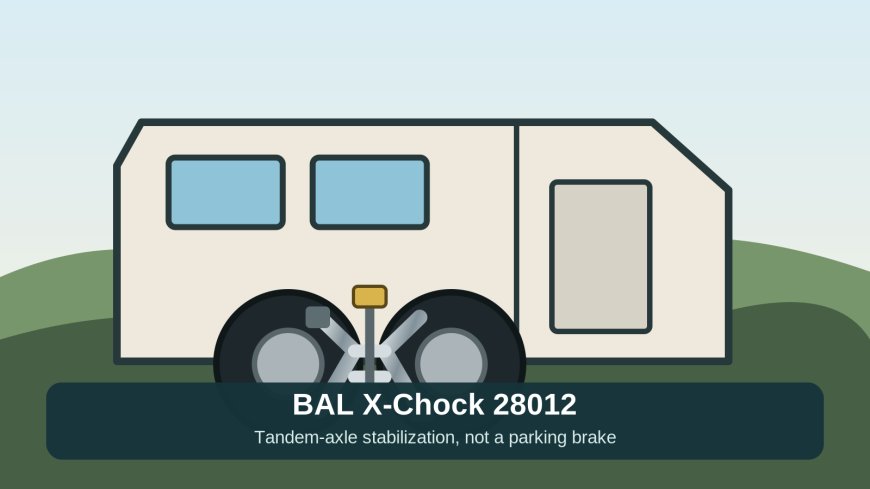
The BAL X-Chock 28012 is worth considering if a tandem-axle travel trailer or fifth wheel still rocks fore and aft after it is level and its stabilizer jacks are down.[2][6] Skip it if your trailer has one axle, if the gap between the facing tire sidewalls falls outside 1 3/8 to 10 inches, or if you want a replacement for ground-contact wheel chocks.[2][3][4] The main tradeoff is simple: the X-Chock can reduce one annoying kind of campsite movement, but it adds two steel devices to the setup checklist and creates a serious departure mistake if you forget to remove them.[2][6]
This is a research-based review. RVCamping.info did not buy, install, or physically test this product.
As an Amazon Associate, RVCamping.info earns from qualifying purchases. If you buy through an Amazon link in this article, we may earn a commission at no additional cost to you.
Check the BAL X-Chock 28012 on Amazon. The verified listing title identifies the two-piece model 28012 and ASIN B002XLHUQG; BAL identifies 28012 as the double pack with UPC 702028280128.[1][2]
The short verdict
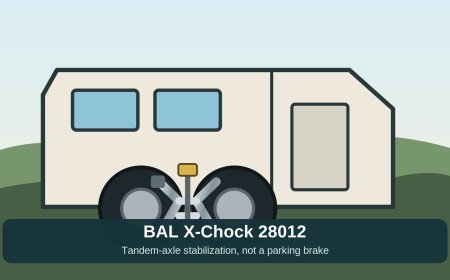
Buy the 28012 if your tandem-axle towable has a 1 3/8- to 10-inch gap between the facing tire sidewalls and the remaining cabin movement feels like the wheels shifting slightly forward and backward.[2][3] BAL designed the X-Chock to press outward between adjacent tires, adding stabilization by resisting that tire shift.[2]
Do not treat it as a parking brake or as permission to skip ordinary wheel chocks. The current BAL page calls it a "tire stabilizing chock," while Forest River instructs towable owners to use ground chocks or blocks before unhitching so the trailer cannot roll.[2][4] That distinction matters most on a slope, during hitching, and while the tongue or leveling system is changing the load on the axles.[4][6]
Owner reports are broadly positive about reducing fore-and-aft motion, but they do not support promises of a motionless trailer. In an iRV2 discussion, multiple owners reported a noticeable reduction while others said the result was incomplete; owners also commonly described using ordinary chocks alongside the X-Chocks.[6] That mixed result makes sense because the product acts at the tires.[2][6] It cannot remove flex in the suspension, frame, stabilizer jacks, or soft ground.[4][6]
Exact model and compatibility
Model 28012 is the two-piece package of BAL's standard X-Chock. BAL lists model 28010 as one standard unit and 28012 as the double pack.[2][3] The two-piece pack is the practical choice for a tandem-axle trailer because it lets you place one device between the tires on each side.
Measure before ordering.[2][3] The standard model retracts to 1 3/8 inches and extends to 10 inches.[2][3] BAL directs owners with wider spacing to its extended models; the official catalog lists 28014 as one extended unit and 28024 as the extended double pack for gaps from 10 to 17 inches.[2][3] Do not assume that "tandem axle" guarantees a fit, especially with wide-track axles, unusual fenders, or limited hand access.[2][3]
The compatibility boundaries are firm:
- It needs two adjacent tires to press against, so it is not for a single-axle trailer.[2][3]
- The facing sidewalls must fall within the model's adjustment range.[2][3]
- There must be enough clearance to insert the device and operate the wrench without hitting trim, suspension parts, or a slideout.
- It stabilizes a parked towable; it does not level the trailer or carry trailer weight.[2][4]
Model identity deserves a final check at checkout.[1][2] Amazon has carried more than one product page for model 28012 over time.[1] The affiliate link in this review points to ASIN B002XLHUQG, whose page title and hidden product data both identify model 28012.[1] Home Depot's owner-review route independently labels the reviewed product as model 28012 and describes it for use between tandem tires.[5] Verify that the delivered package says 28012 and UPC 702028280128 before use.[1][2]
What the X-Chock can and cannot fix
A parked trailer can move in several ways.[4] Stabilizer jacks reduce frame movement at their contact points, but the tires and suspension can still allow a little longitudinal motion. The X-Chock targets that tire shift by applying opposing force between two adjacent tires.[2][3]
This makes it a focused tool, not a complete stabilization system.[2][4] It will not correct side-to-side level, lift a low side, support a sinking jack, or remove every bounce from springs and tires.[2][4] Forest River's manual treats leveling, wheel blocking, and stabilizing as separate steps; it also warns that stabilizer jacks are not meant to raise or lower the trailer.[4] Use the same separation of jobs here: leveling blocks establish level, ground chocks prevent roll, stabilizer jacks steady the frame, and the X-Chocks address residual tire shift.[2][4]
A lock hole is available for BAL's optional 28015 padlock.[2][3] That may discourage casual removal, but it does not turn the stabilizer into a theft-proof immobilizer or a substitute for a hitch lock.
A safer setup sequence
Follow the RV maker's manual if its sequence differs. For a conventional tandem-axle travel trailer, this is the conservative order:
- Park, keep the tow vehicle secured, and level the trailer side to side while it remains hitched.[4]
- Place proper ground-contact chocks so the trailer cannot roll during unhitching.[4]
- Unhitch and level front to back using the tongue jack or the installed leveling system, as directed by the RV manufacturer.[4]
- Deploy the trailer's stabilizer jacks only after it is level. Do not use stabilizer-only jacks to lift the trailer.[4]
- Measure the tire gap again in the settled camping position. Confirm that each X-Chock sits within its rated adjustment range.[2][3]
- Position one X-Chock between the tandem tires on each side. Make sure the contact pads sit squarely on the facing tread or sidewall area intended by the supplied instructions.
- Tighten with the supplied ratchet until each unit is secure. Stop if a pad sits crooked, the device binds, or the tire visibly deforms.
- Recheck after the tires have cooled and after any leveling adjustment. If the geometry has changed, loosen and reset rather than forcing the mechanism.
BAL includes a plated ratchet wrench with the standard X-Chock.[2][3] Its current warning says not to use a cordless impact and says a drill must have an adjustable chuck set appropriately; BAL prefers the supplied manual tool because it lets the user feel resistance.[2] The safe default is the hand ratchet. Speed is not worth a bent mechanism, damaged tire, or over-tightened setup.
Teardown needs its own checklist line
Remove both X-Chocks before changing tongue height, retracting an auto-level system, or attempting to move the trailer.[6] Owners in the iRV2 discussion repeatedly described the X-Chocks as the last stabilizers installed and the first removed, and some reported damage after forgetting one during departure.[6]
A bright reminder can help: place the ratchet on the driver's seat, add "X-Chocks out" to the departure checklist, or attach a remove-before-towing tag to the hitch coupler. Then walk both sides of the trailer and physically count two removed units. Do not rely on remembering which side you handled first.
Inspect the threaded rod, pivots, contact pads, coating, and ratchet before packing them.[2] Clean off grit that can enter the screw mechanism and dry the steel before storage. BAL describes the finish as rust inhibitive, which is not the same as rustproof.[2][3] Replace a bent, cracked, seized, or heavily corroded unit rather than trying to straighten it under load.
Who should buy it
The 28012 is a good fit for these use cases.[2][3][6]
- tandem-axle travel-trailer and fifth-wheel owners with a measured gap of 1 3/8 to 10 inches;[2][3]
- campers who notice fore-and-aft rocking after their normal leveling and stabilizing routine;
- owners willing to keep ordinary wheel chocks in service and add two more items to setup and teardown;[4]
- people who prefer a manual steel mechanism with replaceable components over an installed bracing system.[2]
It is most defensible as a comfort upgrade. If the trailer already feels stable, the extra weight and checklist burden may not buy much.
Who should skip it
Choose something else if:
- the trailer has one axle;
- the measured gap is above 10 inches, in which case BAL's extended 28024 double pack is the relevant family member;[2][3]
- the gap is below 1 3/8 inches or surrounding bodywork blocks safe access;[2][3]
- you need a device to stop an unhitched trailer from rolling;
- you expect it to level the trailer or replace frame stabilizers;
- kneeling beside the tires and manually fitting a steel device is impractical;
- your departure routine is already prone to missed exterior items.
For roll prevention, buy appropriately sized ground-contact chocks and follow the towable maker's placement instructions.[4] For vertical bounce or frame sway, inspect the existing stabilizer system and its footing before adding a tire stabilizer.
Is the BAL X-Chock 28012 worth buying?
Yes, for the right tandem-axle trailer and the right complaint. The 28012 has a clear mechanical job, a documented fit range, and enough independent owner support to expect a noticeable reduction in fore-and-aft movement on many towables.[2][3][6]
The name causes the biggest risk. "X-Chock" sounds like an all-purpose wheel chock, but the safer reading is "between-tire stabilizer." Use ground chocks before unhitching, finish leveling before installing the X-Chocks, and remove both units before changing trailer height or towing.[4][6]
Before ordering, measure the tire gap at normal camping height and verify model 28012, UPC 702028280128, and ASIN B002XLHUQG.[1][2] If the gap is wider than 10 inches, do not stretch the standard unit to its limit; choose the extended family after checking its dimensions against the trailer.[2][3]
Sources
What's Your Reaction?