








Great Smoky Mountains RV Campgrounds: A Rig-First 2026 Comparison
A rig-first comparison of Elkmont, Cades Cove, and Smokemont with exact official RV and trailer limits, 2026 seasons, dry-camping services, reservation rules, and loop-specific generator restrictions.


Great Smoky Mountains RV campgrounds: a rig-first 2026 comparison
By Romana | Information checked September 17, 2026
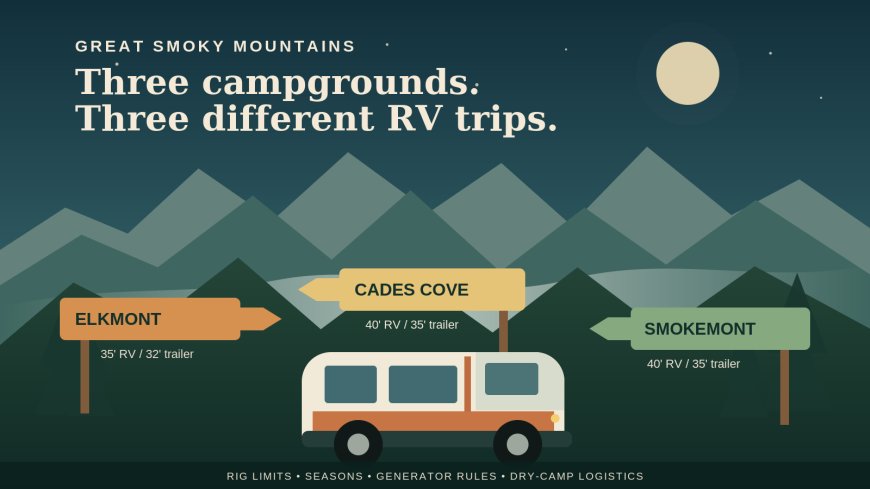
There is no single best RV campground in Great Smoky Mountains National Park. Cades Cove is the destination-first choice, Smokemont has the cleanest setup for a longer rig arriving from North Carolina, and Elkmont puts a smaller RV close to Sugarlands, Gatlinburg, and trails that leave from camp.
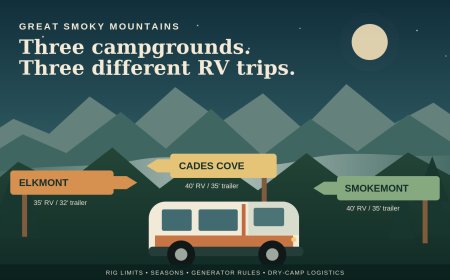
The hard filters come first. Elkmont has the lowest published limits and no dump station at the campground. Cades Cove and Smokemont accept longer RVs and trailers at the campground level, have year-round dump stations, and stay open through winter. None of the three has ordinary electric, water, or sewer hookups.[1][2][3]
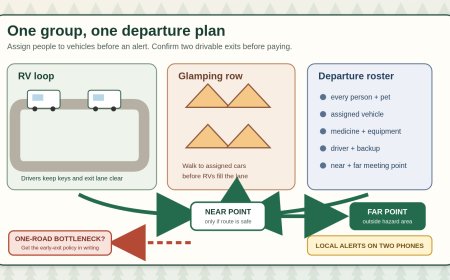
Status snapshot, September 17, 2026: Elkmont, Cades Cove, and Smokemont are open and reservation-only. Recreation.gov also carries a same-day notice: crews are working on Little River Road between Metcalf Bottoms and Elkmont Junction, with a 7 a.m.-noon closure. Elkmont remains accessible, but large RVs and all vehicles towing trailers must not use the restricted Wear Cove Gap Road/Metcalf Bottoms bridge detour.[5][6]
The RV comparison at a glance
| Campground | Published NPS maximum | 2026 season | RV services | Generator catch | Best fit |
|---|---|---|---|---|---|
| Elkmont | RV 35 ft; trailer 32 ft | Open now; NPS lists a seasonal closure Nov. 29, 2026-Apr. 3, 2027 | No hookups; no campground dump; dump/fill about 6 miles away at Sugarlands | 8 a.m.-8 p.m. where allowed; no generators May 15-Oct. 31 in A, B, L, M, or N | Smaller rigs; Gatlinburg/Sugarlands side; trail access |
| Cades Cove | 40-foot RV; 35-foot trailer | Open year-round; reduced winter inventory | No hookups; potable water and dump station year-round | 8 a.m.-8 p.m.; C is generator-free while B is open, then permits generators after B closes | Cove loop, wildlife, west-side trips, winter camping |
| Smokemont | 40-foot RV; 35-foot trailer | Open year-round; A and B all year, other loops seasonal | No hookups; potable water and dump station year-round | 8 a.m.-8 p.m.; A/B/C rules switch with D/F status; 60 dB ceiling | Cherokee/Oconaluftee side; longer rigs; winter camping |
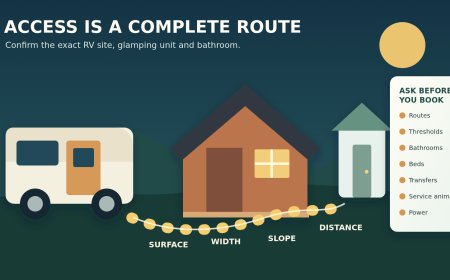
The length entries above are two separate NPS fields: maximum RV length and maximum trailer length. They are campground ceilings, not a promise that every driveway fits that length. Recreation.gov tells Elkmont campers to read each site's measurements because slope or driveway length makes some sites better for tents.[1][5] Use the exact campsite record for the parked RV, trailer, tow vehicle, and any second vehicle.
The shared reality: all three are dry camping
These are national park campgrounds, not RV resorts. Ordinary sites do not provide 30- or 50-amp electricity, a water connection, sewer, showers, laundry, campground Wi-Fi, or reliable cell reception.[1][2][3]
Some accessible sites have 5-amp outlets reserved for medical equipment. Recreation.gov is explicit that those outlets are for medical use; they are not a substitute for a normal RV pedestal.[5][6][7] If a refrigerator, furnace blower, CPAP machine, or mobility equipment changes the power calculation, confirm the exact accessible site and its rules before paying.
Potable water is available, but campground spigots do not turn a site into a water hookup. Elkmont says hoses cannot be attached to its restroom-area spigots. The nearest RV dump/fill facility sits roughly six miles from camp, opposite Sugarlands Visitor Center.[5] Cades Cove and Smokemont each list potable water and a dump station as year-round amenities.[2][3]
That difference matters after the second or third night. A small gray tank can force an Elkmont camper to break camp for a utility run. At Cades Cove or Smokemont, the same rig can dump without leaving the campground.
Elkmont: best for the Sugarlands side, with the tightest limits
Of these three campgrounds, Elkmont has the shortest trip to Sugarlands Visitor Center. It sits about eight miles from Gatlinburg. NPS lists 211 sites, an RV maximum of 35 feet, and a trailer maximum of 32 feet.[1] It is the first campground to remove from the list if either piece of equipment exceeds those published numbers.
Its 2026 calendar is also different. The NPS page lists a closed exception from November 29, 2026 through April 3, 2027, while Cades Cove and Smokemont operate all year.[1][2][3] For a late-fall reservation, read the exact arrival-night availability rather than assuming "November" means every night in the month.
Elkmont works well when the trip centers on Little River Road, Sugarlands, Gatlinburg, or the Little River and Jakes Creek trailheads. An independent comparison by Knoxville-area campers favors Elkmont for its more wooded feel, greater privacy in many sites, and more central access to other park destinations, while warning that popular river sites go quickly.[8] That is useful context, not a fit guarantee; the official site record still decides whether an RV belongs in a particular driveway.
The utility plan needs more thought here. There is no dump station at Elkmont, and there are no regular hookups. Arrive with the fresh-water tank set for the stay and the waste tanks empty, or budget a trip to the Sugarlands dump/fill facility.[1][5]
The generator map is not obvious from the word "nonelectric." Generators can run only from 8 a.m. to 8 p.m. and cannot be left unattended. Loops A, B, L, M, and N prohibit them for the period beginning May 15 and ending October 31.[5] Recreation.gov labels sites by generator-use or generator-free loop. If daily charging is necessary, filter on that designation before comparing scenery.
One approach warning is easy to miss. Recreation.gov says RVs and towed trailers may not cross the Metcalf Bottoms bridge when GPS routes them through Line Springs Road because of weight and length restrictions. It directs RV traffic to approach from the Gatlinburg or Townsend entrances.[5] The September 17 maintenance detour makes that warning especially important today.
Choose Elkmont when:
- the RV is 35 feet or shorter, or the trailer is 32 feet or shorter, and the selected site fits;
- Sugarlands, Gatlinburg, and nearby trailheads matter more than Cades Cove or Cherokee;
- the tanks can handle the stay without an onsite dump; and
- the booked loop's generator rule matches the electrical plan.
Skip it for a 36-foot motorhome, a 33-foot trailer, or a trip that depends on winter availability after the seasonal closing date.[1]
Cades Cove: best when the cove is the trip
Cades Cove Campground sits at the entrance to the 11-mile loop road. This is the practical reason to stay here: a camper can start a wildlife, history, photography, or bicycle outing without first crossing the park. Recreation.gov notes that Townsend, with groceries and fuel, is about nine miles away.[6]
NPS publishes a 40-foot maximum for RVs and 35 feet for trailers. The campground has 161 sites and stays open year-round.[2] Loop B and portions of Loop C operate from mid-spring through November 30; winter inventory narrows to sites C1-12 and C26-61, all by reservation.[2][6]
Cades Cove has no ordinary hookups or showers, but its year-round potable water and dump station make it easier to manage than Elkmont for a longer dry-camping stay.[2] The two 5-amp medical sites in the NPS inventory should not be counted as general electric sites.
The generator rule follows the seasonal loop pattern. The park-wide clock permits use from 8 a.m. to 8 p.m.[4] In Cades Cove, generator use and engine idling for battery charging are prohibited in Loop C whenever Loop B is open. After B closes for the season, C permits generator use during the restricted hours until B reopens.[6] In plain terms, a summer C-loop reservation is a quiet-loop reservation even if the batteries run low.
The same independent comparison that preferred Elkmont overall describes Cades Cove sites as more open and closer together, but gives Cades Cove the edge for immediate access to the loop road, wildlife viewing, bike rentals, and cove activities.[8] That trade is sensible for travelers who plan to spend several mornings and evenings in the cove. It is less convincing if every day requires a drive back toward Sugarlands or over Newfound Gap.
Choose Cades Cove when:
- the campground's 40-foot RV or 35-foot trailer ceiling is needed;
- an onsite, year-round dump station reduces tank anxiety;
- the cove loop is the main attraction; or
- the stay falls after Elkmont's seasonal closure.
Its downside is location. A campsite at Cades Cove is excellent for Cades Cove and merely workable for destinations on the other side of the park.
Smokemont: the strongest North Carolina base
Smokemont is six miles north of Cherokee on US 441 and near Oconaluftee Visitor Center. NPS lists 142 sites, including 44 RV-only sites. The published limits match Cades Cove: 40 feet for an RV and 35 feet for a trailer.[3]
Loops A and B remain open year-round. Loop C generally runs from March until October ends, while D and F open around the middle of May and also finish at October's end. The dump station, potable water, and flush toilets remain available all year.[3] Loop F is RV-only; tents are not allowed there.[7]
This is the cleanest option for an RV arriving through Cherokee. It avoids hauling the rig across Newfound Gap merely to camp, gives longer equipment the same campground-level limits as Cades Cove, and keeps dumping and water in the campground. It also makes more sense for days around Oconaluftee, Cherokee, Deep Creek, and the North Carolina side.
Generator permission changes as the seasonal loops open and close. Recreation.gov permits operation between 8 a.m. and 8 p.m. and sets a 60-decibel maximum. When D and F are open, generators are prohibited in A, B, and C. When D and F close, generator use shifts to A, B, and C.[7] Do not carry a summer loop assumption into a winter booking.
US 441 is the other caveat. Recreation.gov says severe weather, including wind or snow, can shut the park section.[7] A winter reservation does not guarantee that crossing from Gatlinburg will be available. Arriving from Cherokee keeps that mountain crossing out of the towing plan, though current road status still needs a check.
Choose Smokemont when:
- the trip enters from North Carolina or centers on Oconaluftee and Cherokee;
- a motorhome between 36 and 40 feet or trailer between 33 and 35 feet eliminates Elkmont;
- year-round camping and an onsite dump station matter; or
- an RV-only loop is preferable to a mixed tent/RV area.
A rig-first booking rule
- Identify the equipment type the NPS field describes. The published ceilings are RV 35 feet/trailer 32 feet at Elkmont, and RV 40 feet/trailer 35 feet at Cades Cove and Smokemont.[1][2][3]
- Open the individual Recreation.gov site record. Confirm driveway length, back-in or pull-through layout, slope notes, obstruction warnings, and where the tow or towed vehicle must park.
- Eliminate generator-free sites if the stay requires generator charging. Check both the clock and the loop-season rule.[5][6][7]
- Build the tank plan. Elkmont uses the Sugarlands dump/fill station; Cades Cove and Smokemont have onsite stations.[1][2][3]
- Match the campground to the side of the park. Elkmont serves Sugarlands and Gatlinburg, Cades Cove serves the cove, and Smokemont serves Cherokee and Oconaluftee.
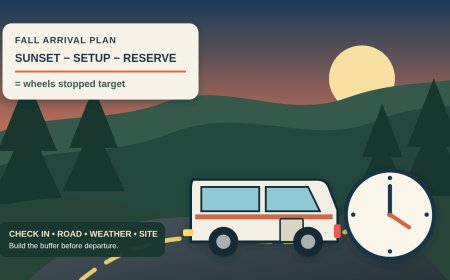
- Recheck alerts and the reservation on departure day. Weather, roads, loop inventory, and maintenance notices can change after this September 17 snapshot.
All Great Smoky Mountains frontcountry campsites require advance reservations. The park has ended walk-up, first-come camping.[4] Reservations can be made through Recreation.gov or by phone. The three campground pages state that inventory may be booked up to six months ahead.[1][2][3]
Bottom line
Cades Cove is the best choice when the cove itself is the reason for the trip. Smokemont is the better operational choice for a longer RV arriving from North Carolina, particularly when year-round water and dumping matter. Elkmont wins for a smaller rig that values the Sugarlands side, wooded sites, and trail access more than an onsite dump station.
The published maximum is only the first gate. A successful reservation matches the exact campsite, generator zone, season, tank plan, and approach road to the equipment actually being driven.Sources
What's Your Reaction?