














How to read an RV tire DOT date code without guessing its replacement date
Decode the DOT date on RV and trailer tires, then use exact manufacturer age guidance, actual load, cold pressure and tire condition to discuss replacement.


How to read an RV tire DOT date code without guessing its replacement date
By Romana
Category: Tips and Trends
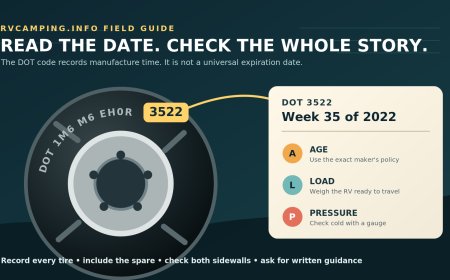
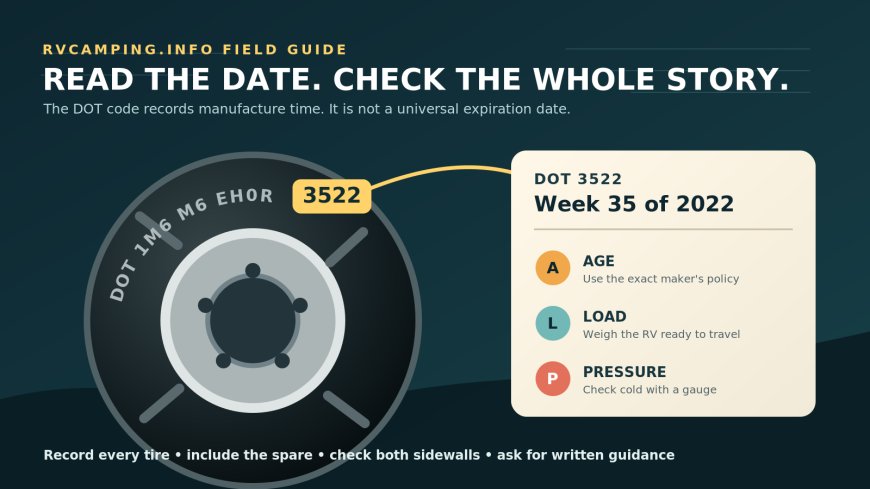
The four numbers at the end of a tire's full DOT identification number tell you when the tire was made. They do not tell you when it expires. On a modern tire, 3522 means week 35 of 2022: the first pair is the week and the second pair is the year.[1]
That date belongs in an RV tire decision, but it cannot make the decision alone. Condition, service history, actual load, cold inflation pressure, wheel limits, the RV maker's instructions and the tire maker's policy all matter. NHTSA says some vehicle and tire manufacturers call for replacement at six to 10 years regardless of tread, but it does not turn that range into one federal replacement interval.[1]
The short answer
Find the complete string that starts with DOT, then read its final four numerals. Check both sidewalls because the complete Tire Identification Number (TIN), including the date, may appear on only one side.[1] Record the code for every road tire and full-size spare rather than assuming the whole set is the same age.
Then separate three questions:
- Age: What is each tire's manufacture week and year, when was it put into service, and what age policy applies to this exact tire and RV?
- Load: What does the RV weigh when packed for travel, and is any axle end, tire or dual assembly carrying too much?
- Pressure and condition: Is each tire at the specified cold pressure, holding that pressure and free of damage or abnormal wear?
A tire can fail the conversation on any one of those tracks. Fresh tread does not cancel an age limit from the applicable manufacturer. A young date code does not excuse a bulge, deep cut, run-flat history, chronic pressure loss or overload damage.[2][4]
Find the real date code
A tire sidewall has many numbers. The date is not necessarily the four digits closest to the word DOT; it is the last four digits of the complete TIN. A sample such as DOT 1M6 M6 EH0R 0921 was made in week 09 of 2021.[2]
Use a flashlight and clean only enough dirt to read the molded characters. Do not crawl under an RV that is supported only by a jack. If the visible DOT marking ends before a four-digit date, inspect the opposite sidewall from a safe position or ask a tire shop to locate and record the full TIN. NHTSA specifically tells consumers to look on both sides.[1]
Read common examples this way:
0124: first week of 20242720: 27th week of 20205223: 52nd week of 2023
The code gives a production week, not a purchase date and not an installation date. Save invoices if a tire maker's policy runs from time in service. If the service date is unknown, ask how that manufacturer uses the DOT date as a fallback.
A three-digit date ending belongs to the pre-2000 coding system and does not identify the decade unambiguously. On an RV in current road service, that is not a puzzle to solve at the campsite. Have a qualified tire dealer identify the casing and address replacement before travel.
What the DOT mark does, and does not, establish
The letters DOT and the TIN are federal identification and compliance markings. The number supports tire identification and recalls; its ending encodes manufacture time.[1][4] It is not a federal sell-by date stamped into the rubber.
That distinction prevents two bad shortcuts. The first is, "Every RV tire expires at year X." The second is, "It has tread, so age does not matter." NHTSA warns that aging deserves attention on recreational and other low-mileage vehicles, and notes that older tires are more prone to failure. It points owners to vehicle and tire manufacturer recommendations.[1]
The U.S. Tire Manufacturers Association says calendar age alone cannot predict the service life of a specific passenger or light-truck tire. Its guide says to follow specific vehicle and tire maker recommendations where they exist and warns that such a recommendation is not a guaranteed minimum life.[4]
Tire makers can set different product policies. Goodyear's November 2022 bulletin applies to RV tires sold under its Goodyear and Cooper family brands. It recommends replacement at six years in service, using manufacture date when the in-service date is unknown.[2] Michelin's RV guide says calendar age alone cannot predict replacement, calls for yearly specialist inspections after five years in service, and recommends replacing its RV tires at 10 years from manufacture as a precaution, including spares.[3]
Those are brand-specific recommendations, not competing universal laws. The useful question for a dealer is: "Which written vehicle and tire manufacturer instructions apply to this exact tire, and what date starts each clock?"
Put age beside actual load
An RV tire's workload is not the brochure's unloaded weight. Water, fuel, batteries, aftermarket equipment, food, tools, passengers, tongue or pin load, and uneven storage can change what each tire carries.
Start with the RV's certification label, tire placard and owner manual. Record GVWR and each GAWR, the specified tire size, load range or service description, and the listed cold inflation pressures. The maximum load and pressure molded on a tire sidewall describe limits for that tire in a stated configuration; they are not a substitute for the RV's specified pressure.[4]
Weigh the RV in travel trim: people and usual cargo aboard or represented, tanks at the levels you travel with, and the tow vehicle or towed vehicle configured normally. At minimum, obtain individual axle weights. Individual wheel-position or axle-end weights are better when a suitable scale and safe procedure are available because side-to-side loading can differ.
Michelin recommends individual wheel-position weighing for motorhomes using its RV tires. It says to use the heavier end of an axle to select one cold pressure for every tire on that axle from the current Michelin load-and-inflation table.[3] That is Michelin motorhome guidance, not a blanket instruction for every trailer tire. Trailer owners should use the trailer maker's instructions and the current load table for the exact tire brand, size, load range and single/dual application.
If an axle total is all you have, dividing by the number of tires can hide an overloaded wheel position. Treat the result as incomplete, not proof that every tire is within capacity. USTMA says loading must stay within the capacity of each axle, individual tire and dual assembly; GVWR and GAWR are limits too.[4]
Pressure is part of carrying capacity
Check pressure cold with an accurate gauge. NHTSA defines its recommended cold reading as a tire that has not been driven for at least three hours and directs drivers to the vehicle placard or owner manual, not the pressure molded on the tire, for the vehicle setting.[1]
Motorhomes with commercial-size tires may have a manufacturer-approved process that combines actual wheel-position weights with the exact tire maker's load table. Do not improvise that process from a table for another brand, size or application. Never exceed the pressure limit of the tire or wheel, and do not lower pressure below the RV maker's requirement without written guidance that applies to the vehicle and tire combination.[3][4]
Pressure also tells a story. A tire that repeatedly needs air may have a puncture, valve leak, wheel problem or other damage. USTMA says continuous underinflated use can build heat and cause internal injury, and that adding air later does not repair damage already done.[4]
Include the spare and inside duals in the gauge check. A TPMS is useful for warnings on the road, but it does not replace a cold manual check or an inspection. NHTSA notes that a TPMS alert may not appear until a tire is already significantly underinflated.[1]
Conditions that outrank the calendar
Do not keep a tire in service until an age milestone if it already has a removal condition. Arrange a professional inspection for:
- a bulge, blister, deep cut, exposed cord or severe cracking;
- irregular wear, a flat spot, tread separation signs or tread at the wear bars;
- a puncture or repair whose location and method are uncertain;
- repeated air loss, vibration, new noise or a change in handling;
- evidence that the tire ran flat, substantially underinflated or overloaded;
- impact damage, wheel damage, valve damage or contact between duals;
- an open recall that includes the full TIN.
Goodyear's RV bulletin says wear, cuts, cracks, bulges, underinflation damage and overload damage can require removal regardless of age.[2] USTMA likewise lists service conditions that can end a tire's useful life before tread is worn out.[4]
Do not judge internal condition from a sidewall photograph. A tire professional may need to demount the tire. When one tire in a dual pair has been flat or badly underinflated, the companion can have carried the pair's load; USTMA says both should be inspected.[4]
A replacement conversation that produces an answer
Bring a one-page record to an RV-capable tire dealer. For every tire, list:
- position on the RV, including spare;
- brand, product line, size, load range and service description;
- full TIN and four-digit manufacture code;
- purchase and installation dates, if known;
- cold pressure specification and current cold reading;
- travel-ready axle or wheel-position weights;
- repairs, pressure-loss events, impacts, long storage and known run-low episodes;
- visible wear or damage and any TPMS alerts.
Then ask the dealer to answer these questions in writing:
- Is this the complete TIN, and is the tire covered by a recall?
- Which RV-maker and tire-maker service-life documents apply?
- Does the recommendation run from manufacture, purchase or installation?
- Does condition require removal now, regardless of age?
- Do the measured loads fit the tire capacity at the specified cold pressure?
- Are the tire, wheel, valve and dual-spacing limits compatible?
- If one tire is replaced, what matching rules apply on this axle or dual pair?
A vague answer such as "trailers get five years" is not enough. Ask for the product bulletin, RV manual section or current data table behind the recommendation. Likewise, a date code by itself cannot clear a tire for continued service.
Keep a tire record before the next trip
Photograph each full TIN and sidewall marking while access is easy. Store the images with the invoice, weight tickets and pressure notes. Register new tires with the manufacturer and check NHTSA's tire recall search using the identifying information.[1]
Repeat the quick work before travel: inspect tread and sidewalls, check cold pressure with a gauge, and investigate unexplained pressure loss. Reweigh after a meaningful change such as adding batteries, solar equipment, a generator, a motorcycle carrier or a different towing setup.
The DOT date is valuable because it turns "these tires seem old" into a fact. It still leaves the real job intact: match the exact tire to its written age guidance, prove that the load and pressure work together, and let damage or poor service history end the conversation early.
Sources
What's Your Reaction?